
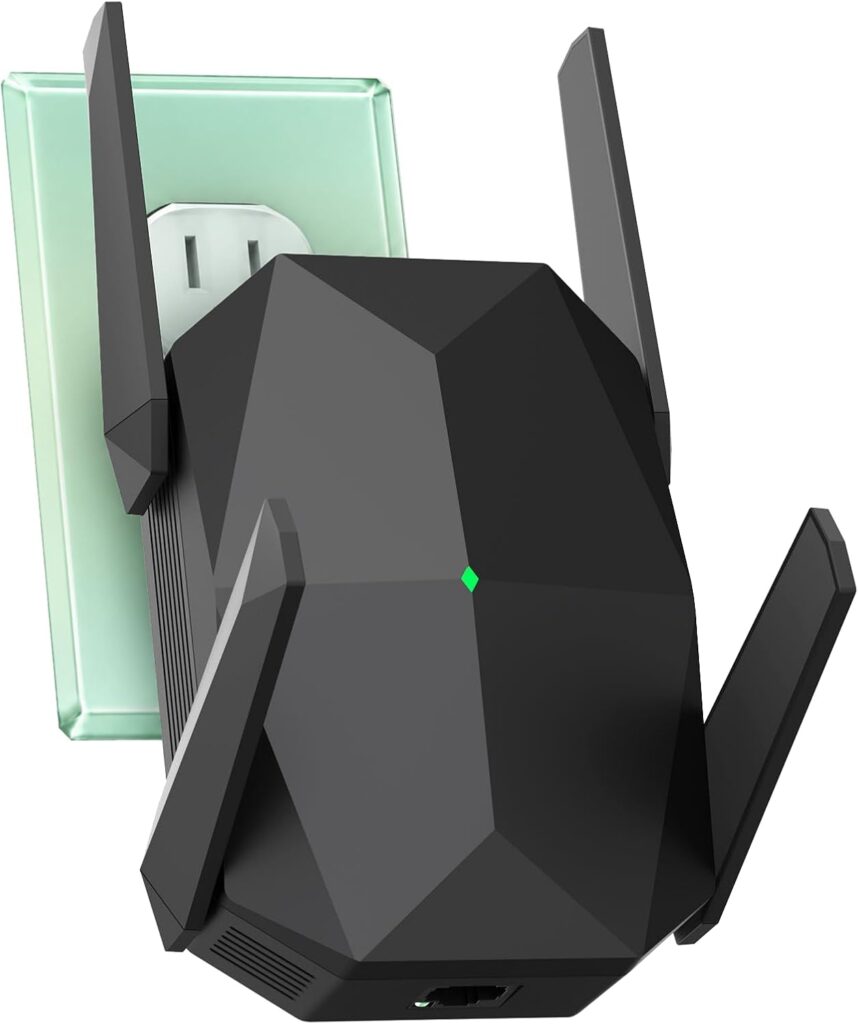
JoyLantern AX3000 WiFi 6 Extender: Specs, Price, Pros & Cons
This review measures the JoyLantern AX3000 WiFi 6 Extender against the full 14-spec sheet we track for Range Extenders, comparing it like for like with the 2 other models in our database. It earns a VS Score of 75 out of 100 — the weighted result of every verified specification measured against the class average.
On the spec sheet it is strongest in wireless and weakest in connectivity. Its clearest single advantage over the class average: a much higher max wireless speed — 3,000 Mbps vs 1,200 Mbps (avg). Street prices currently start at $ 59.97 for the JoyLantern AX3000 WiFi 6 Extender. A transparency note: this spec sheet is 79% complete. Anything unverified shows as Unknown and is left out of the score — we never estimate a missing value.
Category strengths
Where the JoyLantern AX3000 WiFi 6 Extender beats the average
- A much higher max wireless speed ?3,000 Mbps vs 1,200 Mbps (avg)
- More frequency bands ?2 vs 1.33 (avg)
- More max connected devices ?155 vs 79 (avg)
Editor’s note
The JoyLantern AX3000 is the most interesting of the no-name extenders we track, because underneath the marketing it describes genuinely modern hardware: dual-band Wi-Fi 6 rated at 3,000 Mbps (600 on 2.4 GHz, 2,400 on 5.8 GHz), four antennas, a gigabit Ethernet port and claimed capacity for over 150 devices. That's the same headline class as brand-name AX3000 extenders costing two or three times more.
Now the honesty section, which with listing-brand products is most of the job. JoyLantern has no manufacturer website, so the Amazon listing is the only source for everything here — there's no spec sheet to verify against, no firmware download page, and no way to know what support looks like in a year. The coverage claim of 25,999 sq ft is fiction (a $1,700 Orbi three-pack is rated for 10,000), so we haven't stored it. The listing even disagrees with itself about the 2.4 GHz speed in different images. Security tops out at WPA2 — no WPA3 — and setup is browser-based with no app.
If the hardware delivers what the listing describes, it's a lot of extender for the money: Wi-Fi 6 efficiency, a proper gigabit port for a TV or console, and enough radio to be a genuine 5 GHz repeater rather than a 2.4 GHz trickle. That "if" is the entire purchase decision. There are no independent measurements, and no brand reputation to lean on.
I'd consider it for a secondary space — a garage office, a rental, a workshop — where the downside of it disappointing is a cheap lesson. For the main house, where the extender is load-bearing infrastructure, the brand-name equivalent (TP-Link's RE705X class) buys accountability that a mystery brand structurally cannot offer.
Specifications
Quality bars are generated automatically against 2 other range extenders.
Wireless
The Wi-Fi generation supported; later is faster and handles more devices.
The combined theoretical throughput across all bands.
How many radio bands the extender uses (dual-band = 2, tri-band = 3).
The extra area the extender is rated to cover.
How many devices the extender is rated to handle at once.
Connectivity
A wired port to connect a nearby TV or console.
The speed of the wired port.
Features
Joins the router's mesh for one network name and seamless roaming (e.g. EasyMesh, OneMesh, AiMesh).
The latest Wi-Fi security standard.
Set up and manage the extender from a phone app.
Can also serve as a wired access point.
An LED that helps you find the best plug location.
Design
Plugs directly into an outlet with no shelf space or cables needed.
Keeps the power outlet usable while plugged in.
How the VS Score works — and what it can’t tell you
Every measurable spec is scored against the average of all the Range Extenders we track: matching the class average scores 50, clearly beating it climbs towards 100, and each spec counts according to an editorial weight that reflects real-world impact — a battery-capacity gap moves the score far more than a colour-options list. The quality bars on the spec cards above show where this model sits inside the full range for its class, and the overall VS Score rolls every weighted result into one number.
Unknown values are never estimated. A spec this product doesn’t report simply drops out of its scoring — it isn’t penalised with a guess — but a thinner spec sheet does mean a score built on fewer data points, which is why completeness is disclosed under About this data.
Most importantly: a spec-sheet lead is not the same as a better product. Megapixels, gigahertz and benchmark points describe capacity, not experience — image processing, software optimisation, thermals, haptics and ergonomics decide how a device actually feels, and no table captures reliability or long-term support quality. Treat the VS Score as a structured summary of what can be measured, not a substitute for your own priorities.
About this data
- Specifications are compiled from each manufacturer’s official spec sheet, cross-checked against trusted specification databases, and normalised into one schema so identical things are compared identically.
- Specifications last verified August 20, 2026.
- Data completeness: 11 of the 14 specs in this category are verified (79%). Anything we could not verify is shown as Unknown — never estimated — and is excluded from the score.
- Prices and availability come from live retailer feeds via our shopping partners and refresh throughout the day; a missing price means no partner currently lists the product, not that it is discontinued.
- Want the full picture? Our editorial guidelines explain how we research products, weight the scores and stay independent.
- Spotted an error in a spec? Tell us and we will correct the sheet.
Where to buy
Prices and availability may change. Check the retailer before buying. We may earn a commission on purchases.
Price history
Range Extenders with similar specs to the JoyLantern AX3000 WiFi 6 Extender
Ratings & reviews
No reviews yet. Be the first to share your experience.
The bottom line
The JoyLantern AX3000 WiFi 6 Extender earns a VS Score of 75, putting it among the very best of the 3 range extenders we compare here.
- Who it’s for
- A secondary space — rental, garage office, workshop — where you want modern dual-band Wi-Fi 6 speeds and a gigabit wired port at a mystery-brand price, and can shrug it off if it disappoints.
- Who should look elsewhere
- The main house, where an extender is load-bearing infrastructure: there's no manufacturer website, no firmware page, no WPA3, and no way to know what support looks like next year.
- The trade-off that matters
- Brand-name AX3000 hardware claims at half the money, paid for entirely in accountability — if the listing's numbers are honest it's a bargain, and there is no independent way to know.
- The main alternative
- TP-Link's RE705X delivers the same AX3000 class with a real spec sheet, app support and updates — worth the premium wherever reliability matters.
The VS Score is generated automatically from the weighted specifications above, measured against all other range extenders in our database. Treat it as a shortlisting guide — not a substitute for your own priorities.