Ubiquiti UniFi Dream Machine SE: Specs, Pros & Cons
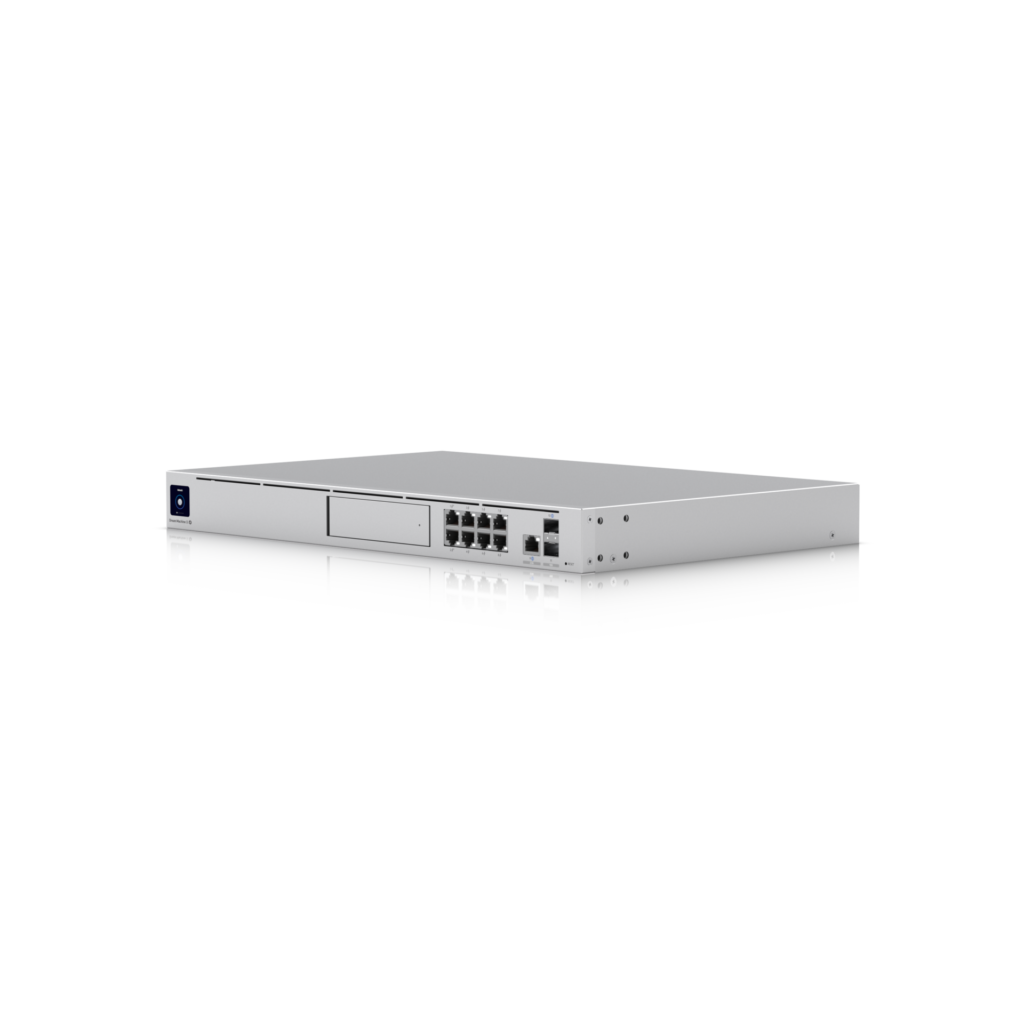
This exists to reduce the number of boxes in a rack. One chassis holds the router and firewall, an eight-port powered switch, the controller that manages the rest of the ecosystem, and a bay for a hard drive so it can record from cameras as well.
Throughput with intrusion detection running is the number to read, and Ubiquiti quotes it at a level that comfortably covers a multi-gig connection. Two 10G SFP+ fiber cages and a 2.5 GbE port (Ubiquiti's default WAN pair is one cage plus that port) mean the incoming side is not the constraint, and eight LAN ports with power available cover a reasonable installation directly.
There is a great deal of memory behind it, VLAN support, site-to-site VPN and dual-WAN failover, and the built-in security features carry no subscription, though Ubiquiti sells its expanded threat signatures separately as CyberSecure.
The practical considerations are physical. It is a rack-mounted unit weighing several kilograms, it is not designed to sit on a shelf or hang on a wall, and it is not silent. Its power budget for connected devices is real but finite, so a large camera deployment will still want a separate switch.
It suits someone building a serious managed network in a house or small business (cameras, several access points, segmented networks) who wants one appliance doing the work of four. For a household that needs a router and nothing more, it is a great deal of equipment to buy, house and power for no practical benefit.
How this VS Score was computed
Score 0: each known spec is measured against the median of all wired gateways (2 products), then weighted; 50 means level with that median. In classes of six or more, a value beyond the class’s 10th–90th percentile range counts as that limit, so one extreme product cannot set the scale. 0% of the scoreable weight could be used; unknown values, features not applicable to this class and proxies (battery capacity where a rated life exists) add or remove nothing.
Not scored: WAN port speed (too few comparable peers (2, need 3)); WAN ports (too few comparable peers (2, need 3)); LAN ports (too few comparable peers (2, need 3)); Multi-gig LAN (too few comparable peers (2, need 3)); SFP/SFP+ ports (too few comparable peers (2, need 3)); PoE ports (unknown: not scored); Link aggregation (too few comparable peers (2, need 3)); USB ports (unknown: not scored); Routing throughput (unknown: not scored); Threat-protection throughput (too few comparable peers (2, need 3)); VPN throughput (unknown: not scored); Concurrent sessions (unknown: not scored); Processor cores (too few comparable peers (2, need 3)); RAM (too few comparable peers (2, need 3)); Intrusion prevention (too few comparable peers (2, need 3)); Built-in security suite (too few comparable peers (2, need 3)); VPN server (too few comparable peers (2, need 3)); Site-to-site VPN (too few comparable peers (2, need 3)); Dual-WAN failover (too few comparable peers (2, need 3)); VLAN support (too few comparable peers (2, need 3)); Quality of Service (QoS) (too few comparable peers (2, need 3)); Cloud management (too few comparable peers (2, need 3)); App control (too few comparable peers (2, need 3)); Subscription required (too few comparable peers (2, need 3)); Fanless (unknown: not scored).
Editor’s note
The Dream Machine SE is Ubiquiti's answer to a rack that already has too many boxes in it. One 1U chassis gives you the router and firewall, an eight-port PoE switch with a 180 W budget, the UniFi Network controller, and a bay for a 3.5-inch drive so it can act as the recorder for UniFi Protect cameras as well.
The performance figure that matters is 3.5 Gbps of routing with IPS/IDS switched on. That is enough headroom to leave threat detection enabled on a gigabit or two-gigabit line without watching your speed tests collapse. Stateful and application-aware Layer 7 firewalling, DPI, content filtering, ad blocking, site-to-site VPN and a WireGuard server all run on the console itself.
All eight PoE ports are gigabit, so a multi-gig access point or a NAS has to take the spare SFP+ cage or sit behind a separate switch. Redundancy gets more thought than port speed, with Shadow Mode pairing two consoles for gateway failover and a DC input for Ubiquiti's USP-RPS backup supply, which lets an office plan around one failed box instead of waiting out an RMA.
Specifications
Quality bars show where each figure sits between the lowest and highest of the 2 wired gateways this VS Score is measured against.
Ports & wired
Performance
Security & management
Design
Networking assessment
What the specification table does not say on its own: what this device needs to connect, what speeds are realistic, what costs extra, and where it falls short. Every statement below is read from the verified sheet or written by an editor — nothing is estimated.
Test environment
Research-based assessment: this brief is derived from the manufacturer’s published specifications for the Ubiquiti UniFi Dream Machine SE and the documents listed under Sources and verification. We have not run this unit on our own network, so nothing here is a measurement of ours.
Connection requirements
The WAN (internet) port is rated at 10 Gbps. An internet plan faster than that is capped at the router, and nothing on the network can download faster than this port regardless of the wireless figures.
There are 8 LAN ports, at least one of them multi-gig, so one wired device can run above Gigabit speed.
Throughput expectations
With threat protection (deep packet inspection) switched on, throughput drops to 3,500 Mbps — the figure to plan around if you intend to use it.
Firmware and subscriptions
The Dream Machine SE takes its updates through UniFi OS. Ubiquiti's Update Manager in Site Manager (unifi.ui.com or the mobile app) shows pending updates for the console, its applications and every adopted device, and each console can be set to an Official or Early Access release channel with automatic updates under Settings > Control Plane > Updates. Release notes for every version are posted on community.ui.com/releases. The console needs internet access to update, and an offline Update Cache method exists for closed sites. CyberSecure, Ubiquiti's expanded threat-signature service, is a separate add-on billed annually.
A built-in security suite is on the spec sheet. On most brands the full version is a paid subscription after a trial; check the manufacturer’s page linked under Sources for the current terms.
Set-up and day-to-day management run through the manufacturer’s cloud service, so that account’s availability and privacy terms are part of the product.
VPN support is built in, which avoids a subscription to a third-party VPN router service for remote access.
Security support
Intrusion prevention is built in; on gateways this is the function most affected by the threat-protection throughput figure above.
VLAN support allows work, IoT and guest traffic to be separated on the wired side.
Security-update cadence is not something manufacturers publish as a specification; see Support and updates below.
Known limitations
Not offered, according to the spec sheet: wall-mountable.
6 specifications are not published by the manufacturer and are shown as Unknown rather than guessed.
Support and updates
Ubiquiti's support is built around its help center (help.ui.com), the community forum and online RMA and warranty requests, with release notes and tech specs published per model. UI Care, sold per device, extends replacement protection to five years and ships the replacement before the failed unit is inspected, which is worth pricing in if the gateway runs a business that cannot wait out a standard RMA.
Sources and verification
Where the specifications come from
- Official product pagetechspecs.ui.com
- Support and firmware documentationhelp.ui.com
- Retailer listing (cross-check)amazon.com
Verification
- First published
- Specifications last checked
- Sheet completeness
- 23 of 29 specifications verified; the rest show as Unknown and are never estimated or scored
- Page type
- Product specification page — Compiled from the manufacturer’s published specifications and the cited sources; this is not a hands-on test.
- Basis
- Research-based: specifications and editorial text were compiled from the documents listed here and the manufacturer’s published data. We have not tested this unit ourselves; where independent measurements are mentioned they belong to the linked publication.
Ratings & reviews
No reviews yet. Be the first to share your experience.
The bottom line
- Who it’s for
- Homes and small offices that already have a rack, PoE access points and UniFi cameras. It replaces four separate boxes and the controller you were otherwise going to run on a spare PC.
- Who should look elsewhere
- Anyone who wants a router to set up once and forget, and anyone with no rack, no PoE devices and no cameras to feed.
- The trade-off that matters
- An enormous amount of function in one chassis, paid for with eight gigabit-only LAN ports and a platform that expects you to learn it rather than ignore it.
- The main alternative
- Ubiquiti UniFi Cloud Gateway Fiber: routes 5 Gbps with IPS enabled and adds a 10 GbE RJ45 port and four 2.5 GbE ports, the better pick if you can do without the PoE switching and the 3.5-inch drive bay.
The VS Score is calculated from the weighted specifications above, each measured against the median of comparable wired gateways — a shortlisting guide, not a substitute for your own priorities. See how we score.