
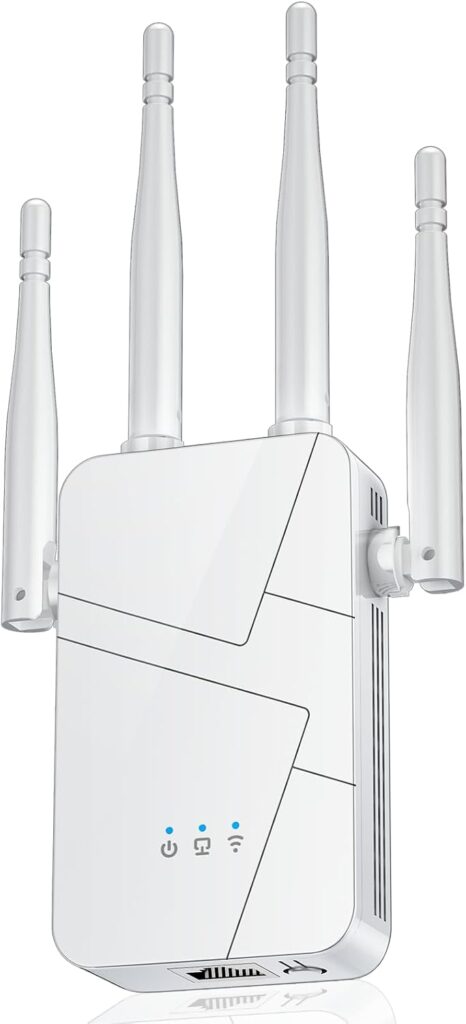
Baetaey WiFi Extender: Specs, Features, Pros & Cons
This review measures the Baetaey WiFi Extender against the full 14-spec sheet we track for Range Extenders, comparing it like for like with the 2 other models in our database. It earns a VS Score of 33 out of 100 — the weighted result of every verified specification measured against the class average.
On the spec sheet it is strongest in connectivity and weakest in wireless. Its clearest single advantage over the class average: a slightly higher coverage added — 15,000 sq ft vs 14,597 sq ft (avg). None of our retail partners currently lists the Baetaey WiFi Extender, so availability may be limited; a missing price never affects the VS Score. A transparency note: this spec sheet is 71% complete. Anything unverified shows as Unknown and is left out of the score — we never estimate a missing value.
Category strengths
Where the Baetaey WiFi Extender beats the average
- A slightly higher coverage added ?15,000 sq ft vs 14,597 sq ft (avg)
Where the Baetaey WiFi Extender trails the average
- A much lower max wireless speed ?300 Mbps vs 1,200 Mbps (avg)
- Fewer frequency bands ?1 vs 1.33 (avg)
- Fewer max connected devices ?70 vs 79 (avg)
Editor’s note
The Baetaey is the classic Amazon extender formula: four adjustable antennas, one Ethernet port, WPS pairing, and a price that undercuts brand-name gear by half or more. Its one genuine distinguishing feature in this crowd is versatility — the listing states four operating modes (repeater, bridge, access point and router), which makes it a little Swiss Army knife for odd networking jobs: turning a hotel Ethernet jack into Wi-Fi, bridging a smart TV, or serving as a bare-bones AP off a wired run.
The fundamentals are modest and it's important to be clear-eyed about them. This is a single-band 2.4 GHz device at 300 Mbps — Wi-Fi 4 — with security topping out at WPA2. The 15,000 sq ft coverage claim is the usual fiction this product class traffics in; we haven't stored it, because a single-band N300 repeater covering fifteen thousand square feet would put every mesh system on this site out of business. Realistically you're extending usable signal into one or two adjacent rooms.
As with every listing-brand product, the Amazon page is the only source of truth available — Baetaey has no website, no published manual, no firmware page. The 4.8-star rating across a few dozen reviews is encouraging but thin.
Where it makes sense: cameras, printers, smart plugs, a garage or garden office where 2.4 GHz reach matters more than speed, or as a cheap mode-flexible gadget in a drawer. Where it doesn't: any household hoping to stream or video-call through it, or anyone who expects the thing to be supported in three years. At that point the calculus is simple — a TP-Link RE315 or similar costs a coffee or two more and comes with an actual company attached.
Specifications
Quality bars are generated automatically against 2 other range extenders.
Wireless
The Wi-Fi generation supported; later is faster and handles more devices.
The combined theoretical throughput across all bands.
How many radio bands the extender uses (dual-band = 2, tri-band = 3).
The extra area the extender is rated to cover.
How many devices the extender is rated to handle at once.
Connectivity
A wired port to connect a nearby TV or console.
The speed of the wired port.
Features
Joins the router's mesh for one network name and seamless roaming (e.g. EasyMesh, OneMesh, AiMesh).
The latest Wi-Fi security standard.
Set up and manage the extender from a phone app.
Can also serve as a wired access point.
An LED that helps you find the best plug location.
Design
Plugs directly into an outlet with no shelf space or cables needed.
Keeps the power outlet usable while plugged in.
How the VS Score works — and what it can’t tell you
Every measurable spec is scored against the average of all the Range Extenders we track: matching the class average scores 50, clearly beating it climbs towards 100, and each spec counts according to an editorial weight that reflects real-world impact — a battery-capacity gap moves the score far more than a colour-options list. The quality bars on the spec cards above show where this model sits inside the full range for its class, and the overall VS Score rolls every weighted result into one number.
Unknown values are never estimated. A spec this product doesn’t report simply drops out of its scoring — it isn’t penalised with a guess — but a thinner spec sheet does mean a score built on fewer data points, which is why completeness is disclosed under About this data.
Most importantly: a spec-sheet lead is not the same as a better product. Megapixels, gigahertz and benchmark points describe capacity, not experience — image processing, software optimisation, thermals, haptics and ergonomics decide how a device actually feels, and no table captures reliability or long-term support quality. Treat the VS Score as a structured summary of what can be measured, not a substitute for your own priorities.
About this data
- Specifications are compiled from each manufacturer’s official spec sheet, cross-checked against trusted specification databases, and normalised into one schema so identical things are compared identically.
- Specifications last verified August 20, 2026.
- Data completeness: 10 of the 14 specs in this category are verified (71%). Anything we could not verify is shown as Unknown — never estimated — and is excluded from the score.
- Prices and availability come from live retailer feeds via our shopping partners and refresh throughout the day; a missing price means no partner currently lists the product, not that it is discontinued.
- Want the full picture? Our editorial guidelines explain how we research products, weight the scores and stay independent.
- Spotted an error in a spec? Tell us and we will correct the sheet.
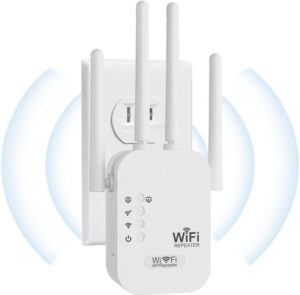
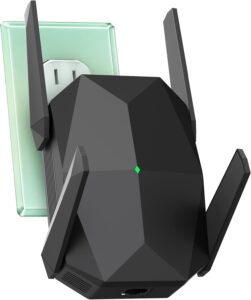
Range Extenders with similar specs to the Baetaey WiFi Extender
Ratings & reviews
No reviews yet. Be the first to share your experience.
The bottom line
The Baetaey WiFi Extender earns a VS Score of 33, trailing most of the 3 range extenders we compare here, at least on the spec sheet.
- Who it’s for
- Odd-job networking: its four stated modes (repeater, bridge, access point, router) make it a cheap Swiss Army knife for hotel jacks, smart TVs on Ethernet, or pushing 2.4 GHz reach to cameras and a garden office.
- Who should look elsewhere
- Streaming or video calls through the extension (single-band N300 shares one crowded radio), and anyone who wants a supported product — Baetaey has no website, manual or firmware page anywhere.
- The trade-off that matters
- Versatility at a throwaway price versus 2009-era wireless: the four modes are genuinely useful, the 15,000 sq ft coverage claim genuinely is not.
- The main alternative
- TP-Link RE315 — a few dollars more for a real brand with honest range numbers; choose the Baetaey only for its bridge/AP/router mode flexibility.
The VS Score is generated automatically from the weighted specifications above, measured against all other range extenders in our database. Treat it as a shortlisting guide — not a substitute for your own priorities.