
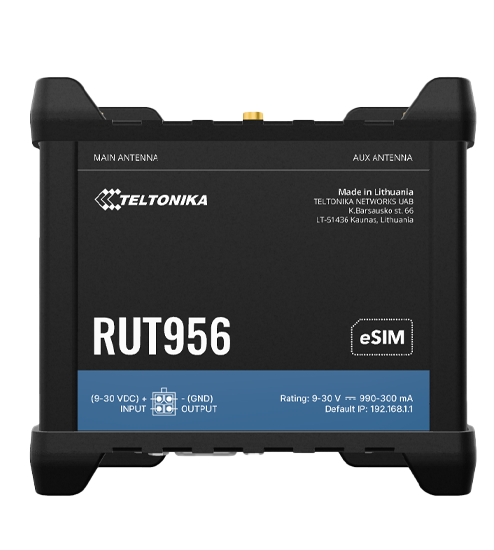
Teltonika RUT956: Specs, Price, Pros & Cons
Besides an LTE modem, the RUT956 carries an RS232 port on a DB9 connector and a six-pin RS485 socket. Two digital inputs and two outputs sit on a 10-pin socket, with one more of each on the power connector, and a GNSS receiver handles location and time. Those are the connections a router needs when it lives in a control cabinet, talking to meters, controllers and sensors.
The RUT956 is certified for hazardous (classified) locations to UL 121201 and CSA C22.2 No. 213, with testing by SGS. Teltonika also lists IEC 60068 tests for random vibration, shock, bumps and cyclic damp heat. Power comes through a four-pin socket that accepts 9 to 30 V DC, or as passive PoE through the first LAN port. That suits a vehicle, a solar box or a mast.
Its four RJ45 ports negotiate at 10 or 100 Mbps, so none of them is gigabit. The Wi-Fi is a single 2.4 GHz 802.11b/g/n radio. The modem is LTE Cat 4 with 3G fallback (and 2G outside North America), fed by two SIM slots. Some order codes add an eSIM that holds up to seven profiles, and the rest take physical SIM cards only.
RutOS, Teltonika's own firmware, carries the industrial protocols the hardware exists for: Modbus, MQTT, DNP3, OPC UA and BACnet. Data-to-server forwarding, VPN, firewall, VLAN and failover settings sit alongside them. A USB port and an internal microSD slot add storage or extra devices. The current stable firmware on Teltonika's wiki is dated November 11, 2026, and its notes list fixes for several critical CVEs.
Category strengths
Where the Teltonika RUT956 beats the median
- Has cellular modem ?
- More LAN ports ?3 vs 1 (median)
- More SIM slots ?2 vs 0 (median)
Where the Teltonika RUT956 trails the median
- A much lower WAN port speed ?0.1 Gbps vs 2.5 Gbps (median)
- Much less RAM ?128 MB vs 768 MB (median)
- Fewer frequency bands ?1 vs 2 (median)
- No USB-C charging ?
- A heavier build ?287 g vs 232 g (median)
- A much lower processor speed ?0.58 GHz vs 1.65 GHz (median)
- A much thicker body ?50 mm vs 34 mm (median)
How this VS Score was computed
Score 45: each known spec is measured against the median of all travel routers (5 products), then weighted. 44% of the scoreable weight could be used. See how we score
| Specification | This product | Cohort median | Score weight | Points moved |
|---|---|---|---|---|
| Wi-Fi standard | Wi-Fi 4 | Wi-Fi 6 | 2 | −50.0 |
| Cellular modem | Yes — held to half its range (fewer than six products in this class list it) | 40% of the class have it | 1.5 | +37.5 |
| Cellular generation | 4G LTE | None | 1.5 | +37.5 |
| Frequency bands | 1 | 2 | 1 | −25.0 |
| WAN port speed | 0.1 — held to half its range (fewer than six products in this class list it) | 2.5 | 1 | −25.0 |
| LAN ports | 3 — held to half its range (fewer than six products in this class list it) | 1 | 0.7 | +17.5 |
| RAM | 128 — held to half its range (fewer than six products in this class list it) | 768 | 0.7 | −17.5 |
| SIM slots | 2 — held to half its range (fewer than six products in this class list it) | 0 | 0.5 | +12.5 |
| USB-C charging | No — held to half its range (fewer than six products in this class list it) | 80% of the class have it | 0.5 | −12.5 |
| Display | No — held to half its range (fewer than six products in this class list it) | 40% of the class have it | 0.4 | −10.0 |
| Weight | 287 | 232 | 1 | −10.0 |
| Processor speed | 0.58 — held to half its range (fewer than six products in this class list it) | 1.65 | 0.3 | −7.5 |
| Thickness | 50 | 34 | 0.3 | −4.8 |
| USB ports | 1 | 1 | 0.3 | +0.0 |
Not scored: eSIM (unknown: not scored); Max cellular download (too few comparable peers (2, need 3)); Max wireless speed (unknown: not scored); 6 GHz band (not applicable: only 20% of this class have it); Beamforming (unknown: not scored); Max connected devices (too few comparable peers (2, need 3)); Repeater mode (unknown: not scored); Multi-gig LAN (not applicable: only 20% of this class have it); Battery capacity (unknown: not scored); Battery life (unknown: not scored); Works while charging (unknown: not scored); Processor cores (unknown: not scored); WPA3 (standard for the class (100% have it)); VPN client (standard for the class (100% have it)); VPN server (standard for the class (100% have it)); Guest network (unknown: not scored); Parental controls (unknown: not scored); Quality of Service (QoS) (standard for the class (100% have it)); App control (unknown: not scored).
Editor’s note
If all you need is internet in a place with no wired line, a consumer LTE router will serve you better than the RUT956. What this one adds is an operating range of minus 40 to 75 degrees Celsius, dual-SIM failover, and serial and I/O interfaces. None of that shows up as speed.
For a buyer who needs those things, dual SIM is the feature I would choose it for. The router switches on signal loss, a data limit or a carrier denying service. A single-SIM router in a remote installation is one carrier outage away from a site visit.
A hundred and fifty megabits down from the Cat 4 modem is fine for telemetry, card payments and remote access. It is too little for a primary office line that carries a team's video calls and cloud backups. For a cabinet that reports a few readings a minute, that ceiling will never come into view.
Specifications
Cellular
Wireless
Ports & wired
Battery
Hardware
Features & security
Design
Networking assessment
Connection requirements
The WAN (internet) port is rated at 0.1 Gbps. An internet plan faster than that is capped at the router, and nothing on the network can download faster than this port regardless of the wireless figures.
It has a built-in 4G LTE cellular modem, so it needs a SIM or eSIM data plan for use away from a wired or Wi-Fi source.
There are 3 LAN ports, all Gigabit; a switch is needed for more wired devices.
Throughput expectations
It is a Wi-Fi 4 device; real-world speeds run well below the theoretical link rate even in the same room.
There is no 6 GHz band, so the least congested spectrum available to new phones and laptops is not on offer here.
Firmware and subscriptions
VPN support is built in, which avoids a subscription to a third-party VPN router service for remote access.
Security support
WPA3 is supported, the current Wi-Fi encryption standard; devices that only speak WPA2 still connect in mixed mode.
Security-update cadence is not something manufacturers publish as a specification; see Support and updates below.
Real-world household suitability
Rated for 100 connected devices — a marketing figure, but a useful indication of whether a home full of smart plugs, cameras and phones is within its design.
Known limitations
Not offered, according to the spec sheet: 6 GHz band, multi-gig LAN, uSB-C charging, display.
11 specifications are not published by the manufacturer and are shown as Unknown rather than guessed.
Support and updates
We have not found a published firmware support-lifetime commitment for this model. Update policies differ widely between brands; check the support page linked under Sources and verification before relying on it for a long deployment, and treat a device that has stopped receiving security updates as due for replacement.
Sources and verification
Where the specifications come from
- Official product pageteltonika-networks.com
Verification
- First published
- Specifications last checked
- Sheet completeness
- 23 of 34 specifications verified; the rest show as Unknown and are never estimated or scored
- Page type
- Product specification page — Compiled from the manufacturer’s published specifications and the cited sources; this is not a hands-on test.
- Basis
- Research-based: specifications and editorial text were compiled from the documents listed here and the manufacturer’s published data. We have not tested this unit ourselves; where independent measurements are mentioned they belong to the linked publication.
Where to buy
Prices and availability may change. Check the retailer before buying. We may earn a commission on purchases.
Price history
Travel Routers with similar specs to the Teltonika RUT956
Ratings & reviews
No reviews yet. Write the first one
The bottom line
The Teltonika RUT956 earns a VS Score of 45, below the median of the 5 travel routers it is measured against (a score of 50 is level with that median).
- Who it’s for
- Someone connecting remote equipment (telemetry, payment terminals, monitoring cameras) who needs dual-SIM failover, serial interfaces and a device rated to survive an unheated cabinet.
- Who should look elsewhere
- Anyone wanting mobile internet for a home, an office or a trip. Its Wi-Fi and Ethernet ports are several generations behind a home router, and the ruggedness and serial ports would go unused.
- The trade-off that matters
- You give up modern Wi-Fi, gigabit ports and LTE speed for a router that keeps running in a hot or freezing cabinet and talks to serial equipment.
- The main alternative
- Teltonika RUT361: a Cat 6 modem with twice the download ceiling and the same temperature range, but one SIM slot and no serial ports or GNSS.
This page was created with the help of AI. How we work
Latest Travel Routers