
GL.iNet Mudi 7 (GL-E5800): Specs, Features, Pros & Cons
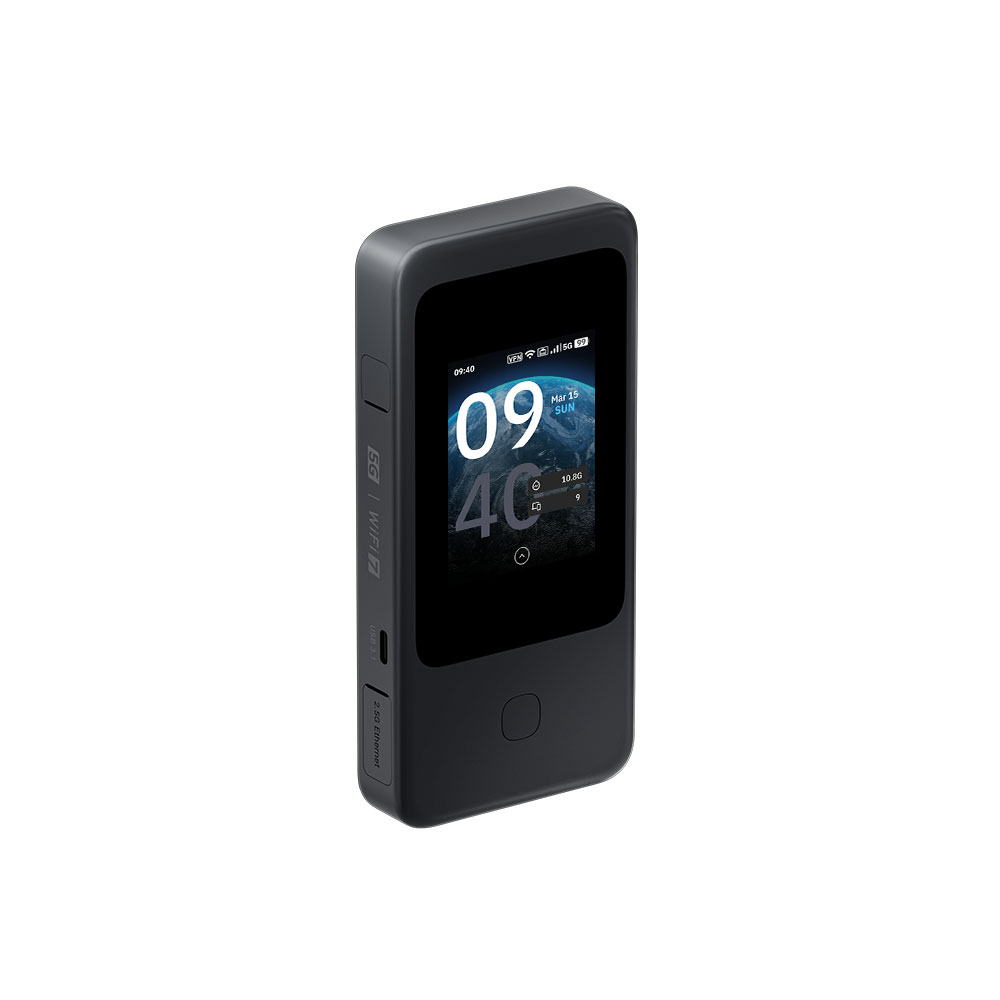
This is a router built around a battery and a SIM card rather than a wall socket, and everything about it follows from that. It carries a 5G modem with an onboard eSIM plus two physical SIM slots, sockets for external cellular antennas, a battery rated for a long working day, and it weighs about as much as a paperback.
The touchscreen is the part that changes daily use. Toggling a VPN, sharing the network by scannable code, or switching repeater settings happens on the device itself rather than through an admin page on a laptop, which helps when the laptop is the thing you are trying to get online in the first place.
Underneath it is the same open firmware the brand builds everything on, so the VPN clients, ad filtering and remote-access tooling are the full versions rather than simplified travel equivalents, backed by an unusually large amount of memory for a device this size.
The wireless side is tri-band Wi-Fi 7 and the wired side is a single 2.5 Gigabit port, so this is not a router for a wired household. One port is the whole allocation, and repeater mode exists for the common case of joining a hotel or cafe network and re-serving it privately.
It suits someone who works from hotels, moves between countries, or needs a dependable private network in places where the local one cannot be trusted. As a home router it makes little sense: the battery, the screen and the cellular modem are the product, and none of them earn their keep on a desk.
Category strengths
Where the GL.iNet Mudi 7 (GL-E5800) beats the median
- A much higher max wireless speed ?6,453 Mbps vs 3,570 Mbps (median)
- Much more RAM ?2,048 MB vs 768 MB (median)
- More antennas ?8 vs 2 (median)
- Has cellular modem ?
- Has eSIM ?
- Has 6 GHz band ?
- More SIM slots ?2 vs 1 (median)
- More frequency bands ?3 vs 2 (median)
- Has multi-gig LAN ?
- Has display ?
Where the GL.iNet Mudi 7 (GL-E5800) trails the median
- A heavier build ?300 g vs 259.5 g (median)
How this VS Score was computed
Score 68: each known spec is measured against the median of all travel routers (4 products), then weighted; 50 means level with that median. In classes of six or more, a value beyond the class’s 10th–90th percentile range counts as that limit, so one extreme product cannot set the scale. 63% of the scoreable weight could be used; unknown values, features not applicable to this class and proxies (battery capacity where a rated life exists) add or remove nothing.
| Specification | This product | Cohort median | Score weight | Points moved |
|---|---|---|---|---|
| Cellular modem | Yes — held to half its range (class of fewer than six) | 50% of the class have it | 1.5 | +37.5 |
| Cellular generation | 5G — held to half its range (class of fewer than six) | 4G LTE | 1.5 | +37.5 |
| Max wireless speed | 6,453 — held to half its range (class of fewer than six) | 3,570 | 1.5 | +37.5 |
| Wi-Fi standard | Wi-Fi 7 | Wi-Fi 6E | 2 | +26.0 |
| Frequency bands | 3 | 2 | 1 | +25.0 |
| WPA3 | Yes — held to half its range (class of fewer than six) | 75% of the class have it | 1 | +25.0 |
| eSIM | Yes — held to half its range (class of fewer than six) | 25% of the class have it | 0.7 | +17.5 |
| 6 GHz band | Yes — held to half its range (class of fewer than six) | 25% of the class have it | 0.7 | +17.5 |
| RAM | 2,048 — held to half its range (class of fewer than six) | 768 | 0.7 | +17.5 |
| SIM slots | 2 — held to half its range (class of fewer than six) | 1 | 0.5 | +12.5 |
| Multi-gig LAN | Yes — held to half its range (class of fewer than six) | 25% of the class have it | 0.5 | +12.5 |
| USB-C charging | Yes — held to half its range (class of fewer than six) | 75% of the class have it | 0.5 | +12.5 |
| Display | Yes — held to half its range (class of fewer than six) | 25% of the class have it | 0.4 | +10.0 |
| Antennas | 8 — held to half its range (class of fewer than six) | 2 | 0.3 | +7.5 |
| Thickness | 22.8 — held to half its range (class of fewer than six) | 35 | 0.3 | +7.5 |
| Weight | 300 | 259.5 | 1 | −7.0 |
| Processor speed | 2.2 | 1.65 | 0.3 | +5.1 |
| WAN port speed | 2.5 | 2.5 | 1 | +0.0 |
| LAN ports | 1 | 1 | 0.7 | +0.0 |
| USB ports | 1 | 1 | 0.3 | +0.0 |
| Processor cores | 4 | 4 | 0.5 | +0.0 |
Not scored: Max cellular download (too few comparable peers (2, need 3)); Beamforming (too few comparable peers (2, need 3)); Max connected devices (unknown: not scored); Repeater mode (standard for the class (100% have it)); Battery capacity (capacity is a proxy; the rated battery life is scored instead); Battery life (too few comparable peers (1, need 3)); Works while charging (too few comparable peers (1, need 3)); VPN client (standard for the class (100% have it)); VPN server (standard for the class (100% have it)); Guest network (too few comparable peers (2, need 3)); Parental controls (standard for the class (100% have it)); Quality of Service (QoS) (standard for the class (100% have it)); App control (standard for the class (100% have it)).
Editor’s note
The Mudi 7 is the most capable travel router GL.iNet has built, and also the one whose spec sheet most rewards careful reading.
The good part is unambiguous. A Qualcomm X72 5G platform with LTE Cat 20 fallback, an onboard eSIM plus two nano-SIM slots with dual-SIM dual-standby switching, two TS-9 sockets for external cellular antennas, a 5,380 mAh battery rated at 13.5 hours, USB-C PD charging, and a 2.8-inch touchscreen that lets you toggle a VPN, share Wi-Fi by QR code or change repeater settings without opening an admin panel. If you work from hotels, vans or sites where wired internet is unreliable, that combination is hard to match.
The part to read twice is "tri-band Wi-Fi 7". It supports 2.4, 5 and 6 GHz, but GL.iNet's own datasheet footnote says it runs dual-band simultaneous (2.4 + 5 GHz or 2.4 + 6 GHz, never all three), and of the eight internal antennas, six serve the cellular modem and only two serve Wi-Fi. So the wireless is 2×2 and two bands at a time. That is enough for a handful of travel devices and too little for a house.
There is one Ethernet port, a single 2.5 Gbps WAN/LAN, so any wired setup means adding a switch. VPN throughput is 700 Mbps on OpenVPN with DCO and 600 Mbps on WireGuard, lower than the mains-powered Flint 2 and unsurprisingly so. And the datasheet notes that the battery must be removed when the unit is used in an RV or vehicle, which is worth knowing before buying it for a van build.
Judged as a travel router it is overbuilt, and judged as a 5G router with a battery and a screen it is complete. Deciding which of those two products you are buying should settle it.
Specifications
Quality bars show where each figure sits between the lowest and highest of the 4 travel routers this VS Score is measured against.
Cellular
Wireless
Ports & wired
Battery
Hardware
Features & security
Design
Networking assessment
What the specification table does not say on its own: what this device needs to connect, what speeds are realistic, what costs extra, and where it falls short. Every statement below is read from the verified sheet or written by an editor — nothing is estimated.
Test environment
Research-based assessment: this brief is derived from the manufacturer’s published specifications for the GL.iNet Mudi 7 (GL-E5800) and the documents listed under Sources and verification. We have not run this unit on our own network, so nothing here is a measurement of ours.
Connection requirements
The WAN (internet) port is rated at 2.5 Gbps. An internet plan faster than that is capped at the router, and nothing on the network can download faster than this port regardless of the wireless figures.
It has a built-in 5G cellular modem, so it needs a SIM or eSIM data plan for use away from a wired or Wi-Fi source.
There are 1 LAN ports, at least one of them multi-gig, so one wired device can run above Gigabit speed.
Throughput expectations
The Wi-Fi 7 headline of 6,453 Mbps adds together the theoretical peak of every band. A single device connects to one band at a time, so no client ever sees the total, and real-world speeds run well below the link rate even in the same room.
The 6 GHz band is only usable by Wi-Fi 6E or Wi-Fi 7 clients and has noticeably shorter range through walls; older devices stay on the 5 GHz and 2.4 GHz bands.
Firmware and subscriptions
Set-up and management run through the manufacturer’s app; check whether a local web interface is offered as well.
Parental controls are listed; on several brands the scheduling and filtering tiers sit behind the same subscription as the security suite.
VPN support is built in, which avoids a subscription to a third-party VPN router service for remote access.
Security support
WPA3 is supported, the current Wi-Fi encryption standard; devices that only speak WPA2 still connect in mixed mode.
A guest network is available for visitors and smart-home devices, keeping them off the network your computers use.
Security-update cadence is not something manufacturers publish as a specification; see Support and updates below.
Real-world household suitability
Battery life is rated at 13.5 h per charge.
Known limitations
One specification is not published by the manufacturer and is shown as Unknown rather than guessed.
Support and updates
We have not found a published firmware support-lifetime commitment for this model. Update policies differ widely between brands; check the support page linked under Sources and verification before relying on it for a long deployment, and treat a device that has stopped receiving security updates as due for replacement.
Sources and verification
Where the specifications come from
- Official product pagegl-inet.com
- Datasheet or manualstatic.gl-inet.com
- Retailer listing (cross-check)amazon.com
Verification
- First published
- Specifications last checked
- Sheet completeness
- 33 of 34 specifications verified; the rest show as Unknown and are never estimated or scored
- Page type
- Product specification page — Compiled from the manufacturer’s published specifications and the cited sources; this is not a hands-on test.
- Basis
- Research-based: specifications and editorial text were compiled from the documents listed here and the manufacturer’s published data. We have not tested this unit ourselves; where independent measurements are mentioned they belong to the linked publication.
Travel Routers with similar specs to the GL.iNet Mudi 7 (GL-E5800)
Ratings & reviews
No reviews yet. Be the first to share your experience.
The bottom line
The GL.iNet Mudi 7 (GL-E5800) earns a VS Score of 68, above the median of the 4 travel routers it is measured against (a score of 50 is level with that median).
- Who it’s for
- Frequent travelers, RV users and remote workers who need cellular as the primary connection rather than a backup. eSIM plus two physical SIMs, TS-9 antenna ports and the all-day battery are what justify the price.
- Who should look elsewhere
- Anyone wanting a Wi-Fi 7 router for a home. It runs two bands at a time over 2×2 radios and has a single Ethernet port, so a mains-powered router does far more in that role.
- The trade-off that matters
- Cellular capability against wireless capability. Six of the eight internal antennas serve the 5G modem, so the Wi-Fi is deliberately modest. That is the right split for a travel device and the wrong one anywhere with fixed broadband.
- The main alternative
- GL.iNet Slate 7 (GL-BE3600): a Wi-Fi 7 travel router with no cellular modem or battery, for anyone who will tether from a phone.
The VS Score is calculated from the weighted specifications above, each measured against the median of comparable travel routers — a shortlisting guide, not a substitute for your own priorities. See how we score.