
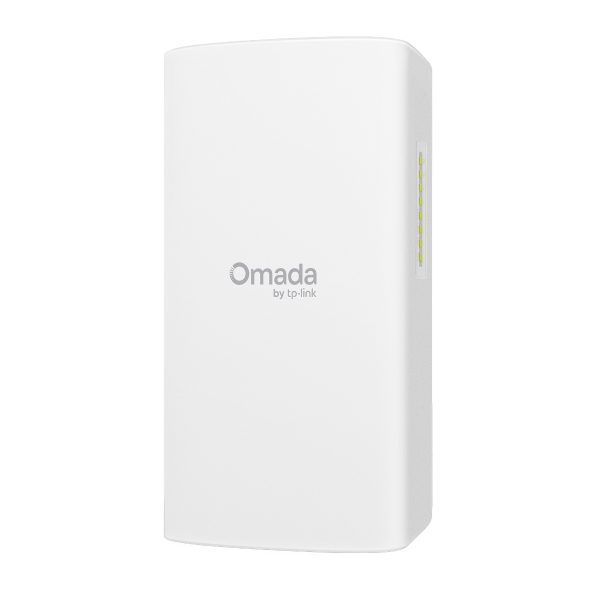
TP-Link Omada Flex Bridge 5: Specs, Price, Pros & Cons
This review measures the TP-Link Omada Flex Bridge 5 against the full 18-spec sheet we track for Access Points. It earns a VS Score of 29 out of 100 — the weighted result of every verified specification measured against the class average.
On the spec sheet it is strongest in management and weakest in wireless. Its clearest single advantage over the class average: a lighter build — 590 g vs 670 g (avg). Street prices currently start at $ 119.99 for the TP-Link Omada Flex Bridge 5. A transparency note: this spec sheet is 78% complete. Anything unverified shows as Unknown and is left out of the score — we never estimate a missing value.
Category strengths
Where the TP-Link Omada Flex Bridge 5 beats the average
- Has standalone mode ?
- Has outdoor rated ?
- Has DC power option ?
- A lighter build ?590 g vs 670 g (avg)
Where the TP-Link Omada Flex Bridge 5 trails the average
- A much lower max wireless speed ?867 Mbps vs 5,827.5 Mbps (avg)
- A much lower ethernet port speed ?1 Gbps vs 5.5 Gbps (avg)
- No 6 GHz band ?
- No ceiling mountable ?
Editor’s note
The Omada Flex Bridge 5 does one narrow job: it carries a network across open air, up to a rated 5 km line-of-sight, so you don't have to trench cable to a detached garage, barn, workshop or gate camera. Understand one thing before buying — this is a single unit. A working point-to-point link needs two of them (about $240 all in), or several Flex units talking to a Sector Bridge 5 hub for point-to-multipoint.
What I like most about it is the far end. Each unit has three gigabit ports, and two of them supply PoE out — 10 W on one port or 5 W each — which means the bridge itself can power a pair of IP cameras at the remote building. That folds an entire outdoor surveillance run into one PoE line from the house. DIP-switch pairing makes a two-unit link close to plug-and-play, and the IP66 housing plus pole and wall kits in the box handle the outdoor part. Power is flexible too: 802.3af/at, the included 54V passive injector, or 12V DC, which makes solar installs realistic.
The limitation to price in is the radio. This is Wi-Fi 5 at 867 Mbps with gigabit ports, so real throughput lands well under a gigabit — completely fine for cameras, a workshop PC and smart-home gear, but this is not a multi-gig backhaul between buildings. The 5 km rating also assumes clean line of sight; trees and buildings shrink it fast.
It slots into Omada SDN (cloud, hardware or software controller) or runs standalone from the app, which makes it the natural pick if you already run Omada gear. If you don't, Ubiquiti's NanoBeam 5AC does the same job for less per unit — with a steeper learning curve. For a camera-heavy outbuilding link, the built-in PoE out tips it TP-Link's way.
Specifications
Quality bars are generated automatically against 1 other access points.
Wireless
The Wi-Fi generation supported; later is faster and handles more devices.
The combined theoretical throughput across all bands.
A 6 GHz radio offers uncongested airspace for Wi-Fi 6E/7 devices.
The area a single access point is rated to cover.
How many devices the access point is rated to serve at once.
Serves multiple devices simultaneously instead of in turn.
Ports & power
The uplink port speed; multi-gig keeps Wi-Fi 6E/7 from bottlenecking.
Runs off Power over Ethernet — one cable for data and power.
The PoE standard required (e.g. 802.3af, 802.3at).
Can also run from a plug-in power adapter.
Management
Managed centrally with others through a controller (e.g. UniFi, Omada).
Works on its own without a controller.
Hands devices off between access points without drops (802.11k/v/r).
Maps separate Wi-Fi networks onto isolated VLANs.
A separate network keeps visitors off your main devices.
Design
Mounts flat on a ceiling for the best coverage pattern.
Weatherproof housing for outdoor placement.
A lighter unit is easier to mount.
How the VS Score works — and what it can’t tell you
Every measurable spec is scored against the average of all the Access Points we track: matching the class average scores 50, clearly beating it climbs towards 100, and each spec counts according to an editorial weight that reflects real-world impact — a battery-capacity gap moves the score far more than a colour-options list. The quality bars on the spec cards above show where this model sits inside the full range for its class, and the overall VS Score rolls every weighted result into one number.
Unknown values are never estimated. A spec this product doesn’t report simply drops out of its scoring — it isn’t penalised with a guess — but a thinner spec sheet does mean a score built on fewer data points, which is why completeness is disclosed under About this data.
Most importantly: a spec-sheet lead is not the same as a better product. Megapixels, gigahertz and benchmark points describe capacity, not experience — image processing, software optimisation, thermals, haptics and ergonomics decide how a device actually feels, and no table captures reliability or long-term support quality. Treat the VS Score as a structured summary of what can be measured, not a substitute for your own priorities.
About this data
- Specifications are compiled from each manufacturer’s official spec sheet, cross-checked against trusted specification databases, and normalised into one schema so identical things are compared identically.
- Specifications last verified August 20, 2026.
- Data completeness: 14 of the 18 specs in this category are verified (78%). Anything we could not verify is shown as Unknown — never estimated — and is excluded from the score.
- Prices and availability come from live retailer feeds via our shopping partners and refresh throughout the day; a missing price means no partner currently lists the product, not that it is discontinued.
- Want the full picture? Our editorial guidelines explain how we research products, weight the scores and stay independent.
- Spotted an error in a spec? Tell us and we will correct the sheet.
Where to buy
Prices and availability may change. Check the retailer before buying. We may earn a commission on purchases.
Price history
Access Points with similar specs to the TP-Link Omada Flex Bridge 5

Ratings & reviews
No reviews yet. Be the first to share your experience.
The bottom line
The TP-Link Omada Flex Bridge 5 earns a VS Score of 29, trailing most of the 2 access points we compare here, at least on the spec sheet.
- Who it’s for
- Anyone linking a detached garage, workshop, barn or gate to the house network without trenching cable — especially camera installs, since its two PoE-out ports can power IP cameras at the far end directly. Omada users get controller integration as a bonus.
- Who should look elsewhere
- Anyone who needs multi-gig speed between buildings — this is a Wi-Fi 5 radio behind gigabit ports, so real throughput lands well under 1 Gbps. Also not for links without clean line of sight; the 5 km rating assumes open air.
- The trade-off that matters
- Buy-two economics: at about $120 per unit a working link costs ~$240, which buys convenience (DIP-switch pairing, PoE flexibility, IP66) rather than speed. Cheaper per-unit rivals exist but lack the camera-powering PoE-out ports.
- The main alternative
- Ubiquiti NanoBeam 5AC Gen2 — the same point-to-point job for less money per unit, if you don't need PoE-out at the remote end and don't mind airMAX's steeper setup.
The VS Score is generated automatically from the weighted specifications above, measured against all other access points in our database. Treat it as a shortlisting guide — not a substitute for your own priorities.