
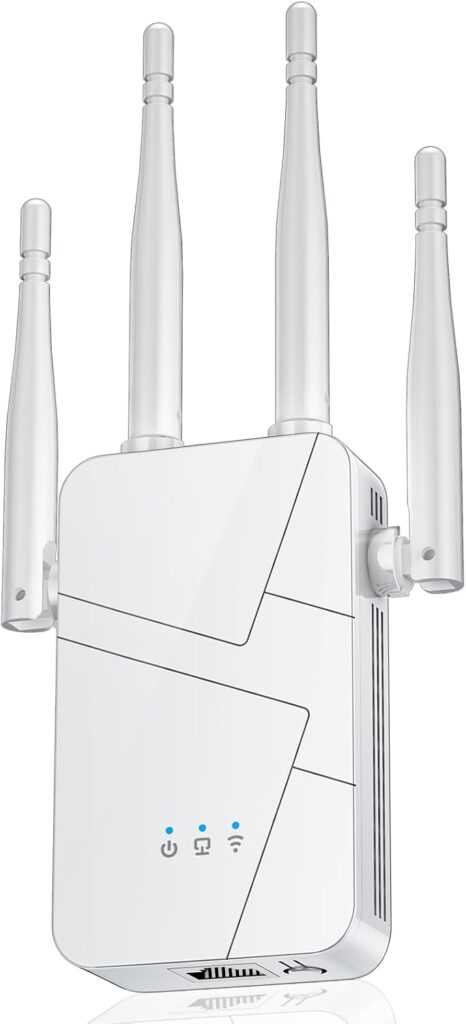
Baetaey WiFi Extender: Specs, Features, Pros & Cons
What distinguishes this from the crowd of similar devices is versatility rather than speed. The listing describes four operating modes – repeater, bridge, access point and router – which makes it a small utility tool for awkward jobs: turning a hotel Ethernet socket into a private wireless network, bridging a smart television that has no wireless of its own, or serving as a basic access point at the end of a wired run.
The fundamentals are modest and should be stated plainly. It is single-band 2.4 GHz on an old standard, rated at a few hundred megabits, with one Ethernet port, four adjustable antennas and pairing by button. There is no WPA3, no mesh capability and no app for setup.
The coverage figure quoted is not credible for hardware of this type, and like most products in this category it comes from a marketplace listing rather than a manufacturer, so there is no documentation, firmware channel or support to appeal to. Treat every headline number as a claim rather than a specification.
As a repeater it behaves like all simple repeaters: receiving and retransmitting on the same radio roughly halves throughput, and devices connect to a separate network name rather than roaming smoothly from the main one.
Bought for what it actually is – a cheap, flexible box for a specific small problem, especially the access-point and bridge modes that more expensive extenders often omit – it is reasonable value. Bought as a way to fix poor coverage across a whole house, it will disappoint, and the money is better put toward a mesh node that cooperates with the existing network.
Category strengths
How this VS Score was computed
Score 50: each known spec is measured against the median of all range extenders (3 products), then weighted. 45% of the scoreable weight could be used. See how we score
| Specification | This product | Cohort median | Score weight | Points moved |
|---|---|---|---|---|
| Wi-Fi standard | Wi-Fi 4 | Wi-Fi 4 | 2 | +0.0 |
| Max wireless speed | 300 | 300 | 1.5 | +0.0 |
| Frequency bands | 1 | 1 | 1 | +0.0 |
| Max connected devices | 70 | 70 | 0.5 | +0.0 |
Not scored: Coverage added (too few comparable peers (2, need 3)); Ethernet port (standard for the class (100% have it)); Ethernet port speed (unknown: not scored); Mesh compatible (not applicable: only 0% of this class have it); WPA3 (not applicable: only 0% of this class have it); App setup (not applicable: only 0% of this class have it); Access point mode (too few comparable peers (1, need 3)); Signal strength indicator (unknown: not scored); Wall-plug design (unknown: not scored); Pass-through outlet (unknown: not scored).
Editor’s note
The Baetaey is the classic Amazon extender formula: four adjustable antennas, one Ethernet port, WPS pairing, and a price that undercuts brand-name gear by half or more. Its one genuine distinguishing feature in this crowd is versatility — the listing states four operating modes (repeater, bridge, access point and router), which makes it a little Swiss Army knife for odd networking jobs: turning a hotel Ethernet jack into Wi-Fi, bridging a smart TV, or serving as a bare-bones AP off a wired run.
The fundamentals are modest and it's important to be clear-eyed about them. This is a single-band 2.4 GHz device at 300 Mbps — Wi-Fi 4 — with security topping out at WPA2. The 15,000 sq ft coverage claim is the usual fiction this product class traffics in; we haven't stored it, because a single-band N300 repeater covering fifteen thousand square feet would put every mesh system on this site out of business. Realistically you're extending usable signal into one or two adjacent rooms.
As with every listing-brand product, the Amazon page is the only source of truth available — Baetaey has no website, no published manual, no firmware page. The 4.8-star rating across a few dozen reviews is encouraging but thin.
Where it makes sense: cameras, printers, smart plugs, a garage or garden office where 2.4 GHz reach matters more than speed, or as a cheap mode-flexible gadget in a drawer. Where it doesn't: any household hoping to stream or video-call through it, or anyone who expects the thing to be supported in three years. At that point the calculus is simple — a TP-Link RE315 or similar costs a coffee or two more and comes with an actual company attached.
Specifications
Wireless
Connectivity
Features
Design
Networking assessment
Connection requirements
Not mesh-capable: it repeats the signal under its own network name, so devices do not roam between it and the router automatically.
It has an Ethernet port for a wired device at the far end.
Throughput expectations
The Wi-Fi 4 headline of 300 Mbps adds together the theoretical peak of every band. A single device connects to one band at a time, so no client ever sees the total, and real-world speeds run well below the link rate even in the same room.
Security support
WPA3 is not listed, so WPA2 is the strongest encryption on offer — adequate today, but a shorter runway than a WPA3 device.
Security-update cadence is not something manufacturers publish as a specification; see Support and updates below.
Real-world household suitability
The manufacturer says it adds 15,000 sq ft of coverage, assuming it is placed roughly halfway between the router and the dead zone.
Rated for 70 connected devices — a marketing figure, but a useful indication of whether a home full of smart plugs, cameras and phones is within its design.
Known limitations
Not offered, according to the spec sheet: mesh compatible, wPA3, app setup.
4 specifications are not published by the manufacturer and are shown as Unknown rather than guessed.
Support and updates
We have not found a published firmware support-lifetime commitment for this model. Update policies differ widely between brands; check the support page linked under Sources and verification before relying on it for a long deployment, and treat a device that has stopped receiving security updates as due for replacement.
Sources and verification
Where the specifications come from
- Retailer listing (cross-check)amazon.com
Verification
- First published
- Specifications last checked
- Sheet completeness
- 10 of 14 specifications verified; the rest show as Unknown and are never estimated or scored
- Page type
- Product specification page — Compiled from the manufacturer’s published specifications and the cited sources; this is not a hands-on test.
- Basis
- Research-based: specifications and editorial text were compiled from the documents listed here and the manufacturer’s published data. We have not tested this unit ourselves; where independent measurements are mentioned they belong to the linked publication.
Range Extenders with similar specs to the Baetaey WiFi Extender
Ratings & reviews
No reviews yet. Write the first one
The bottom line
The Baetaey WiFi Extender earns a VS Score of 50, level with the median of the 3 range extenders it is measured against.
- Who it’s for
- Odd-job networking: its four stated modes (repeater, bridge, access point, router) make it a cheap Swiss Army knife for hotel jacks, smart TVs on Ethernet, or pushing 2.4 GHz reach to cameras and a garden office.
- Who should look elsewhere
- Streaming or video calls through the extension (single-band N300 shares one crowded radio), and anyone who wants a supported product — Baetaey has no website, manual or firmware page anywhere.
- The trade-off that matters
- Versatility at a throwaway price versus 2009-era wireless: the four modes are genuinely useful, the 15,000 sq ft coverage claim genuinely is not.
- The main alternative
- TP-Link RE315 — a few dollars more for a real brand with honest range numbers; choose the Baetaey only for its bridge/AP/router mode flexibility.
This page was created with the help of AI. How we work