
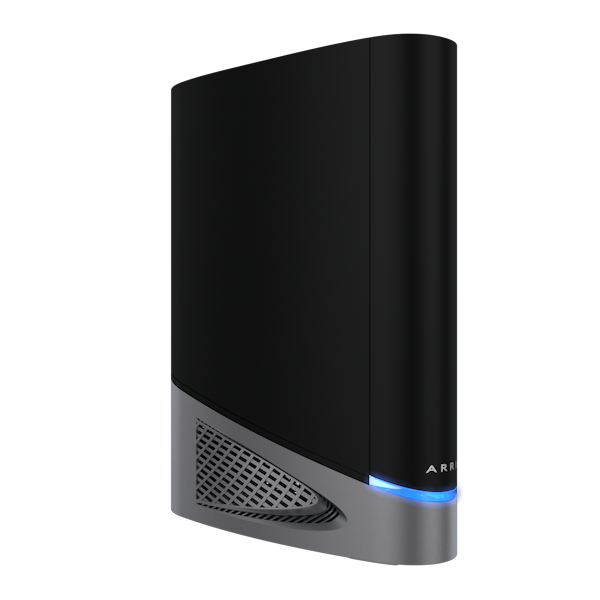
ARRIS SURFboard G54: Specs, Features, Pros & Cons
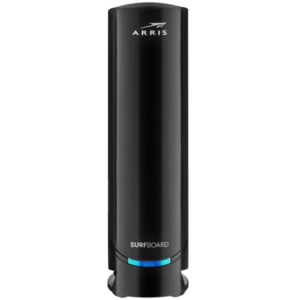
This is the top of the cable-modem-plus-router category rather than a compromise between the two halves. The modem side is DOCSIS 3.1 with a high download rating, the router side is quad-band Wi-Fi 7, and there are five Ethernet ports, one of them running at 10 Gigabit.
The detail worth understanding is what that 10 Gigabit port can do. It doubles as a wired input, so if the street is upgraded to fiber in a year or two, the device stops being a cable modem and carries on as a standalone Wi-Fi 7 router with a very fast wired connection. That is unusual, and it changes the calculation for anyone who suspects their connection type may change before their hardware wears out.
ARRIS's datasheet also lists a switchable diplexer, so the upstream can move from the 5-42 MHz split to 5-85 MHz when a cable provider widens its upload band. That is the change behind the faster upload tiers some providers now sell, and this modem does not have to be replaced to use it.
The compatibility check is not optional. It is certified with several large cable providers, and cable networks authorize modems individually, so a device absent from your provider's list will not be activated whatever its capabilities. There are also no telephone ports, which rules it out for anyone with voice service bundled onto the cable line.
Being the maximum specification, much of what it offers only becomes visible on a fast plan in a large home. On a gigabit connection in an apartment, a smaller combination unit will behave identically and the extra radios and ports will sit idle.
Category strengths
Where the ARRIS SURFboard G54 beats the median
- More ethernet ports ?5 vs 2 (median)
How this VS Score was computed
Score 64: each known spec is measured against the median of all modems (6 products), then weighted; 50 means level with that median. In classes of six or more, a value beyond the class’s 10th–90th percentile range counts as that limit, so one extreme product cannot set the scale. 82% of the scoreable weight could be used; unknown values, features not applicable to this class and proxies (battery capacity where a rated life exists) add or remove nothing.
| Specification | This product | Cohort median | Score weight | Points moved |
|---|---|---|---|---|
| Ethernet ports | 5 | 2 | 0.8 | +40.0 |
| Multi-gig Ethernet | Yes | 67% of the class have it | 0.8 | +40.0 |
| Built-in Wi-Fi router | Yes | 67% of the class have it | 0.5 | +25.0 |
| DOCSIS version | DOCSIS 3.1 | DOCSIS 3.1 | 2 | +0.0 |
| Max download speed | 2,500 | 2,500 | 2 | +0.0 |
| Downstream channels | 32 | 32 | 0.8 | +0.0 |
| Upstream channels | 8 | 8 | 0.5 | +0.0 |
| Voice / telephony ports | 0 | 0 | 0.2 | +0.0 |
Not scored: Max upload speed (unknown: not scored); Link aggregation (unknown: not scored); Weight (unknown: not scored); Fanless (unknown: not scored).
Editor’s note
The SURFboard G54 is the maxed-out option in cable-modem combos: DOCSIS 3.1 on the modem side, quad-band Wi-Fi 7 rated at BE18000 on the router side, five Ethernet ports including a 10G one, and a 5,000 sq ft coverage claim. If you're on a fast cable plan from Xfinity, Spectrum or Cox and want one box on the shelf instead of two, this is the ceiling of what's currently sold.
The detail I like most isn't the Wi-Fi: the 10G port doubles as an Ethernet WAN input, so if your street gets fiber next year the G54 keeps working as a standalone Wi-Fi 7 router. That makes the purchase less of a bet on how long the cable line stays in the house.
ARRIS's product page says "best for plans up to 2.5 Gbps" in its feature list and "up to 10 Gbps" in its technical specs, and the safer reading is that DOCSIS 3.1's two OFDM channels top out well below the Ethernet port's headline. There are no phone ports, so Xfinity Voice customers still need the ISP's gateway, and a combo remains a single point of failure: when one half dies or ages out, you replace both.
For a large home on a multi-gig cable plan with no interest in separates, it's the strongest single-box answer available. Tinkerers and upgraders should still weigh a standalone DOCSIS 3.1 modem plus a router of their choosing, which is always more flexible.
Specifications
Quality bars show where each figure sits between the lowest and highest of the 6 modems this VS Score is measured against.
Performance
Connectivity
Features
Design
Networking assessment
What the specification table does not say on its own: what this device needs to connect, what speeds are realistic, what costs extra, and where it falls short. Every statement below is read from the verified sheet or written by an editor — nothing is estimated.
Test environment
Research-based assessment: this brief is derived from the manufacturer’s published specifications for the ARRIS SURFboard G54 and the documents listed under Sources and verification. We have not run this unit on our own network, so nothing here is a measurement of ours.
Connection requirements
Needs a cable internet provider whose network supports DOCSIS 3.1; a modem is only usable once the provider has approved that model, so check their compatibility list before buying.
Listed provider compatibility: Certified for Xfinity, Spectrum and Cox; works with other major US cable ISPs.
It includes a Wi-Fi router, so no separate router is required for a basic setup.
Throughput expectations
The DOCSIS link is rated for 2,500 Mbps down and an unspecified rate up; your plan speed, not the modem, is the practical ceiling.
Security support
Security-update cadence is not something manufacturers publish as a specification; see Support and updates below.
Known limitations
4 specifications are not published by the manufacturer and are shown as Unknown rather than guessed.
Support and updates
We have not found a published firmware support-lifetime commitment for this model. Update policies differ widely between brands; check the support page linked under Sources and verification before relying on it for a long deployment, and treat a device that has stopped receiving security updates as due for replacement.
Sources and verification
Where the specifications come from
- Official product pagesurfboard.com
- Datasheet or manualarris.my.salesforce.com
- Independent testingrtings.com
Verification
- First published
- Specifications last checked
- Sheet completeness
- 9 of 13 specifications verified; the rest show as Unknown and are never estimated or scored
- Page type
- Product specification page — Compiled from the manufacturer’s published specifications and the cited sources; this is not a hands-on test.
- Basis
- Research-based: specifications and editorial text were compiled from the documents listed here and the manufacturer’s published data. We have not tested this unit ourselves; where independent measurements are mentioned they belong to the linked publication.
Modems with similar specs to the ARRIS SURFboard G54
Ratings & reviews
No reviews yet. Be the first to share your experience.
The bottom line
The ARRIS SURFboard G54 earns a VS Score of 64, above the median of the 6 modems it is measured against (a score of 50 is level with that median).
- Who it’s for
- Large homes on fast Xfinity, Spectrum or Cox plans that want modem and Wi-Fi 7 router in one box, with insurance built in, since the 10G port doubles as the Ethernet WAN if fiber arrives.
- Who should look elsewhere
- Households on a gigabit plan or slower, where a smaller combo or separates do the same job without idle radios and ports. Also skip it on voice plans, since it has no phone ports.
- The trade-off that matters
- One box instead of two good ones: the G54 matches separates on capability today, but modem and router age as a single unit, and ARRIS's plan guidance sits well below what the 10G port suggests.
- The main alternative
- ARRIS SURFboard G20: if your plan is a gigabit or less, it gives the same one-box convenience and the new upload-tier support with Wi-Fi 6 radios that suit that plan.
The VS Score is calculated from the weighted specifications above, each measured against the median of comparable modems — a shortlisting guide, not a substitute for your own priorities. See how we score.