Ubiquiti USW Pro XG 8 PoE: Specs, Features, Pros & Cons
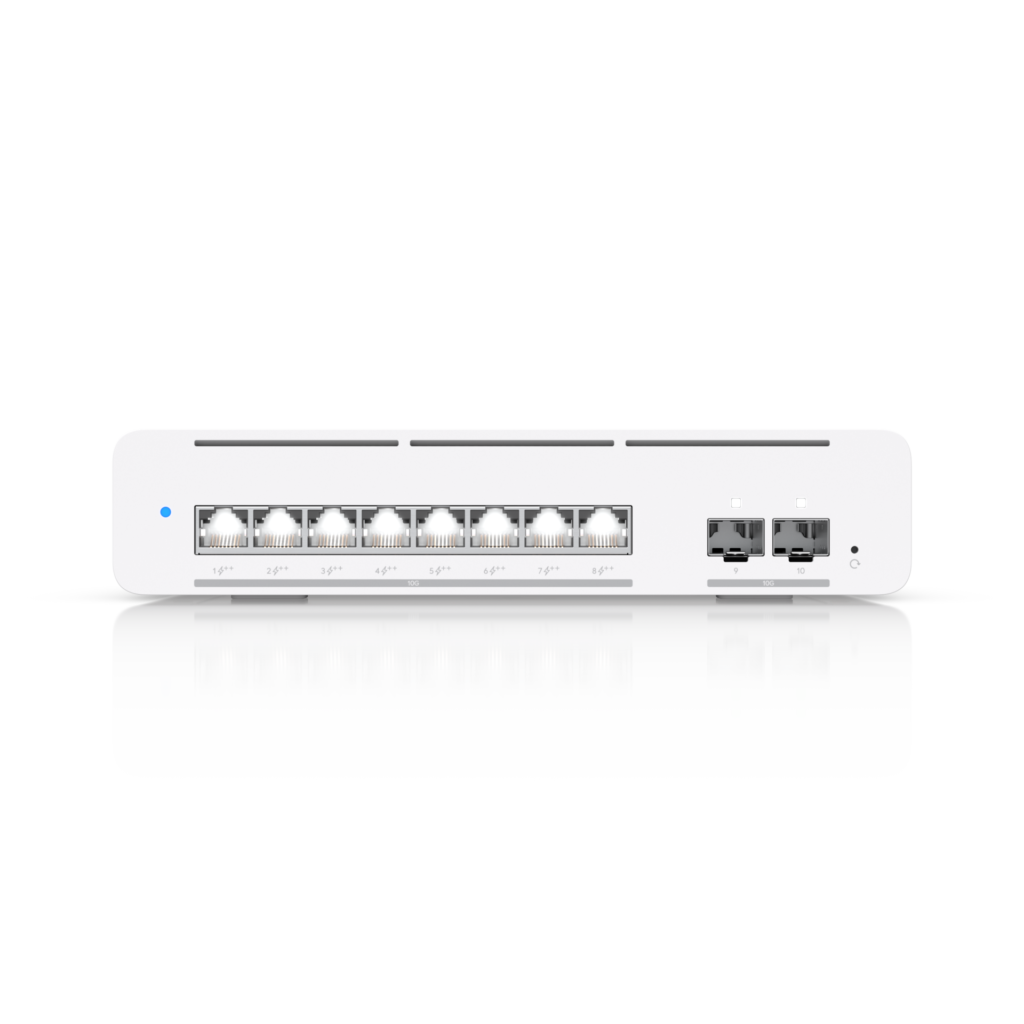
Every copper port on this switch runs at 10 Gigabit, and every one of them also supplies power. That combination in a chassis about the size of a hardback book makes it unusual, because the equipment that normally offers eight 10 Gigabit powered ports is rack-mounted and loud.
It suits a specific situation: a handful of devices that need more than a gigabit each, without the space or appetite for a rack. Two fiber uplinks carry the aggregate traffic onward, and the internal capacity is high enough to run every port at once without contention, which separates it from multi-gig hardware that oversubscribes its backplane.
The constraint, as usual with dense powered switches, is the shared budget rather than the per-port rating. Eight ports capable of the highest power standard imply far more capacity than the switch has to give, so the total available is what determines how many demanding devices can run at once.
Note also what is absent: there are no 2.5 Gigabit ports and no plain gigabit ports at all. Everything is 10 Gigabit, which is excellent if your devices are, and wasteful if most of them are not. A mixed network is usually better served by a switch with a broader spread of speeds.
Management is full, through the same controller as the rest of the ecosystem, with VLANs, link aggregation and traffic prioritization available. Like its siblings, it is designed to be one component in a larger managed network rather than a standalone purchase.
Category strengths
Where the Ubiquiti USW Pro XG 8 PoE beats the median
- A much higher switching capacity ?200 Gbps vs 40 Gbps (median)
- A much higher forwarding rate ?149 Mpps vs 32.73 Mpps (median)
- More PoE ports ?8 vs 4 (median)
- More 10G ports ?8 vs 0 (median)
- More SFP/SFP+ ports ?2 vs 0 (median)
- Has cloud management ?
- A higher PoE budget ?155 W vs 135 W (median)
Where the Ubiquiti USW Pro XG 8 PoE trails the median
- A much higher power consumption ?61 W vs 26.5 W (median)
How this VS Score was computed
Score 74: each known spec is measured against the median of all network switches (17 products), then weighted; 50 means level with that median. In classes of six or more, a value beyond the class’s 10th–90th percentile range counts as that limit, so one extreme product cannot set the scale. 92% of the scoreable weight could be used; unknown values, features not applicable to this class and proxies (battery capacity where a rated life exists) add or remove nothing.
| Specification | This product | Cohort median | Score weight | Points moved |
|---|---|---|---|---|
| Switching capacity | 200 | 40 | 1.5 | +75.0 |
| PoE ports | 8 | 4 | 1.2 | +60.0 |
| 10G ports | 8 | 0 | 0.8 | +40.0 |
| Forwarding rate | 149 — capped at the class’s upper range (119) | 32.73 | 0.8 | +40.0 |
| VLAN support | Yes | 59% of the class have it | 0.8 | +40.0 |
| SFP/SFP+ ports | 2 | 0 | 0.5 | +25.0 |
| Management level | Fully managed | Smart managed | 1 | +25.0 |
| Link aggregation | Yes | 53% of the class have it | 0.5 | +25.0 |
| Quality of Service (QoS) | Yes | 62% of the class have it | 0.5 | +25.0 |
| Cloud management | Yes | 50% of the class have it | 0.4 | +20.0 |
| IGMP snooping | Yes | 60% of the class have it | 0.3 | +15.0 |
| Rack-mountable | No | 35% of the class have it | 0.3 | −14.4 |
| Power consumption | 61 | 26.5 | 0.5 | −14.0 |
| PoE standard | PoE++ (802.3bt) | PoE+ (802.3at) | 0.8 | +13.6 |
| PoE budget | 155 | 135 | 1.2 | +8.4 |
| Total ports | 10 | 10 | 2 | +0.0 |
| Gigabit ports | 0 | 0 | 1.5 | +0.0 |
| 2.5G ports | 0 | 0 | 1 | +0.0 |
| MAC address table | 32 — capped at the class’s upper range (16) | 16 | 0.3 | +0.0 |
Not scored: Jumbo frame support (standard for the class (100% have it)); Fanless (standard for the class (80% have it)); Metal housing (standard for the class (87% have it)).
Editor’s note
With 155 W to share, the Pro XG 8 PoE can run two 60 W PoE++ devices and still have 35 W left for a third, smaller one. Eight ports at their full rating would need 480 W, so the per-port figure describes what one port can do, and the total decides how many demanding access points or PTZ cameras the switch can carry.
The fanless design shapes the rest. Power comes from an external 210 W adapter, the switch draws up to 61 W itself before any PoE, and the steel case weighs 1.6 kg and is rated for rooms up to 45 degrees Celsius. On a desk or a wall that heat has to go somewhere, so an open shelf suits it better than a closed cabinet.
The Layer 3 side earns its keep in a studio. Inter-VLAN routing, static routes and a DHCP server run on the switch, so a NAS on a storage VLAN and editing machines on a workstation VLAN exchange files at 10G without the round trip through the gateway that a Layer 2 switch such as the USW Aggregation forces. Ubiquiti also lists Pro AV profiles for Dante, Q-SYS, NDI, AES67 and others, which saves an AV installer hand-tuning multicast and QoS.
Every RJ45 port here negotiates down to 1G, so older gear still works. A desk of 2.5G clients, though, gets nothing from it that Ubiquiti's USW Flex 2.5G 8 PoE would not give, and the Flex can even run on power from its own uplink.
Specifications
Quality bars show where each figure sits between the lowest and highest of the 17 network switches this VS Score is measured against.
Ports
Power over Ethernet
Performance
Management
Design & power
Networking assessment
What the specification table does not say on its own: what this device needs to connect, what speeds are realistic, what costs extra, and where it falls short. Every statement below is read from the verified sheet or written by an editor — nothing is estimated.
Test environment
Research-based assessment: this brief is derived from the manufacturer’s published specifications for the Ubiquiti USW Pro XG 8 PoE and the documents listed under Sources and verification. We have not run this unit on our own network, so nothing here is a measurement of ours.
Connection requirements
Management level: Fully managed. Expect a web interface or cloud dashboard to configure it, which is where VLANs, link aggregation and QoS are set up.
Ports: 10 in total, of which an unspecified number are Gigabit and 8 are 10 Gigabit.
PoE budget is 155 W shared across the powered ports — add up the draw of the cameras, phones and access points you intend to hang off it before assuming they all fit.
Throughput expectations
Switching capacity is 200 Gbps, enough for every port to run flat out at once — the usual case for a home or small-office switch.
Jumbo frames are supported, which helps large file transfers between NAS and desktop.
Firmware and subscriptions
Set-up and day-to-day management run through the manufacturer’s cloud service, so that account’s availability and privacy terms are part of the product.
Security support
VLAN support allows work, IoT and guest traffic to be separated on the wired side.
Security-update cadence is not something manufacturers publish as a specification; see Support and updates below.
Known limitations
Not offered, according to the spec sheet: rack-mountable.
Support and updates
We have not found a published firmware support-lifetime commitment for this model. Update policies differ widely between brands; check the support page linked under Sources and verification before relying on it for a long deployment, and treat a device that has stopped receiving security updates as due for replacement.
Sources and verification
Where the specifications come from
- Official product pagetechspecs.ui.com
- Retailer listing (cross-check)amazon.com
Verification
- First published
- Specifications last checked
- Sheet completeness
- 22 of 22 specifications verified; the rest show as Unknown and are never estimated or scored
- Page type
- Product specification page — Compiled from the manufacturer’s published specifications and the cited sources; this is not a hands-on test.
- Basis
- Research-based: specifications and editorial text were compiled from the documents listed here and the manufacturer’s published data. We have not tested this unit ourselves; where independent measurements are mentioned they belong to the linked publication.
Network Switches with similar specs to the Ubiquiti USW Pro XG 8 PoE

Ratings & reviews
No reviews yet. Be the first to share your experience.
The bottom line
The Ubiquiti USW Pro XG 8 PoE earns a VS Score of 74, above the median of the 17 network switches it is measured against (a score of 50 is level with that median).
- Who it’s for
- A UniFi studio or small office with a few 10G-capable devices, such as Wi-Fi 7 access points, a NAS and editing workstations, that should be powered and switched from a silent unit on a desk or wall.
- Who should look elsewhere
- Networks without a UniFi controller, and anyone whose devices top out at 2.5G or gigabit, since every RJ45 port here is built for 10G.
- The trade-off that matters
- It routes between VLANs at 10G on the switch itself, but only inside UniFi: every Layer 3 setting is made in UniFi Network and nowhere else.
- The main alternative
- NETGEAR XS508Mv2: eight 10G RJ45 ports with nothing to configure, for a 10G desk that needs neither PoE nor UniFi.
The VS Score is calculated from the weighted specifications above, each measured against the median of comparable network switches — a shortlisting guide, not a substitute for your own priorities. See how we score.