Tenda TEM2008D: Specs, Price, Pros & Cons
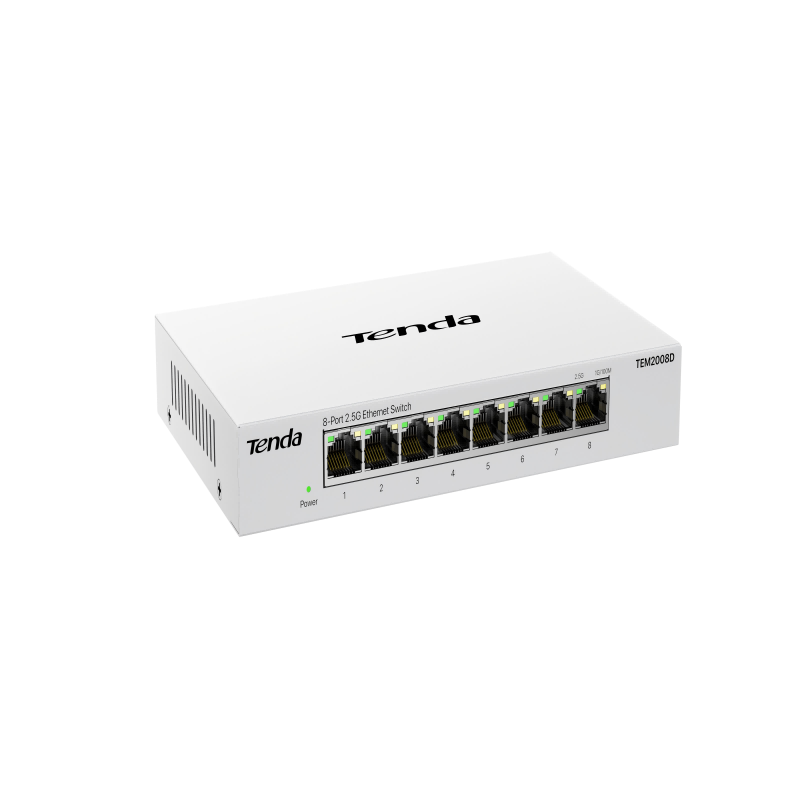
Every one of the TEM2008D's eight ports runs at 2.5 Gbps. No port is slower for an old printer to sit on, and none is faster to serve as an uplink. That shapes how the switch fits into a network more than any other line on its sheet.
It is the eight-port version of Tenda's TEM2005D. The steel case is 177.5 mm wide and 26 mm tall, has no fan, and sits on a desk or screws to a wall. Each port also drops to gigabit or Fast Ethernet, so older laptops, TVs and printers can share it with the faster machines. Tenda recommends Cat5 or Cat5e cable or better. The 2.5GBASE-T standard was written to run over Cat5e at full length, so existing Cat5e runs can carry the faster speed without being pulled again.
Tenda's switching capacity figure, 40 Gbps, is exactly eight ports at full duplex, so the switch is non-blocking and never runs short of internal bandwidth. It works store-and-forward, checking each frame before passing it on, at a rated 29.76 million packets per second. The MAC table holds 16,000 entries.
Power goes straight in as 100 to 220 V mains AC rather than through a separate adapter, and the maximum draw stays under 9.8 W. Each port has 4 kV surge protection. The rated operating range runs from freezing to 104 degrees Fahrenheit. No jumbo-frame support is listed for this model, so check before setting a NAS to a 9,000-byte MTU.
Category strengths
Where the Tenda TEM2008D beats the median
- More 2.5G ports ?8 vs 0 (median)
Where the Tenda TEM2008D trails the median
- Fewer PoE ports ?0 vs 4 (median)
- A much lower PoE budget ?0 W vs 135 W (median)
- No VLAN support ?
- No Quality of Service (QoS) ?
- No IGMP snooping ?
- A slightly lower switching capacity ?40 Gbps vs 44 Gbps (median)
- A lower forwarding rate ?29.76 Mpps vs 35.7 Mpps (median)
How this VS Score was computed
Score 30: each known spec is measured against the median of all network switches (19 products), then weighted. 78% of the scoreable weight could be used. See how we score
| Specification | This product | Cohort median | Score weight | Points moved |
|---|---|---|---|---|
| PoE ports | 0 | 4 | 1.2 | −57.6 |
| PoE budget | 0 | 135 | 1.2 | −57.6 |
| 2.5G ports | 8 | 0 | 1 | +50.0 |
| VLAN support | No | 53% of the class have it | 0.8 | −38.4 |
| PoE standard | None | PoE+ (802.3at) | 0.8 | −26.4 |
| Management level | Unmanaged | Smart managed | 1 | −25.0 |
| Link aggregation | No | 47% of the class have it | 0.5 | −24.0 |
| Quality of Service (QoS) | No | 53% of the class have it | 0.5 | −24.0 |
| Cloud management | No | 44% of the class have it | 0.4 | −19.2 |
| IGMP snooping | No | 53% of the class have it | 0.3 | −14.4 |
| Rack-mountable | No | 37% of the class have it | 0.3 | −14.4 |
| Switching capacity | 40 | 44 | 1.5 | −7.5 |
| Forwarding rate | 29.76 | 35.7 | 0.8 | −6.4 |
| Gigabit ports | 0 | 0 | 1.5 | +0.0 |
| 10G ports | 0 | 0 | 0.8 | +0.0 |
| SFP/SFP+ ports | 0 | 0 | 0.5 | +0.0 |
| MAC address table | 16 | 16 | 0.3 | +0.0 |
Not scored: Total ports (unknown: not scored); Jumbo frame support (unknown: not scored); Fanless (standard for the class (86% have it)); Metal housing (standard for the class (88% have it)); Power consumption (unknown: not scored).
Editor’s note
A 2.5G NAS on the TEM2008D shares its single link with every machine reading from it, because no port is faster. That link carries about 312 MB/s before protocol overhead. Three PCs copying from the NAS at once get roughly 100 MB/s each. That is a little under what each would see from a gigabit link of its own. The switch pays off when one machine copies at a time. Before overhead, a 50 GB folder takes under three minutes at 2.5G, against nearly seven over gigabit. That is the gap a photo or video archive on a NAS feels every day.
A desk with a 2.5G NAS, two PCs, a game console and a 2.5G router or access point fills five sockets and leaves three spare. Every pair of devices gets a full 2.5G path, so two PCs can trade files at full speed while the console downloads.
Plug a NAS with a 10G card into the TEM2008D and it links at 2.5G, so the speed the card was bought for goes unused. Ten-gigabit storage needs a switch with a 10G port to plug it into.
A summer attic or garage can climb past the top of the rated temperature range, and a fanless steel box there runs outside it.
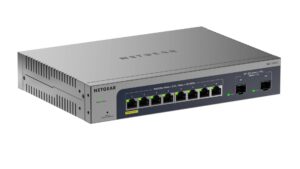
NETGEAR's MS110TX keeps eight 2.5G copper ports, also without a fan, and adds two SFP+ uplinks and VLAN support at a higher price. I'd still take the Tenda for a desk where nothing will outgrow 2.5G. There is nothing on it to configure or keep updated.
Specifications
Ports
Power over Ethernet
Performance
Management
Design & power
Networking assessment
Connection requirements
Unmanaged: it plugs into any router’s LAN port and needs no configuration, but it also offers none — no VLANs, no port monitoring.
PoE budget is 0 W shared across the powered ports — add up the draw of the cameras, phones and access points you intend to hang off it before assuming they all fit.
Throughput expectations
Switching capacity is 40 Gbps, enough for every port to run flat out at once — the usual case for a home or small-office switch.
Security support
Security-update cadence is not something manufacturers publish as a specification; see Support and updates below.
Known limitations
Not offered, according to the spec sheet: vLAN support, link aggregation, quality of Service (QoS), cloud management.
3 specifications are not published by the manufacturer and are shown as Unknown rather than guessed.
Support and updates
We have not found a published firmware support-lifetime commitment for this model. Update policies differ widely between brands; check the support page linked under Sources and verification before relying on it for a long deployment, and treat a device that has stopped receiving security updates as due for replacement.
Sources and verification
Where the specifications come from
- Official product pagetendacn.com
Verification
- First published
- Specifications last checked
- Sheet completeness
- 19 of 22 specifications verified; the rest show as Unknown and are never estimated or scored
- Page type
- Product specification page — Compiled from the manufacturer’s published specifications and the cited sources; this is not a hands-on test.
- Basis
- Research-based: specifications and editorial text were compiled from the documents listed here and the manufacturer’s published data. We have not tested this unit ourselves; where independent measurements are mentioned they belong to the linked publication.
Where to buy
Prices and availability may change. Check the retailer before buying. We may earn a commission on purchases.
Price history
Network Switches with similar specs to the Tenda TEM2008D

Ratings & reviews
No reviews yet. Write the first one
The bottom line
The Tenda TEM2008D earns a VS Score of 30, below the median of the 19 network switches it is measured against (a score of 50 is level with that median).
- Who it’s for
- A desk or home lab where a 2.5G NAS, a couple of PCs and a 2.5G router need to move files faster than gigabit, with nothing to set up.
- Who should look elsewhere
- Anyone who needs to power an access point or a camera over the network cable, since none of the ports supplies PoE.
- The trade-off that matters
- There are no settings at all, so the day a camera or a guest network needs its own VLAN, a managed switch has to replace this one.
- The main alternative
- NETGEAR MS110TX: eight 2.5G ports plus two 10G SFP+ uplinks, VLANs and a fanless case, for a network that needs a faster path out.
This page was created with the help of AI. How we work
Latest Network Switches