NETGEAR GS105EPP: Specs, Price, Pros & Cons
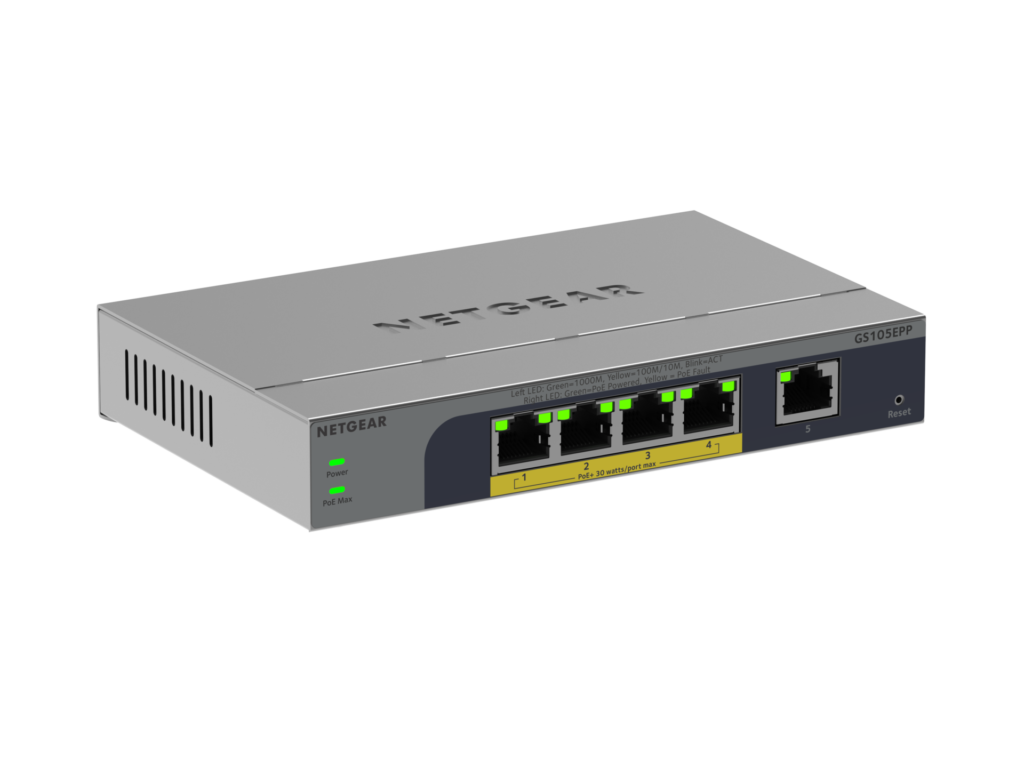
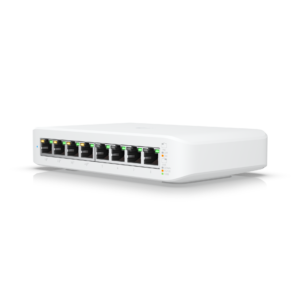
Four PoE+ ports at up to 30 W each, and a 120 W budget behind them: on the GS105EPP the sums come out even, so every powered port can draw its maximum at the same moment. Ubiquiti's USW Lite 8 PoE, a switch of similar size, shares 52 W across its four PoE+ ports, so two hungry devices there can starve the other two.
The GS105EPP is the five-port member of NETGEAR's Easy Smart PoE family, gigabit on every port, with the fifth socket left unpowered for the uplink. Its sibling, the GS105EP, uses the same 158 mm metal case with roughly half the budget, so the second P in the name buys power and nothing else. There is no fan, and NETGEAR rates it at 0 dBA, so it can sit on a desk or hang from the screws in the box, and NETGEAR covers the hardware with a limited lifetime warranty.
Easy Smart means a web page and nothing more elaborate. That page handles port-based and 802.1Q VLANs, priority by 802.1p or DSCP with rate limits, IGMP snooping, port mirroring and a cable tester, plus per-port PoE limits and priorities. There is no cloud portal and no controller to install, and link aggregation stops at one static group.
NETGEAR's uninterrupted PoE keeps cameras and access points powered while the switch installs new firmware or performs a soft reboot, so a routine update does not blank every camera feed in the house for a minute.
Category strengths
Where the NETGEAR GS105EPP beats the median
- More gigabit ports ?5 vs 0 (median)
- Has link aggregation ?
Where the NETGEAR GS105EPP trails the median
- A much higher power consumption ?137.8 W vs 26.5 W (median)
- A much lower switching capacity ?10 Gbps vs 44 Gbps (median)
- Fewer total ports ?5 vs 10 (median)
- A much lower MAC address table ?2 K vs 16 K (median)
- A lower PoE budget ?120 W vs 135 W (median)
How this VS Score was computed
Score 52: each known spec is measured against the median of all network switches (19 products), then weighted. 85% of the scoreable weight could be used. See how we score
| Specification | This product | Cohort median | Score weight | Points moved |
|---|---|---|---|---|
| Gigabit ports | 5 | 0 | 1.5 | +75.0 |
| Total ports | 5 | 10 | 2 | −50.0 |
| Switching capacity | 10 — capped at the class’s lower range (16) | 44 | 1.5 | −48.0 |
| VLAN support | Yes | 53% of the class have it | 0.8 | +40.0 |
| Link aggregation | Yes | 47% of the class have it | 0.5 | +25.0 |
| Quality of Service (QoS) | Yes | 53% of the class have it | 0.5 | +25.0 |
| Power consumption | 137.8 — capped at the class’s upper range (116.9) | 26.5 | 0.5 | −19.5 |
| IGMP snooping | Yes | 53% of the class have it | 0.3 | +15.0 |
| Rack-mountable | No | 37% of the class have it | 0.3 | −14.4 |
| MAC address table | 2 — capped at the class’s lower range (4) | 16 | 0.3 | −11.1 |
| PoE budget | 120 | 135 | 1.2 | −7.2 |
| 2.5G ports | 0 | 0 | 1 | +0.0 |
| 10G ports | 0 | 0 | 0.8 | +0.0 |
| SFP/SFP+ ports | 0 | 0 | 0.5 | +0.0 |
| PoE ports | 4 | 4 | 1.2 | +0.0 |
| PoE standard | PoE+ (802.3at) | PoE+ (802.3at) | 0.8 | +0.0 |
| Management level | Smart managed | Smart managed | 1 | +0.0 |
Not scored: Forwarding rate (unknown: not scored); Jumbo frame support (standard for the class (100% have it)); Cloud management (unknown: not scored); Fanless (standard for the class (86% have it)); Metal housing (standard for the class (88% have it)).
Editor’s note
NETGEAR's datasheet lists no configurable management VLAN for the five- and eight-port Easy Smart models. Only the 16-port versions have one. In practice the admin page cannot be moved onto a VLAN of its own, so on a network split into trusted and IoT segments, keep the port that reaches the admin page on the trusted side and set a strong password. PoE scheduling, which turns ports off on a timetable, is another 16-port extra.
The power ceiling is PoE+. Anything that asks for 802.3bt power, such as a PTZ camera with a heater or one of the larger outdoor access points, will not get it here, and a 2.5G access point will link at gigabit because every port is gigabit.
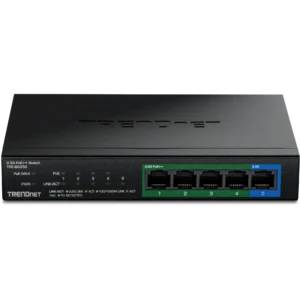
The obvious rival is NETGEAR's own GS108EPP, with eight PoE+ ports on the same software and a budget barely larger, which means its ports cannot all run flat out together. Ubiquiti's USW Lite 8 PoE has deeper Layer 2 features but needs a UniFi controller. TRENDnet's TPE-BG350 goes to 2.5G with far more power per port but has no management at all.
I would pay for this over a plain unmanaged PoE box for the uninterrupted PoE alone, because firmware updates stop being a scheduled outage. Within its limits the GS105EPP suits three or four powered devices that should never fight over the budget: a doorbell camera, two indoor cameras and a ceiling access point can all run at their rated draw with no arithmetic.
Specifications
Ports
Power over Ethernet
Performance
Management
Design & power
Networking assessment
Connection requirements
Management level: Smart managed. Expect a web interface or cloud dashboard to configure it, which is where VLANs, link aggregation and QoS are set up.
Ports: 5 in total, of which 5 are Gigabit.
PoE budget is 120 W shared across the powered ports — add up the draw of the cameras, phones and access points you intend to hang off it before assuming they all fit.
Throughput expectations
Switching capacity is 10 Gbps, enough for every port to run flat out at once — the usual case for a home or small-office switch.
Jumbo frames are supported, which helps large file transfers between NAS and desktop.
Security support
VLAN support allows work, IoT and guest traffic to be separated on the wired side.
Security-update cadence is not something manufacturers publish as a specification; see Support and updates below.
Known limitations
Not offered, according to the spec sheet: rack-mountable.
2 specifications are not published by the manufacturer and are shown as Unknown rather than guessed.
Support and updates
We have not found a published firmware support-lifetime commitment for this model. Update policies differ widely between brands; check the support page linked under Sources and verification before relying on it for a long deployment, and treat a device that has stopped receiving security updates as due for replacement.
Sources and verification
Where the specifications come from
- Official product pagenetgear.com
Verification
- First published
- Specifications last checked
- Sheet completeness
- 20 of 22 specifications verified; the rest show as Unknown and are never estimated or scored
- Page type
- Product specification page — Compiled from the manufacturer’s published specifications and the cited sources; this is not a hands-on test.
- Basis
- Research-based: specifications and editorial text were compiled from the documents listed here and the manufacturer’s published data. We have not tested this unit ourselves; where independent measurements are mentioned they belong to the linked publication.
Where to buy
Prices and availability may change. Check the retailer before buying. We may earn a commission on purchases.
Price history
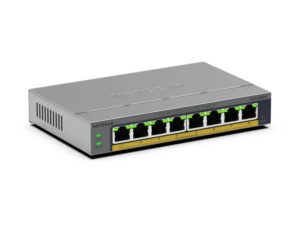
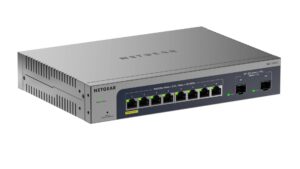
Network Switches with similar specs to the NETGEAR GS105EPP
Ratings & reviews
No reviews yet. Write the first one
The bottom line
The NETGEAR GS105EPP earns a VS Score of 52, above the median of the 19 network switches it is measured against (a score of 50 is level with that median).
- Who it’s for
- A home or small office running up to four PoE+ cameras, phones or access points from one shelf, where each device may pull its full PoE+ allowance and someone wants VLANs for the smart-home gear.
- Who should look elsewhere
- Anyone powering 802.3bt devices or planning a 2.5G access point, since power stops at PoE+ and every port is gigabit. Rack builders should look elsewhere too: it mounts on a desk or a wall only.
- The trade-off that matters
- Full power on every port, but only four powered ports. The fifth device that needs PoE means a bigger switch, because the uplink port supplies none.
- The main alternative
- NETGEAR GS108EPP: the same Easy Smart software and fanless metal case with eight PoE+ ports, for a network that will keep adding cameras.
This page was created with the help of AI. How we work
Latest Network Switches