
Ubiquiti UniFi 5G Max: Specs, Features, Pros & Cons
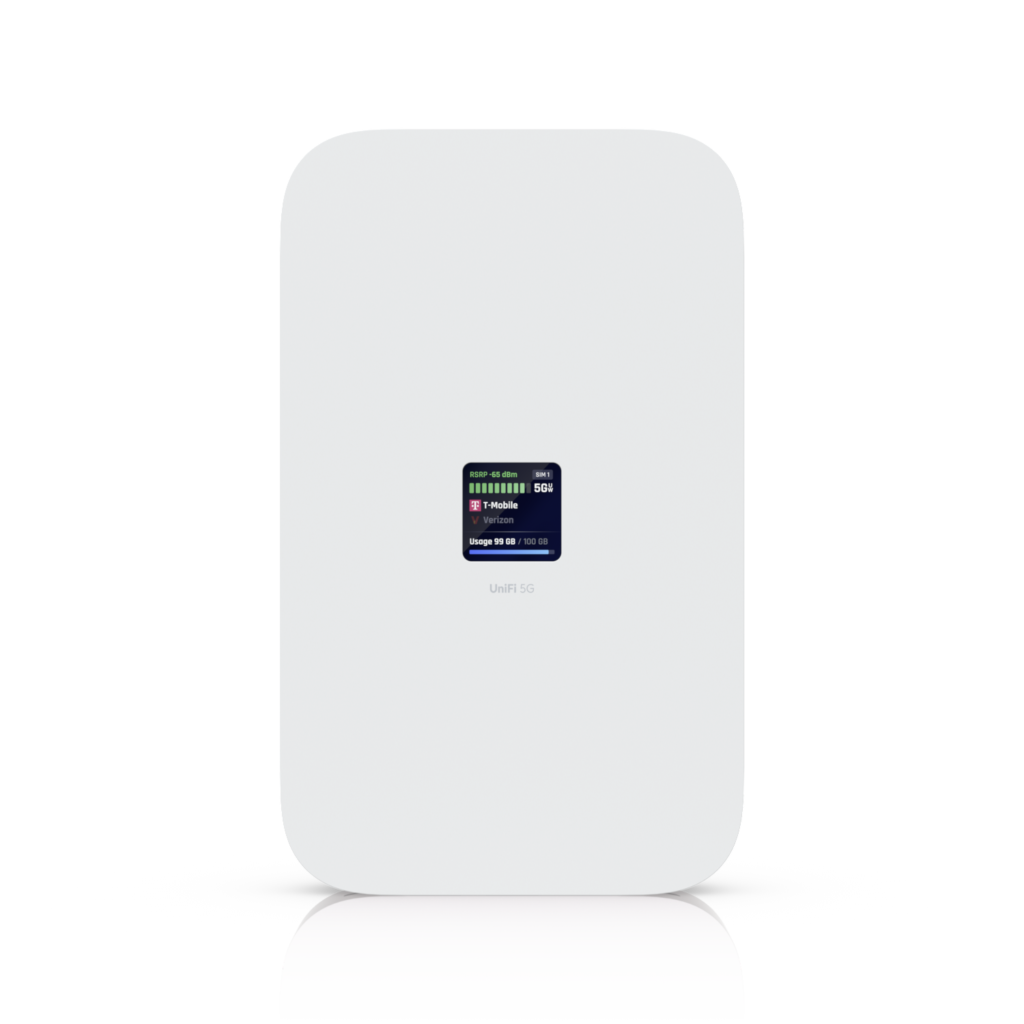
The first thing to say about the UniFi 5G Max is what it is not: it is not a cable modem and not a router. It is Ubiquiti's indoor 5G and LTE cellular modem for UniFi networks, a 180 x 109 x 34 mm slab with four embedded antennas, a 1.3-inch touchscreen and a single 2.5 GbE port that also takes its PoE power. It has no Wi-Fi of its own and does nothing until a UniFi gateway running UniFi Network 10.0.162 or later adopts it, and DOCSIS versions and channel counts do not apply to it.
What it does inside a UniFi network is neat. Plugged into any PoE LAN port it becomes plug-and-play backup internet for every VLAN through a GRE tunnel, taking over when the wired WAN drops. Plugged into a gateway's WAN port through a PoE adapter, it is a primary 5G WAN for load balancing, failover or SD-WAN. The radio supports 5G NR in both standalone and non-standalone modes, LTE and UMTS across 27, 31 and 6 bands respectively, with peak rates of 3.4 Gbps down on 5G NSA, 1.8 Gbps on SA, and 650 Mbps up on SA. The 2.5 GbE port caps what reaches the network. Two SIM slots, one nano-SIM plus a second nano-SIM or eSIM, allow carrier failover, and it is certified with AT&T and T-Mobile, with Verizon named in Ubiquiti's marketing copy but not in its certification list.
It draws up to 14.5 W, ships with desktop, wall and window mounts, is rated for indoor use from 32 to 104 degrees Fahrenheit with IK04 impact resistance and no IP rating, weighs 410 g, and is NDAA compliant. A separate U5G-Max-Outdoor model with directional antennas exists for outdoor mounting.
It is the product for a UniFi site that wants cellular backup or a primary 5G link without a third-party router in the chain. For anyone without a UniFi gateway it is a paperweight with a screen.
Category strengths
Where the Ubiquiti UniFi 5G Max trails the median
- No Built-in Wi-Fi router ?
How this VS Score was computed
Score 54: each known spec is measured against the median of all modems (6 products), then weighted; 50 means level with that median. In classes of six or more, a value beyond the class’s 10th–90th percentile range counts as that limit, so one extreme product cannot set the scale. 46% of the scoreable weight could be used; unknown values, features not applicable to this class and proxies (battery capacity where a rated life exists) add or remove nothing.
| Specification | This product | Cohort median | Score weight | Points moved |
|---|---|---|---|---|
| Multi-gig Ethernet | Yes | 67% of the class have it | 0.8 | +40.0 |
| Built-in Wi-Fi router | No | 67% of the class have it | 0.5 | −24.0 |
| Max download speed | 3,400 — capped at the class’s upper range (2,500) | 2,500 | 2 | +0.0 |
| Ethernet ports | 1 — capped at the class’s lower range (2) | 2 | 0.8 | +0.0 |
| Voice / telephony ports | 0 | 0 | 0.2 | +0.0 |
Not scored: DOCSIS version (unknown: not scored); Max upload speed (too few comparable peers (1, need 3)); Downstream channels (unknown: not scored); Upstream channels (unknown: not scored); Link aggregation (too few comparable peers (1, need 3)); Weight (too few comparable peers (1, need 3)); Fanless (unknown: not scored).
Editor’s note
The 5G Max has exactly one buyer: someone who already runs a UniFi gateway and has lost a day of work to a wired outage. For that person it is the cleanest backup-internet product I know of. A PoE cable into any switch port, adoption in the app and a SIM are the whole setup, and every VLAN in the house fails over without a second router or a manual switch. For anyone else, it is the wrong product, and a cable modem is the wrong comparison.
The data plan is the decision, not the hardware. A backup link that is never used still costs a monthly fee, and a primary 5G WAN needs an unlimited plan that allows hotspot-class use, so check the carrier terms before buying the modem. The dual SIM slot is worth using with two carriers if the site is remote, because that is where 5G coverage is patchy.
The touchscreen shows signal, carrier and data used at a glance, which helps when you are moving the unit around a house looking for the window with the best reception, and the box includes a window mount. It is rated for indoor use only.
The speed figures are radio peaks, and the 2.5 GbE port is the real ceiling. Even on a good T-Mobile or AT&T cell, real throughput will be a fraction of the 5G NSA peak, so nobody should buy it expecting the number on the sheet.
Against a Teltonika RUT956 it is far faster and far simpler, but only inside UniFi, which makes it a UniFi accessory first and a modem second.
Specifications
Quality bars show where each figure sits between the lowest and highest of the 6 modems this VS Score is measured against.
Performance
Connectivity
Features
Design
Networking assessment
What the specification table does not say on its own: what this device needs to connect, what speeds are realistic, what costs extra, and where it falls short. Every statement below is read from the verified sheet or written by an editor — nothing is estimated.
Test environment
Research-based assessment: this brief is derived from the manufacturer’s published specifications for the Ubiquiti UniFi 5G Max and the documents listed under Sources and verification. We have not run this unit on our own network, so nothing here is a measurement of ours.
Connection requirements
Listed provider compatibility: Cellular 5G NR (SA/NSA), LTE and UMTS, not cable. Certified for AT&T and T-Mobile. Dual SIM (nano-SIM + nano-SIM or eSIM).
It is a modem only: a separate router (or mesh system) is required for Wi-Fi.
Throughput expectations
The DOCSIS link is rated for 3,400 Mbps down and 650 Mbps up; your plan speed, not the modem, is the practical ceiling.
Security support
Security-update cadence is not something manufacturers publish as a specification; see Support and updates below.
Known limitations
Not offered, according to the spec sheet: built-in Wi-Fi router, link aggregation.
4 specifications are not published by the manufacturer and are shown as Unknown rather than guessed.
Support and updates
We have not found a published firmware support-lifetime commitment for this model. Update policies differ widely between brands; check the support page linked under Sources and verification before relying on it for a long deployment, and treat a device that has stopped receiving security updates as due for replacement.
Sources and verification
Where the specifications come from
- Official product pagetechspecs.ui.com
Verification
- First published
- Specifications last checked
- Sheet completeness
- 9 of 13 specifications verified; the rest show as Unknown and are never estimated or scored
- Page type
- Product specification page — Compiled from the manufacturer’s published specifications and the cited sources; this is not a hands-on test.
- Basis
- Research-based: specifications and editorial text were compiled from the documents listed here and the manufacturer’s published data. We have not tested this unit ourselves; where independent measurements are mentioned they belong to the linked publication.
Modems with similar specs to the Ubiquiti UniFi 5G Max
Ratings & reviews
No reviews yet. Be the first to share your experience.
The bottom line
The Ubiquiti UniFi 5G Max earns a VS Score of 54, above the median of the 6 modems it is measured against (a score of 50 is level with that median).
- Who it’s for
- UniFi sites that want plug-and-play cellular backup for every VLAN, or a primary 5G WAN with load balancing, without a third-party router in the chain.
- Who should look elsewhere
- Anyone without a UniFi gateway, since it does nothing standalone, and anyone reading it as a cable-modem alternative, because it has no DOCSIS, no Wi-Fi and no routing.
- The trade-off that matters
- The simplest cellular failover for a UniFi network, in exchange for total dependence on UniFi and a 2.5 GbE port that caps its own radio.
- The main alternative
- Teltonika RUT956: an industrial 4G router that works on its own, with Ethernet ports and serial I/O, for sites that can accept LTE-class speeds.
The VS Score is calculated from the weighted specifications above, each measured against the median of comparable modems — a shortlisting guide, not a substitute for your own priorities. See how we score.