
Teltonika RUT956: Specs, Features, Pros & Cons
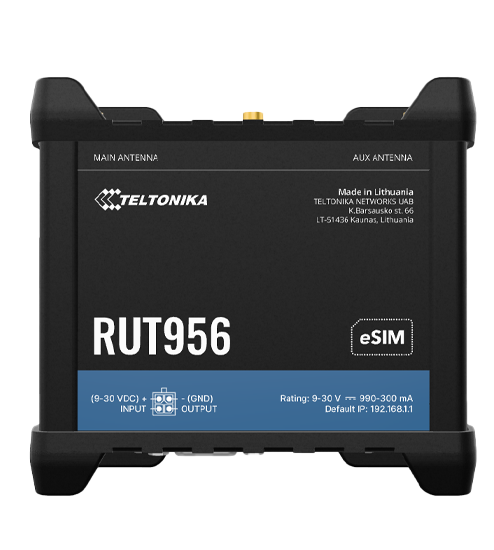
Besides an LTE modem, the RUT956 carries an RS232 port on a DB9 connector, a six-pin RS485 socket, a digital input and a digital output on the power connector, and a GNSS receiver for location and time. Those are the connections a router needs when it lives in a control cabinet talking to meters, controllers and sensors, and Teltonika describes it as a compact industrial 4G router.
The RUT956 is certified for hazardous (classified) locations to UL 121201 and CSA C22.2 No. 213, with testing by SGS, and Teltonika lists IEC 60068 tests for random vibration, shock, bumps and cyclic damp heat. Power comes through a four-pin socket that accepts 9 to 30 V DC, or as passive PoE through the first LAN port, which suits a vehicle, a solar box or a mast better than a wall adapter.
The four RJ45 ports negotiate at 10 or 100 Mbps, so none of them is gigabit, and the Wi-Fi is a single 2.4 GHz 802.11b/g/n radio. The modem is LTE Cat 4 with 3G and 2G fallback, fed by two SIM slots. Teltonika sells an eSIM version as a separate product, so the standard model takes physical SIM cards only.
RutOS, Teltonika's own firmware, carries the industrial protocols the hardware exists for. Modbus, MQTT, DNP3, OPC UA and BACnet sit alongside data-to-server forwarding, VPN, firewall, VLAN and failover settings, and a USB port and an internal microSD slot add storage or extra devices. Teltonika's firmware page lists a stable release dated August 28, 2026.
Category strengths
Where the Teltonika RUT956 beats the median
- More LAN ports ?3 vs 1 (median)
- Has cellular modem ?
- More SIM slots ?2 vs 1 (median)
Where the Teltonika RUT956 trails the median
- No WPA3 ?
- A much lower WAN port speed ?0.1 Gbps vs 2.5 Gbps (median)
- Much less RAM ?128 MB vs 768 MB (median)
- Fewer frequency bands ?1 vs 2 (median)
- No USB-C charging ?
- A much lower processor speed ?0.58 GHz vs 1.65 GHz (median)
- A thicker body ?50 mm vs 35 mm (median)
- A heavier build ?287 g vs 259.5 g (median)
How this VS Score was computed
Score 40: each known spec is measured against the median of all travel routers (4 products), then weighted; 50 means level with that median. In classes of six or more, a value beyond the class’s 10th–90th percentile range counts as that limit, so one extreme product cannot set the scale. 55% of the scoreable weight could be used; unknown values, features not applicable to this class and proxies (battery capacity where a rated life exists) add or remove nothing.
| Specification | This product | Cohort median | Score weight | Points moved |
|---|---|---|---|---|
| Wi-Fi standard | Wi-Fi 4 — held to half its range (class of fewer than six) | Wi-Fi 6E | 2 | −50.0 |
| Cellular modem | Yes — held to half its range (class of fewer than six) | 50% of the class have it | 1.5 | +37.5 |
| Frequency bands | 1 | 2 | 1 | −25.0 |
| WAN port speed | 0.1 — held to half its range (class of fewer than six) | 2.5 | 1 | −25.0 |
| WPA3 | No — held to half its range (class of fewer than six) | 75% of the class have it | 1 | −25.0 |
| Cellular generation | 4G LTE | 4G LTE | 1.5 | +19.5 |
| eSIM | No — held to half its range (class of fewer than six) | 25% of the class have it | 0.7 | −17.5 |
| 6 GHz band | No — held to half its range (class of fewer than six) | 25% of the class have it | 0.7 | −17.5 |
| LAN ports | 3 — held to half its range (class of fewer than six) | 1 | 0.7 | +17.5 |
| RAM | 128 — held to half its range (class of fewer than six) | 768 | 0.7 | −17.5 |
| SIM slots | 2 — held to half its range (class of fewer than six) | 1 | 0.5 | +12.5 |
| Multi-gig LAN | No — held to half its range (class of fewer than six) | 25% of the class have it | 0.5 | −12.5 |
| USB-C charging | No — held to half its range (class of fewer than six) | 75% of the class have it | 0.5 | −12.5 |
| Display | No — held to half its range (class of fewer than six) | 25% of the class have it | 0.4 | −10.0 |
| Processor speed | 0.58 — held to half its range (class of fewer than six) | 1.65 | 0.3 | −7.5 |
| Weight | 287 | 259.5 | 1 | −5.0 |
| Thickness | 50 | 35 | 0.3 | −4.5 |
| USB ports | 1 | 1 | 0.3 | +0.0 |
| Antennas | 2 | 2 | 0.3 | +0.0 |
Not scored: Max cellular download (too few comparable peers (2, need 3)); Max wireless speed (unknown: not scored); Beamforming (unknown: not scored); Max connected devices (too few comparable peers (2, need 3)); Repeater mode (unknown: not scored); Battery capacity (unknown: not scored); Battery life (unknown: not scored); Works while charging (unknown: not scored); Processor cores (unknown: not scored); VPN client (standard for the class (100% have it)); VPN server (standard for the class (100% have it)); Guest network (unknown: not scored); Parental controls (unknown: not scored); Quality of Service (QoS) (standard for the class (100% have it)); App control (unknown: not scored).
Editor’s note
Buying industrial hardware for a domestic problem is a common mistake, so the first question is whether you need what the RUT956 is. If your requirement is internet in a place with no wired line, a consumer LTE router will serve you better. What the RUT956 adds is environmental tolerance, dual-SIM failover, serial and I/O interfaces, and a long support life, none of which show up as speed.
If you do need those things, this is a well-judged piece of kit. Dual SIM with automatic switching on signal loss, data limit or carrier denial is the feature I would choose it for. A single-SIM router in a remote installation is one carrier outage away from a site visit.
The modem class is the honest weak point. A hundred and fifty megabits down is fine for telemetry, card payments and remote access, and it is not fine as a primary office connection for a team sharing video calls and cloud backups. For a cabinet that reports a few readings a minute, that ceiling will never come into view.
Specifications
Quality bars show where each figure sits between the lowest and highest of the 4 travel routers this VS Score is measured against.
Cellular
Wireless
Ports & wired
Battery
Hardware
Features & security
Design
Networking assessment
What the specification table does not say on its own: what this device needs to connect, what speeds are realistic, what costs extra, and where it falls short. Every statement below is read from the verified sheet or written by an editor — nothing is estimated.
Test environment
Research-based assessment: this brief is derived from the manufacturer’s published specifications for the Teltonika RUT956 and the documents listed under Sources and verification. We have not run this unit on our own network, so nothing here is a measurement of ours.
Connection requirements
The WAN (internet) port is rated at 0.1 Gbps. An internet plan faster than that is capped at the router, and nothing on the network can download faster than this port regardless of the wireless figures.
It has a built-in 4G LTE cellular modem, so it needs a SIM or eSIM data plan for use away from a wired or Wi-Fi source.
There are 3 LAN ports, all Gigabit; a switch is needed for more wired devices.
Throughput expectations
It is a Wi-Fi 4 device; real-world speeds run well below the theoretical link rate even in the same room.
There is no 6 GHz band, so the least congested spectrum available to new phones and laptops is not on offer here.
Firmware and subscriptions
VPN support is built in, which avoids a subscription to a third-party VPN router service for remote access.
Security support
WPA3 is not listed, so WPA2 is the strongest encryption on offer — adequate today, but a shorter runway than a WPA3 device.
Security-update cadence is not something manufacturers publish as a specification; see Support and updates below.
Real-world household suitability
Rated for 100 connected devices — a marketing figure, but a useful indication of whether a home full of smart plugs, cameras and phones is within its design.
Known limitations
Not offered, according to the spec sheet: wPA3, eSIM, 6 GHz band, multi-gig LAN.
10 specifications are not published by the manufacturer and are shown as Unknown rather than guessed.
Support and updates
We have not found a published firmware support-lifetime commitment for this model. Update policies differ widely between brands; check the support page linked under Sources and verification before relying on it for a long deployment, and treat a device that has stopped receiving security updates as due for replacement.
Sources and verification
Where the specifications come from
- Official product pageteltonika-networks.com
- Datasheet or manualwiki.teltonika-networks.com
- Support and firmware documentationwiki.teltonika-networks.com
- Retailer listing (cross-check)amazon.com
Verification
- First published
- Specifications last checked
- Sheet completeness
- 24 of 34 specifications verified; the rest show as Unknown and are never estimated or scored
- Page type
- Product specification page — Compiled from the manufacturer’s published specifications and the cited sources; this is not a hands-on test.
- Basis
- Research-based: specifications and editorial text were compiled from the documents listed here and the manufacturer’s published data. We have not tested this unit ourselves; where independent measurements are mentioned they belong to the linked publication.
Travel Routers with similar specs to the Teltonika RUT956
Ratings & reviews
No reviews yet. Be the first to share your experience.
The bottom line
The Teltonika RUT956 earns a VS Score of 40, below the median of the 4 travel routers it is measured against (a score of 50 is level with that median).
- Who it’s for
- Someone connecting remote equipment (telemetry, payment terminals, monitoring cameras) who needs dual-SIM failover, serial interfaces and a device rated to survive an unheated cabinet.
- Who should look elsewhere
- Anyone wanting mobile internet for a home, an office or a trip. The Wi-Fi and the wired ports are a generation old on purpose, and the ruggedness and serial ports would go unused.
- The trade-off that matters
- Every performance number here was traded away for durability and protocol support. That is the right trade for a site you rarely visit and the wrong one for anywhere you can easily reach.
- The main alternative
- Teltonika RUT361: the same industrial build with a Cat 6 modem, worth choosing instead when throughput matters more than the serial ports.
The VS Score is calculated from the weighted specifications above, each measured against the median of comparable travel routers — a shortlisting guide, not a substitute for your own priorities. See how we score.