
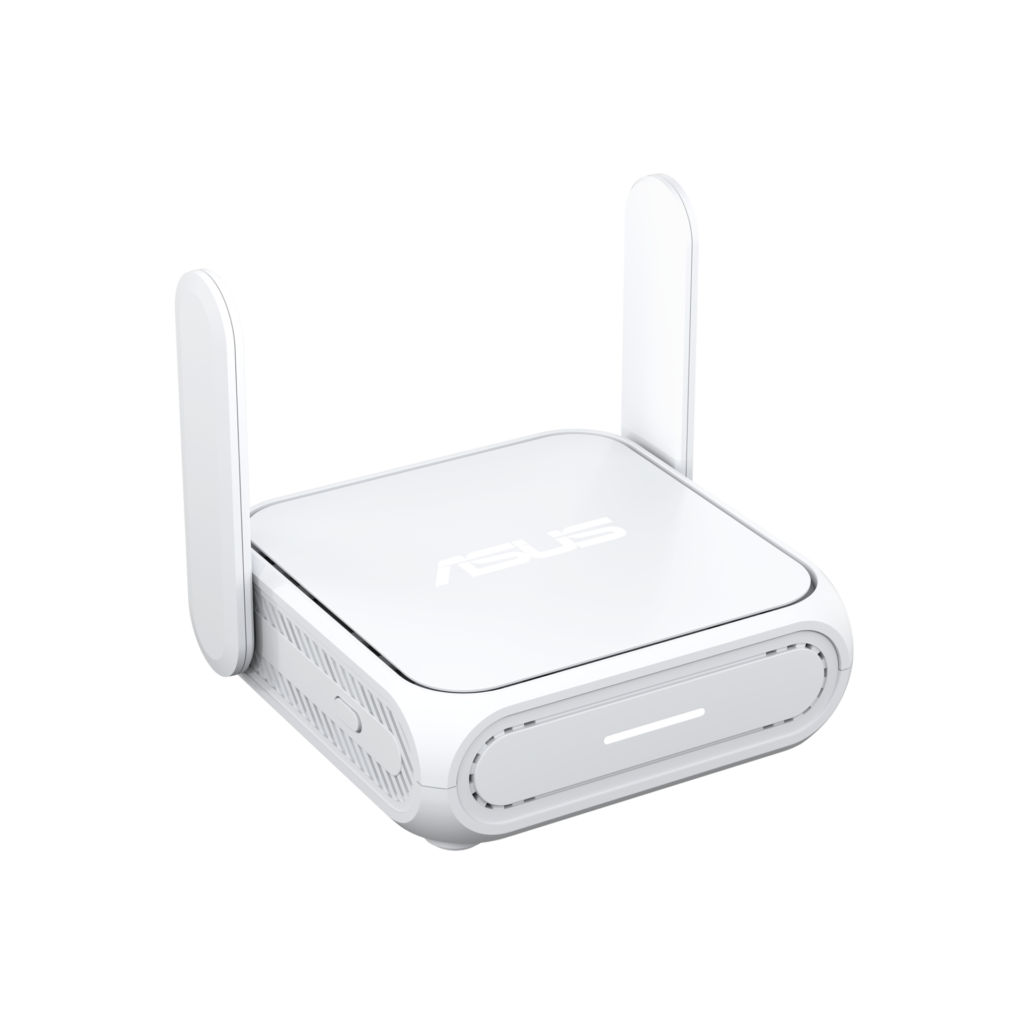
ASUS RT-BE58 Go: Specs, Features, Pros & Cons
Power for the RT-BE58 Go comes over USB-C Power Delivery, and ASUS lists exactly two supply ratings for it: 12 V at 2 A and 9 V at 2 A. A PD power bank or a car charger can run it, a plain 5 V phone charger is not on that list, and that detail decides where it can sit in a hotel room or a van.
It is a dual-band Wi-Fi 7 travel router of the BE3600 class, with 2,882 Mbps on 5 GHz and 688 Mbps on 2.4 GHz, two streams on each, 160 MHz channels and Multi-Link Operation across the pair. There is no 6 GHz radio. The case weighs 232 g and the two antennas fold down for a bag.
A 2.5 Gbps WAN port takes a wired room connection, Public WiFi mode joins a hotel network and re-serves it under your own network name, and the USB-A port accepts a tethered 4G or 5G phone or a USB modem. Dual WAN is on the list as well, so a wired line and a tethered phone can back each other up. The single LAN port runs at gigabit. A slide switch flips between network settings without opening the app.
ASUS rates its own VPN throughput at up to 300 Mbps over WireGuard and 150 Mbps over OpenVPN, tested in client mode on a local network. Once a tunnel is running, that rating, not the wired port, sets the ceiling.
The firmware is full ASUSWRT, the same interface as ASUS's home routers: AiProtection Classic with two-way IPS, Guest Network Pro with VLANs and a dedicated VPN network, DNS-over-TLS, and AdGuard DNS filtering under Safe Browsing.
Category strengths
Where the ASUS RT-BE58 Go beats the median
- More RAM ?1,024 MB vs 768 MB (median)
- A lighter build ?232 g vs 259.5 g (median)
- A higher processor speed ?2 GHz vs 1.65 GHz (median)
Where the ASUS RT-BE58 Go trails the median
- No cellular modem ?
- Fewer SIM slots ?0 vs 1 (median)
- A slightly thicker body ?36 mm vs 35 mm (median)
How this VS Score was computed
Score 48: each known spec is measured against the median of all travel routers (4 products), then weighted; 50 means level with that median. In classes of six or more, a value beyond the class’s 10th–90th percentile range counts as that limit, so one extreme product cannot set the scale. 63% of the scoreable weight could be used; unknown values, features not applicable to this class and proxies (battery capacity where a rated life exists) add or remove nothing.
| Specification | This product | Cohort median | Score weight | Points moved |
|---|---|---|---|---|
| Cellular modem | No — held to half its range (class of fewer than six) | 50% of the class have it | 1.5 | −37.5 |
| Wi-Fi standard | Wi-Fi 7 | Wi-Fi 6E | 2 | +26.0 |
| WPA3 | Yes — held to half its range (class of fewer than six) | 75% of the class have it | 1 | +25.0 |
| Cellular generation | None | 4G LTE | 1.5 | −18.0 |
| eSIM | No — held to half its range (class of fewer than six) | 25% of the class have it | 0.7 | −17.5 |
| 6 GHz band | No — held to half its range (class of fewer than six) | 25% of the class have it | 0.7 | −17.5 |
| SIM slots | 0 — held to half its range (class of fewer than six) | 1 | 0.5 | −12.5 |
| Multi-gig LAN | No — held to half its range (class of fewer than six) | 25% of the class have it | 0.5 | −12.5 |
| USB-C charging | Yes — held to half its range (class of fewer than six) | 75% of the class have it | 0.5 | +12.5 |
| RAM | 1,024 | 768 | 0.7 | +11.9 |
| Display | No — held to half its range (class of fewer than six) | 25% of the class have it | 0.4 | −10.0 |
| Weight | 232 | 259.5 | 1 | +6.0 |
| Processor speed | 2 | 1.65 | 0.3 | +3.3 |
| Thickness | 36 | 35 | 0.3 | −0.3 |
| Max wireless speed | 3,570 | 3,570 | 1.5 | +0.0 |
| Frequency bands | 2 | 2 | 1 | +0.0 |
| WAN port speed | 2.5 | 2.5 | 1 | +0.0 |
| LAN ports | 1 | 1 | 0.7 | +0.0 |
| USB ports | 1 | 1 | 0.3 | +0.0 |
| Processor cores | 4 | 4 | 0.5 | +0.0 |
| Antennas | 2 | 2 | 0.3 | +0.0 |
Not scored: Max cellular download (unknown: not scored); Beamforming (unknown: not scored); Max connected devices (unknown: not scored); Repeater mode (standard for the class (100% have it)); Battery capacity (unknown: not scored); Battery life (unknown: not scored); Works while charging (unknown: not scored); VPN client (standard for the class (100% have it)); VPN server (standard for the class (100% have it)); Guest network (unknown: not scored); Parental controls (standard for the class (100% have it)); Quality of Service (QoS) (standard for the class (100% have it)); App control (standard for the class (100% have it)).
Editor’s note
The way to judge the RT-BE58 Go is to decide first whether you want a travel router or a hotspot, because ASUS has built the former with no pretense of being the latter. There is no SIM slot and no battery. If your plan is to sit in a field with a data SIM, stop here.
If your plan is hotel rooms, rented apartments and conference venues, this is one of the more serious options on sale. The desktop-class silicon means the VPN does not fall over: a WireGuard tunnel back to a home ASUS router, or to a commercial provider, will run at speeds a phone can use. VPN Fusion lets some devices go through the tunnel and others straight out, which is exactly the setup a work laptop and a streaming stick want.
The multi-gig WAN port is slightly absurd on a travel router and I like it anyway, because it means the box is not the bottleneck when a rental has a fast wired connection. The USB-A phone-tethering port turns a phone's data plan into the backup line when a venue's connection fails, which is as close to a hotspot as this box gets.
Specifications
Quality bars show where each figure sits between the lowest and highest of the 4 travel routers this VS Score is measured against.
Cellular
Wireless
Ports & wired
Battery
Hardware
Features & security
Design
Networking assessment
What the specification table does not say on its own: what this device needs to connect, what speeds are realistic, what costs extra, and where it falls short. Every statement below is read from the verified sheet or written by an editor — nothing is estimated.
Test environment
Research-based assessment: this brief is derived from the manufacturer’s published specifications for the ASUS RT-BE58 Go and the documents listed under Sources and verification. We have not run this unit on our own network, so nothing here is a measurement of ours.
Connection requirements
The WAN (internet) port is rated at 2.5 Gbps. An internet plan faster than that is capped at the router, and nothing on the network can download faster than this port regardless of the wireless figures.
No cellular modem: it shares an existing connection (hotel Ethernet, public Wi-Fi in repeater mode, or a phone over USB) rather than providing one.
There are 1 LAN ports, all Gigabit; a switch is needed for more wired devices.
Throughput expectations
The Wi-Fi 7 headline of 3,570 Mbps adds together the theoretical peak of every band. A single device connects to one band at a time, so no client ever sees the total, and real-world speeds run well below the link rate even in the same room.
There is no 6 GHz band, so the least congested spectrum available to new phones and laptops is not on offer here.
Firmware and subscriptions
Set-up and management run through the manufacturer’s app; check whether a local web interface is offered as well.
Parental controls are listed; on several brands the scheduling and filtering tiers sit behind the same subscription as the security suite.
VPN support is built in, which avoids a subscription to a third-party VPN router service for remote access.
Security support
WPA3 is supported, the current Wi-Fi encryption standard; devices that only speak WPA2 still connect in mixed mode.
Security-update cadence is not something manufacturers publish as a specification; see Support and updates below.
Known limitations
Not offered, according to the spec sheet: cellular modem, eSIM, 6 GHz band, multi-gig LAN.
7 specifications are not published by the manufacturer and are shown as Unknown rather than guessed.
Support and updates
We have not found a published firmware support-lifetime commitment for this model. Update policies differ widely between brands; check the support page linked under Sources and verification before relying on it for a long deployment, and treat a device that has stopped receiving security updates as due for replacement.
Sources and verification
Where the specifications come from
- Official product pageasus.com
- Datasheet or manualdlcdnets.asus.com
Verification
- First published
- Specifications last checked
- Sheet completeness
- 27 of 34 specifications verified; the rest show as Unknown and are never estimated or scored
- Page type
- Product specification page — Compiled from the manufacturer’s published specifications and the cited sources; this is not a hands-on test.
- Basis
- Research-based: specifications and editorial text were compiled from the documents listed here and the manufacturer’s published data. We have not tested this unit ourselves; where independent measurements are mentioned they belong to the linked publication.
Travel Routers with similar specs to the ASUS RT-BE58 Go
Ratings & reviews
No reviews yet. Be the first to share your experience.
The bottom line
The ASUS RT-BE58 Go earns a VS Score of 48, below the median of the 4 travel routers it is measured against (a score of 50 is level with that median).
- Who it’s for
- A frequent traveler with a laptop, tablet and streaming stick who wants every hotel room to behave like home, runs a VPN that has to perform, and ideally already has an ASUS router to pair with over AiMesh and Instant Guard.
- Who should look elsewhere
- Anyone who needs a SIM slot or battery life (there is neither), and anyone who wanted a hotspot for a car, a campsite or a place with no wall power.
- The trade-off that matters
- You get desktop-router silicon and a multi-gig port in a pocket-sized box because ASUS left out the battery and the modem. That is the right call for hotel use and the wrong one for anything off-grid.
- The main alternative
- GL.iNet Slate 7 (GL-BE3600): a Wi-Fi 7 travel router in the same class with a touchscreen and GL.iNet's OpenWrt-based firmware, for buyers who prefer open software or do not run ASUS at home.
The VS Score is calculated from the weighted specifications above, each measured against the median of comparable travel routers — a shortlisting guide, not a substitute for your own priorities. See how we score.