Ubiquiti USW Pro XG 8 PoE: Specs, Price, Pros & Cons
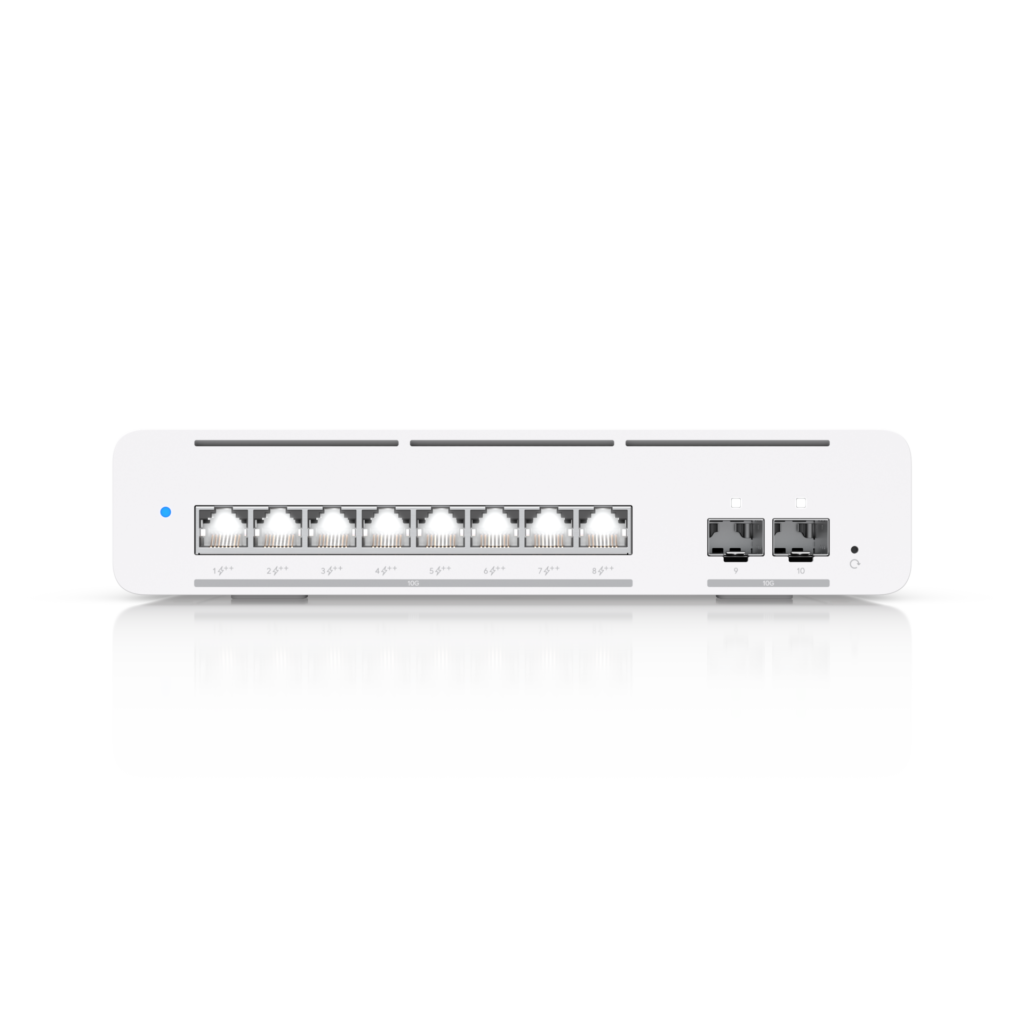
All eight copper ports on the UniFi Pro XG 8 PoE run at up to 10 Gigabit, and all eight can deliver PoE++ power. Ubiquiti builds it as a compact switch for a desk or a wall, 8.28 inches wide. Two SFP+ cages take 10G or 1G modules, so the uplink can be a DAC cable or a fiber run to another room.
The copper ports also link at 5G and 2.5G, which covers access points and NAS boxes whose ports stop short of 10 Gigabit. Ubiquiti rates the non-blocking throughput at 100 Gbps, all ten ports at full speed added up. The 200 Gbps switching capacity counts the same traffic in both directions. So every port can run flat out at the same moment.
Power comes from an external 210 W adapter that ships in the box. The case is steel on a polycarbonate mount, and Ubiquiti gives the form factor as compact desktop or wall, with no rack option listed. Ubiquiti's spec page lists no fan or noise figure, so its documents don't settle how loud the switch runs on a desk.
Setup and management go through UniFi Network, version 9.0.114 or later, so an older UniFi console needs an update before it can adopt the switch. The feature list covers up to 1,000 VLANs, 802.1X port control, storm control, port mirroring and LLDP-MED with a voice VLAN for desk phones. Etherlighting, Ubiquiti's lit-port feature, covers both the RJ45 and the SFP+ ports. The switch is also listed as NDAA compliant, a requirement for many US federal purchases.
Category strengths
Where the Ubiquiti USW Pro XG 8 PoE beats the median
- A much higher switching capacity ?200 Gbps vs 44 Gbps (median)
- A much higher forwarding rate ?149 Mpps vs 35.7 Mpps (median)
- More PoE ports ?8 vs 4 (median)
- More 10G ports ?8 vs 0 (median)
- More SFP/SFP+ ports ?2 vs 0 (median)
- Has link aggregation ?
- Has cloud management ?
- A higher PoE budget ?155 W vs 135 W (median)
Where the Ubiquiti USW Pro XG 8 PoE trails the median
- A much higher power consumption ?61 W vs 26.5 W (median)
How this VS Score was computed
Score 74: each known spec is measured against the median of all network switches (19 products), then weighted. 92% of the scoreable weight could be used. See how we score
| Specification | This product | Cohort median | Score weight | Points moved |
|---|---|---|---|---|
| Switching capacity | 200 — capped at the class’s upper range (160) | 44 | 1.5 | +75.0 |
| PoE ports | 8 | 4 | 1.2 | +60.0 |
| 10G ports | 8 | 0 | 0.8 | +40.0 |
| Forwarding rate | 149 — capped at the class’s upper range (119.04) | 35.7 | 0.8 | +40.0 |
| VLAN support | Yes | 53% of the class have it | 0.8 | +40.0 |
| SFP/SFP+ ports | 2 | 0 | 0.5 | +25.0 |
| Management level | Fully managed | Smart managed | 1 | +25.0 |
| Link aggregation | Yes | 47% of the class have it | 0.5 | +25.0 |
| Quality of Service (QoS) | Yes | 53% of the class have it | 0.5 | +25.0 |
| Cloud management | Yes | 44% of the class have it | 0.4 | +20.0 |
| IGMP snooping | Yes | 53% of the class have it | 0.3 | +15.0 |
| Rack-mountable | No | 37% of the class have it | 0.3 | −14.4 |
| Power consumption | 61 | 26.5 | 0.5 | −14.0 |
| PoE standard | PoE++ (802.3bt) | PoE+ (802.3at) | 0.8 | +13.6 |
| PoE budget | 155 | 135 | 1.2 | +8.4 |
| Total ports | 10 | 10 | 2 | +0.0 |
| Gigabit ports | 0 | 0 | 1.5 | +0.0 |
| 2.5G ports | 0 | 0 | 1 | +0.0 |
| MAC address table | 32 — capped at the class’s upper range (16) | 16 | 0.3 | +0.0 |
Not scored: Jumbo frame support (standard for the class (100% have it)); Fanless (unknown: not scored); Metal housing (standard for the class (88% have it)).
Editor’s note
With 155 W to share, the Pro XG 8 PoE can run two 60 W PoE++ devices and still have 35 W left for a third, smaller one. Eight ports at their full rating would need 480 W. The per-port figure describes what one port can do, and the total decides how many demanding access points or PTZ cameras the switch can carry.
The switch draws up to 61 W itself before any PoE. It weighs 3.5 lb and is rated for rooms up to 113 degrees Fahrenheit. On a desk or a wall that heat has to go somewhere, so an open shelf suits it better than a closed cabinet.
Inter-VLAN routing, static routes and a DHCP server run on the switch itself. A NAS on a storage VLAN and editing machines on a workstation VLAN can then exchange files at 10G without a round trip through the gateway. A Layer 2 switch such as the USW Aggregation forces that trip. Ubiquiti also lists Pro AV profiles for Dante, Q-SYS, NDI, AES67 and others, which saves an AV installer hand-tuning multicast and QoS.
Every RJ45 port here negotiates down to 100 Mbps, so older gear still works. A desk of 2.5G clients, though, gets nothing from it that Ubiquiti's USW Flex 2.5G 8 PoE would not give. The Flex can also run on PoE power from its own uplink.
Specifications
Ports
Power over Ethernet
Performance
Management
Design & power
Networking assessment
Connection requirements
Management level: Fully managed. Expect a web interface or cloud dashboard to configure it, which is where VLANs, link aggregation and QoS are set up.
Ports: 10 in total, of which an unspecified number are Gigabit and 8 are 10 Gigabit.
PoE budget is 155 W shared across the powered ports — add up the draw of the cameras, phones and access points you intend to hang off it before assuming they all fit.
Throughput expectations
Switching capacity is 200 Gbps, enough for every port to run flat out at once — the usual case for a home or small-office switch.
Jumbo frames are supported, which helps large file transfers between NAS and desktop.
Firmware and subscriptions
Set-up and day-to-day management run through the manufacturer’s cloud service, so that account’s availability and privacy terms are part of the product.
Security support
VLAN support allows work, IoT and guest traffic to be separated on the wired side.
Security-update cadence is not something manufacturers publish as a specification; see Support and updates below.
Known limitations
Not offered, according to the spec sheet: rack-mountable.
One specification is not published by the manufacturer and is shown as Unknown rather than guessed.
Support and updates
We have not found a published firmware support-lifetime commitment for this model. Update policies differ widely between brands; check the support page linked under Sources and verification before relying on it for a long deployment, and treat a device that has stopped receiving security updates as due for replacement.
Sources and verification
Where the specifications come from
- Official product pagetechspecs.ui.com
Verification
- First published
- Specifications last checked
- Sheet completeness
- 21 of 22 specifications verified; the rest show as Unknown and are never estimated or scored
- Page type
- Product specification page — Compiled from the manufacturer’s published specifications and the cited sources; this is not a hands-on test.
- Basis
- Research-based: specifications and editorial text were compiled from the documents listed here and the manufacturer’s published data. We have not tested this unit ourselves; where independent measurements are mentioned they belong to the linked publication.
Where to buy
Prices and availability may change. Check the retailer before buying. We may earn a commission on purchases.
Price history
Network Switches with similar specs to the Ubiquiti USW Pro XG 8 PoE

Ratings & reviews
No reviews yet. Write the first one
The bottom line
The Ubiquiti USW Pro XG 8 PoE earns a VS Score of 74, above the median of the 19 network switches it is measured against (a score of 50 is level with that median).
- Who it’s for
- A UniFi studio or small office with a few 10G-capable devices, such as Wi-Fi 7 access points, a NAS and editing workstations, that should be powered and switched from one compact unit on a desk or wall.
- Who should look elsewhere
- Networks without a UniFi controller, and anyone whose devices top out at 2.5G or gigabit, since every RJ45 port here is built for 10G.
- The trade-off that matters
- It routes between VLANs at 10G on the switch itself, but only inside UniFi: every Layer 3 setting is made in UniFi Network and nowhere else.
- The main alternative
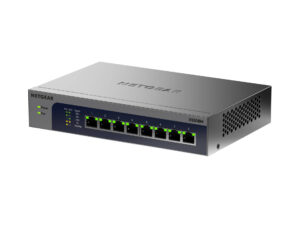
- NETGEAR XS508Mv2: eight 10G RJ45 ports with nothing to configure, for a 10G desk that needs neither PoE nor UniFi.
This page was created with the help of AI. How we work
Latest Network Switches