
Ubiquiti UniFi Travel Router Long-Range: Specs, Pros & Cons
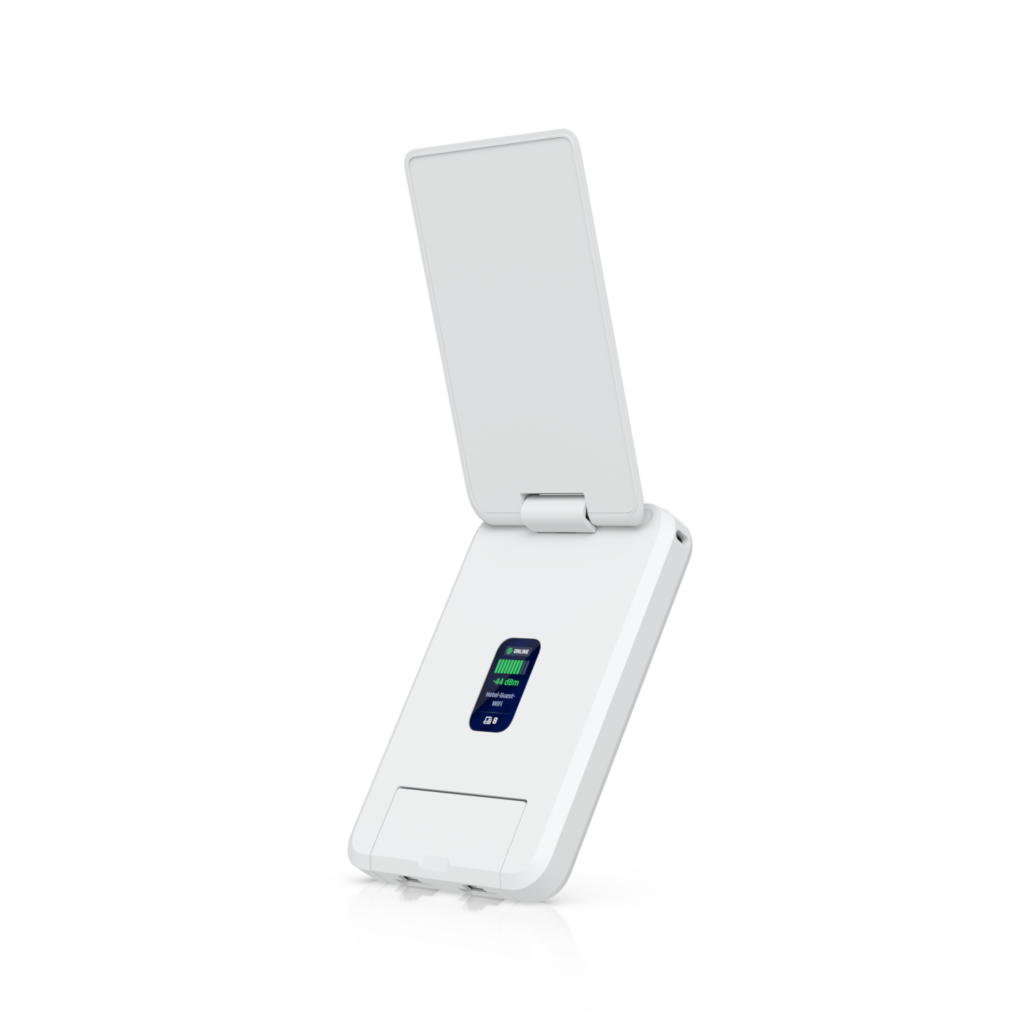
The Long-Range version of UniFi's Travel Router is the standard model with a fold-up antenna panel and a far stronger transmitter. Ubiquiti lists its maximum transmit power at 20 dBm on 2.4 GHz and 23 dBm on 5 GHz, against 13 dBm and 15 dBm for the plain Travel Router. Seven to eight decibels is roughly five to six times the power, and the panel adds bulk to match: 19.5 mm thick and 126 g, where the standard unit is 12.5 mm and 89 g.
The radio itself is unchanged, dual-band Wi-Fi 5 with two streams, rated up to 866.7 Mbps on the upper band and 300 Mbps on the lower one. That puts it a generation or two behind the GL.iNet Beryl AX and the ASUS RT-BE58 Go, and the extra transmit power buys reach, never speed.
Internet can come in three ways: by joining an existing Wi-Fi network, through the WAN port under the flip-up cover, or from a phone over USB tethering on iOS or Android. The same cover hides a LAN port for a wired laptop or a streaming stick's adapter. The router works in stand-alone mode with no UniFi account, and its VPN clients cover WireGuard and OpenVPN.
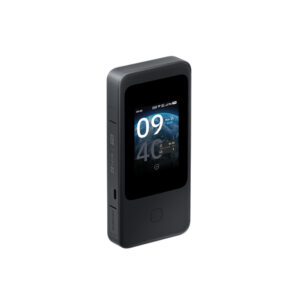
Power comes over USB-C at 5 V and 2 A, with no adapter in the box and no battery inside, so it runs from a wall charger or a power bank. Ubiquiti puts its maximum draw at 5 W, so a 10,000 mAh power bank, about 37 Wh, covers roughly seven hours even at that full draw, before conversion losses. A 1.14-inch status screen sits on the front, and management runs over Bluetooth from the UniFi app.
Category strengths
Where the Ubiquiti UniFi Travel Router Long-Range beats the median
- A much lighter build ?126 g vs 232 g (median)
- Has display ?
- A slimmer body ?19.5 mm vs 34 mm (median)
Where the Ubiquiti UniFi Travel Router Long-Range trails the median
- A much lower max wireless speed ?1,167 Mbps vs 3,273 Mbps (median)
- A much lower WAN port speed ?1 Gbps vs 2.5 Gbps (median)
How this VS Score was computed
Score 42: each known spec is measured against the median of all travel routers (5 products), then weighted. 46% of the scoreable weight could be used. See how we score
| Specification | This product | Cohort median | Score weight | Points moved |
|---|---|---|---|---|
| Cellular modem | No — held to half its range (fewer than six products in this class list it) | 40% of the class have it | 1.5 | −37.5 |
| Max wireless speed | 1,167 — held to half its range (fewer than six products in this class list it) | 3,273 | 1.5 | −37.5 |
| WAN port speed | 1 — held to half its range (fewer than six products in this class list it) | 2.5 | 1 | −25.0 |
| Weight | 126 — held to half its range (fewer than six products in this class list it) | 232 | 1 | +25.0 |
| Wi-Fi standard | Wi-Fi 5 | Wi-Fi 6 | 2 | −24.0 |
| eSIM | No — held to half its range (fewer than six products in this class list it) | 25% of the class have it | 0.7 | −17.5 |
| Display | Yes — held to half its range (fewer than six products in this class list it) | 40% of the class have it | 0.4 | +10.0 |
| Thickness | 19.5 — held to half its range (fewer than six products in this class list it) | 34 | 0.3 | +7.5 |
| Cellular generation | None | None | 1.5 | +0.0 |
| SIM slots | 0 | 0 | 0.5 | +0.0 |
| Frequency bands | 2 | 2 | 1 | +0.0 |
| LAN ports | 1 | 1 | 0.7 | +0.0 |
| USB ports | 1 | 1 | 0.3 | +0.0 |
Not scored: Max cellular download (unknown: not scored); 6 GHz band (not applicable: only 20% of this class have it); Beamforming (unknown: not scored); Max connected devices (unknown: not scored); Repeater mode (standard for the class (100% have it)); Multi-gig LAN (not applicable: only 20% of this class have it); Battery capacity (unknown: not scored); Battery life (unknown: not scored); USB-C charging (standard for the class (80% have it)); Works while charging (unknown: not scored); Processor cores (unknown: not scored); Processor speed (unknown: not scored); RAM (unknown: not scored); WPA3 (unknown: not scored); VPN client (standard for the class (100% have it)); VPN server (unknown: not scored); Guest network (unknown: not scored); Parental controls (unknown: not scored); Quality of Service (QoS) (unknown: not scored); App control (standard for the class (100% have it)).
Editor’s note
This is built for one specific traveler: the person who already runs UniFi at home and keeps ending up in rooms where the hotel access point is two floors away. Site Binding is the feature that earns its keep. Your home SSID, password and policies follow you, so laptops, phones and work devices connect exactly as they do at home, with the tunnel back to your own network already configured.
The antenna is the reason to choose this over the standard Travel Router, and it works by being aimed. Fold the panel up and point it at the source. Left flat on a desk, it gives away its one advantage. The panel also makes the router noticeably thicker, so if it lives in a laptop sleeve the plain model may suit you better.
Two things to plan for. There is no cellular radio, so this is not a hotspot: the internet still has to come from somewhere, whether that is the hotel's Ethernet port, its Wi-Fi or a phone on USB tethering. The other is heat. Ubiquiti rates it for 14 to 104 degrees Fahrenheit, so a car dashboard in summer is outside its range.
Specifications
Cellular
Wireless
Ports & wired
Battery
Hardware
Features & security
Design
Networking assessment
Connection requirements
The WAN (internet) port is rated at 1 Gbps. An internet plan faster than that is capped at the router, and nothing on the network can download faster than this port regardless of the wireless figures.
No cellular modem: it shares an existing connection (hotel Ethernet, public Wi-Fi in repeater mode, or a phone over USB) rather than providing one.
There are 1 LAN ports, all Gigabit; a switch is needed for more wired devices.
Throughput expectations
The Wi-Fi 5 headline of 1,167 Mbps adds together the theoretical peak of every band. A single device connects to one band at a time, so no client ever sees the total, and real-world speeds run well below the link rate even in the same room.
There is no 6 GHz band, so the least congested spectrum available to new phones and laptops is not on offer here.
Firmware and subscriptions
Set-up and management run through the manufacturer’s app; check whether a local web interface is offered as well.
VPN support is built in, which avoids a subscription to a third-party VPN router service for remote access.
Security support
Security-update cadence is not something manufacturers publish as a specification; see Support and updates below.
Known limitations
Not offered, according to the spec sheet: cellular modem, eSIM, 6 GHz band, multi-gig LAN.
15 specifications are not published by the manufacturer and are shown as Unknown rather than guessed.
Support and updates
We have not found a published firmware support-lifetime commitment for this model. Update policies differ widely between brands; check the support page linked under Sources and verification before relying on it for a long deployment, and treat a device that has stopped receiving security updates as due for replacement.
Sources and verification
Where the specifications come from
- Official product pagestore.ui.com
Verification
- First published
- Specifications last checked
- Sheet completeness
- 19 of 34 specifications verified; the rest show as Unknown and are never estimated or scored
- Page type
- Product specification page — Compiled from the manufacturer’s published specifications and the cited sources; this is not a hands-on test.
- Basis
- Research-based: specifications and editorial text were compiled from the documents listed here and the manufacturer’s published data. We have not tested this unit ourselves; where independent measurements are mentioned they belong to the linked publication.
Travel Routers with similar specs to the Ubiquiti UniFi Travel Router Long-Range
Ratings & reviews
No reviews yet. Write the first one
The bottom line
The Ubiquiti UniFi Travel Router Long-Range earns a VS Score of 42, below the median of the 5 travel routers it is measured against (a score of 50 is level with that median).
- Who it’s for
- UniFi households that travel and want their home SSID, policies and VPN to follow them, with a flip-up antenna for rooms where the access point is far away.
- Who should look elsewhere
- Anyone who needs a SIM or eSIM inside the router, or who wants Wi-Fi 6 or 7 speeds, since this is dual-band Wi-Fi 5 with no cellular radio and no battery.
- The trade-off that matters
- Much stronger reach than the standard Travel Router, paid for in thickness and weight, on a Wi-Fi 5 radio set Ubiquiti has not modernized.
- The main alternative
- GL.iNet Mudi 7 (GL-E5800): for when the internet has to come from the router itself, with 5G, eSIM and dual SIM, a battery and Wi-Fi 7.
This page was created with the help of AI. How we work