Ubiquiti UniFi Dream Router 5G Max: Specs, Pros & Cons
The UniFi Dream Router 5G Max puts a 5G modem inside a Dream Router, and Ubiquiti attaches conditions to it on its own store page. The router is certified with AT&T and T-Mobile, a data-only plan is required, T-Mobile Home Internet SIMs are not supported, and Verizon is listed as not supported at this time. SIM choice is two nano-SIMs, or one nano-SIM plus an eSIM, since the second nano-SIM slot cannot be used while the eSIM is active.
The modem is a 5G NR Sub-6 design that falls back to LTE. Ubiquiti quotes peak downlink rates of 3.4 Gbps on non-standalone 5G, 1.8 Gbps on standalone 5G and 1.6 Gbps on LTE, and adds that real speed depends on coverage where the router stands. The tower is 250 mm tall, weighs 1.4 kg and runs from an external 54 V adapter. Ubiquiti rates it for room temperatures of 32 to 104 degrees Fahrenheit, so an unheated cabin in winter is outside its range.
Most of the rest matches Ubiquiti's Dream Router 7. There is a 10G SFP+ port and four 2.5 GbE RJ45 ports, one of them with 15.4 W of PoE, and the gateway accepts up to four WAN connections with load balancing between them. Tri-band Wi-Fi 7 runs two streams on each band, a 64 GB microSD card comes installed for UniFi Protect recordings, and a 1.5 GHz quad-core with 3 GB of memory runs the UniFi application suite.
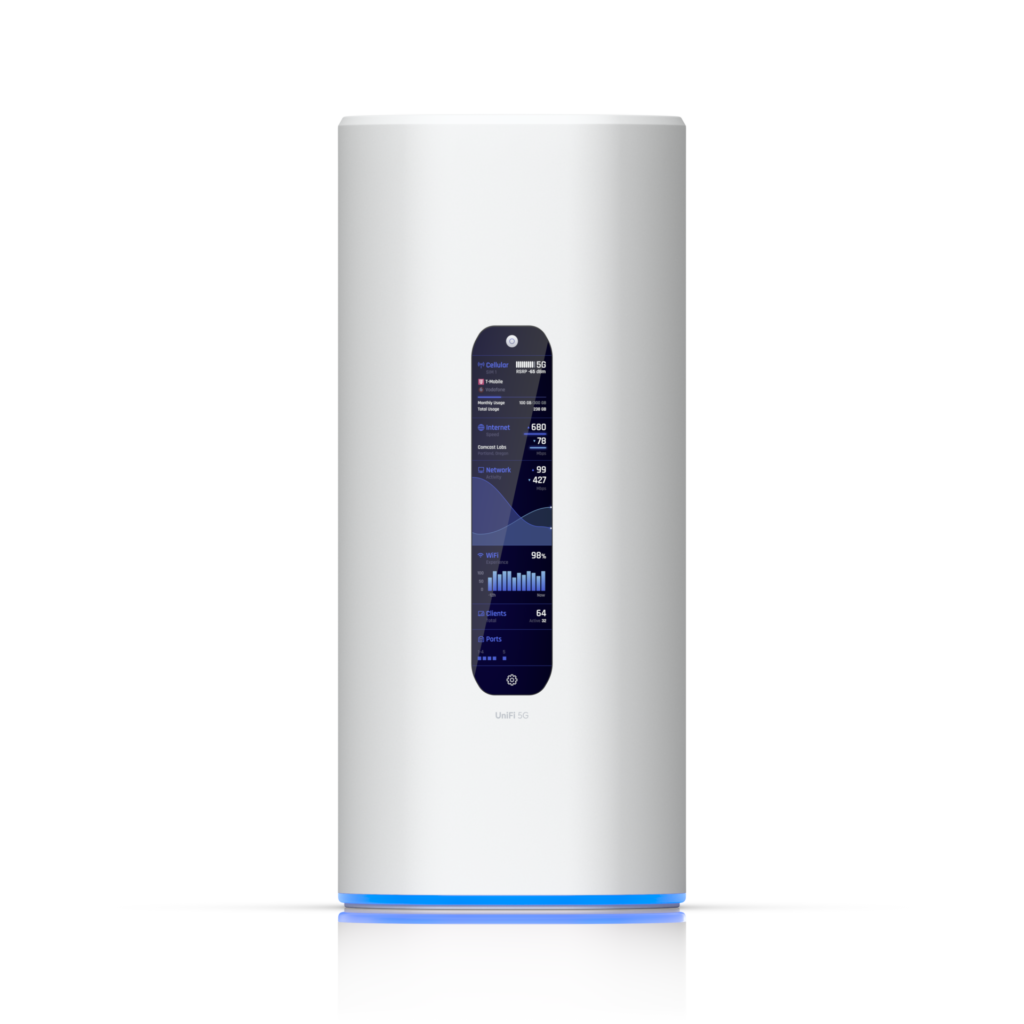
A 4.7-inch touchscreen fills the front. Ubiquiti rates Wi-Fi coverage at 1,750 sq ft, enough for a small house or an office floor, with larger buildings left to UniFi access points.
Category strengths
Where the Ubiquiti UniFi Dream Router 5G Max beats the median
- A much higher WAN port speed ?10 Gbps vs 2.5 Gbps (median)
- Much more RAM ?3,072 MB vs 1,024 MB (median)
- A higher max wireless speed ?10,688 Mbps vs 7,876 Mbps (median)
- More max connected devices ?300 vs 189 (median)
Where the Ubiquiti UniFi Dream Router 5G Max trails the median
- Fewer USB ports ?0 vs 1 (median)
- Fewer LAN ports ?3 vs 4 (median)
- A lower coverage area ?1,750 sq ft vs 2,000 sq ft (median)
- A much heavier build ?1,400 g vs 762.5 g (median)
How this VS Score was computed
Score 67: each known spec is measured against the median of all wi-fi routers (26 products), then weighted; 50 means level with that median. In classes of six or more, a value beyond the class’s 10th–90th percentile range counts as that limit, so one extreme product cannot set the scale. 68% of the scoreable weight could be used; unknown values, features not applicable to this class and proxies (battery capacity where a rated life exists) add or remove nothing.
| Specification | This product | Cohort median | Score weight | Points moved |
|---|---|---|---|---|
| WAN port speed | 10 | 2.5 | 1.5 | +75.0 |
| 6 GHz band | Yes | 52% of the class have it | 1 | +50.0 |
| Multi-gig LAN | Yes | 69% of the class have it | 0.8 | +40.0 |
| Max wireless speed | 10,688 | 7,876 | 2 | +36.0 |
| RAM | 3,072 | 1,024 | 0.7 | +35.0 |
| Built-in security suite | Yes | 52% of the class have it | 0.5 | +25.0 |
| Max connected devices | 300 | 189 | 0.5 | +14.5 |
| USB ports | 0 | 1 | 0.3 | −14.4 |
| LAN ports | 3 | 4 | 1 | −12.0 |
| Coverage area | 1,750 | 2,000 | 1.5 | −9.0 |
| Weight | 1,400 — capped at the class’s upper range (1,166) | 762.5 | 0.2 | −3.4 |
| Wi-Fi standard | Wi-Fi 7 | Wi-Fi 7 | 2 | +0.0 |
| Frequency bands | 3 | 3 | 1 | +0.0 |
| Processor cores | 4 | 4 | 0.5 | +0.0 |
| Processor speed | 1.5 | 1.5 | 0.5 | +0.0 |
Not scored: MU-MIMO (standard for the class (100% have it)); OFDMA (unknown: not scored); Beamforming (unknown: not scored); Link aggregation (unknown: not scored); Antennas (unknown: not scored); WPA3 (standard for the class (100% have it)); Mesh support (unknown: not scored); Guest network (unknown: not scored); Parental controls (standard for the class (100% have it)); Quality of Service (QoS) (standard for the class (100% have it)); VPN server (standard for the class (100% have it)); App control (standard for the class (100% have it)); Wall-mountable (unknown: not scored).
Editor’s note
Next to the Dream Router 7, this model adds the 5G modem and the touchscreen and keeps nearly everything else, so the purchase only makes sense where cellular is the main connection or a backup you expect to use. On a fiber line that never drops, the extra hardware sits idle.
UniFi's multi-WAN load balancing lets the 5G link run beside a wired connection on the SFP+ cage or an RJ45 port, which is the setup I would build for a small office. The SFP+ cage also takes a fiber module directly, something the smaller UniFi gateways with copper-only ports cannot do.
One interaction is worth knowing before switching everything on. Ubiquiti rates the gateway's intrusion prevention at 2.3 Gbps, below the modem's best-case non-standalone 5G figure, so on a perfect signal the inspection would set the ceiling. Real 5G speed depends on the tower, so this mostly stays theoretical.
The expanded threat-signature set is CyberSecure by Proofpoint, a separate subscription billed annually, while the base firewall, content filtering and ad blocking need nothing extra. Camera recording on the preinstalled card is sized for a small system, and Ubiquiti's camera figure for it is five HD streams, two 2K or one 4K.
For a store, a site office or a rural house whose wired line drops often enough to cost money, it stands in for a gateway, a cellular router and a small camera recorder in one box.
Specifications
Quality bars show where each figure sits between the lowest and highest of the 26 wi-fi routers this VS Score is measured against.
Wireless
Ports & wired
Hardware
Features & security
Design
Networking assessment
What the specification table does not say on its own: what this device needs to connect, what speeds are realistic, what costs extra, and where it falls short. Every statement below is read from the verified sheet or written by an editor — nothing is estimated.
Test environment
Research-based assessment: this brief is derived from the manufacturer’s published specifications for the Ubiquiti UniFi Dream Router 5G Max and the documents listed under Sources and verification. We have not run this unit on our own network, so nothing here is a measurement of ours.
Connection requirements
The WAN (internet) port is rated at 10 Gbps. An internet plan faster than that is capped at the router, and nothing on the network can download faster than this port regardless of the wireless figures.
There are 3 LAN ports, at least one of them multi-gig, so one wired device can run above Gigabit speed.
Throughput expectations
The Wi-Fi 7 headline of 10,688 Mbps adds together the theoretical peak of every band. A single device connects to one band at a time, so no client ever sees the total, and real-world speeds run well below the link rate even in the same room.
The 6 GHz band is only usable by Wi-Fi 6E or Wi-Fi 7 clients and has noticeably shorter range through walls; older devices stay on the 5 GHz and 2.4 GHz bands.
OFDMA and MU-MIMO help most when many devices are active at once; they do not make a single download faster.
Firmware and subscriptions
Ubiquiti lists minimum UniFi app versions for this model, 10.33.0 on iOS and 10.36.1 on Android, because console and cellular setup run through the app. Its store page says direct SIM and eSIM activation is expected in a future update, so carrier onboarding is one area where firmware will still change what the router can do.
A built-in security suite is on the spec sheet. On most brands the full version is a paid subscription after a trial; check the manufacturer’s page linked under Sources for the current terms.
Set-up and management run through the manufacturer’s app; check whether a local web interface is offered as well.
Parental controls are listed; on several brands the scheduling and filtering tiers sit behind the same subscription as the security suite.
VPN support is built in, which avoids a subscription to a third-party VPN router service for remote access.
Security support
WPA3 is supported, the current Wi-Fi encryption standard; devices that only speak WPA2 still connect in mixed mode.
Security-update cadence is not something manufacturers publish as a specification; see Support and updates below.
Real-world household suitability
The manufacturer rates coverage at 1,750 sq ft. That figure assumes open space; brick, concrete and floors reduce it, and a large or multi-storey home is usually better served by a mesh system than by one router.
Rated for 300 connected devices — a marketing figure, but a useful indication of whether a home full of smart plugs, cameras and phones is within its design.
Known limitations
7 specifications are not published by the manufacturer and are shown as Unknown rather than guessed.
Support and updates
A web installation guide and a tech-spec page cover the Dream Router 5G Max, with the Help Center at help.ui.com for the rest. CyberSecure, the Proofpoint threat-signature subscription billed annually, is sold as an add-on, and recordings from UniFi Protect cameras go to the microSD card that ships installed.
Sources and verification
Where the specifications come from
- Official product pagestore.ui.com
- Datasheet or manualdl.ui.com
Verification
- First published
- Specifications last checked
- Sheet completeness
- 21 of 28 specifications verified; the rest show as Unknown and are never estimated or scored
- Page type
- Product specification page — Compiled from the manufacturer’s published specifications and the cited sources; this is not a hands-on test.
- Basis
- Research-based: specifications and editorial text were compiled from the documents listed here and the manufacturer’s published data. We have not tested this unit ourselves; where independent measurements are mentioned they belong to the linked publication.
Wi-Fi Routers with similar specs to the Ubiquiti UniFi Dream Router 5G Max
Ratings & reviews
No reviews yet. Be the first to share your experience.
The bottom line
The Ubiquiti UniFi Dream Router 5G Max earns a VS Score of 67, above the median of the 26 wi-fi routers it is measured against (a score of 50 is level with that median).
- Who it’s for
- A small office, store or rural home on AT&T or T-Mobile with a data-only plan, where the wired line is unreliable or missing and one managed box should handle 5G, Wi-Fi 7 and a few cameras.
- Who should look elsewhere
- Verizon customers for now, T-Mobile Home Internet subscribers whose SIMs are not supported, and anyone on dependable fiber who would pay for a modem that never carries traffic.
- The trade-off that matters
- The 5G modem is the reason to buy it, and its usefulness rests on a carrier list Ubiquiti still describes as incomplete.
- The main alternative
- Ubiquiti UDR7: the same radios, ports and UniFi software without the cellular modem or touchscreen, for homes with a dependable wired line.
The VS Score is calculated from the weighted specifications above, each measured against the median of comparable wi-fi routers — a shortlisting guide, not a substitute for your own priorities. See how we score.