Zyxel GS1100-16EPS: Specs, Features, Pros & Cons
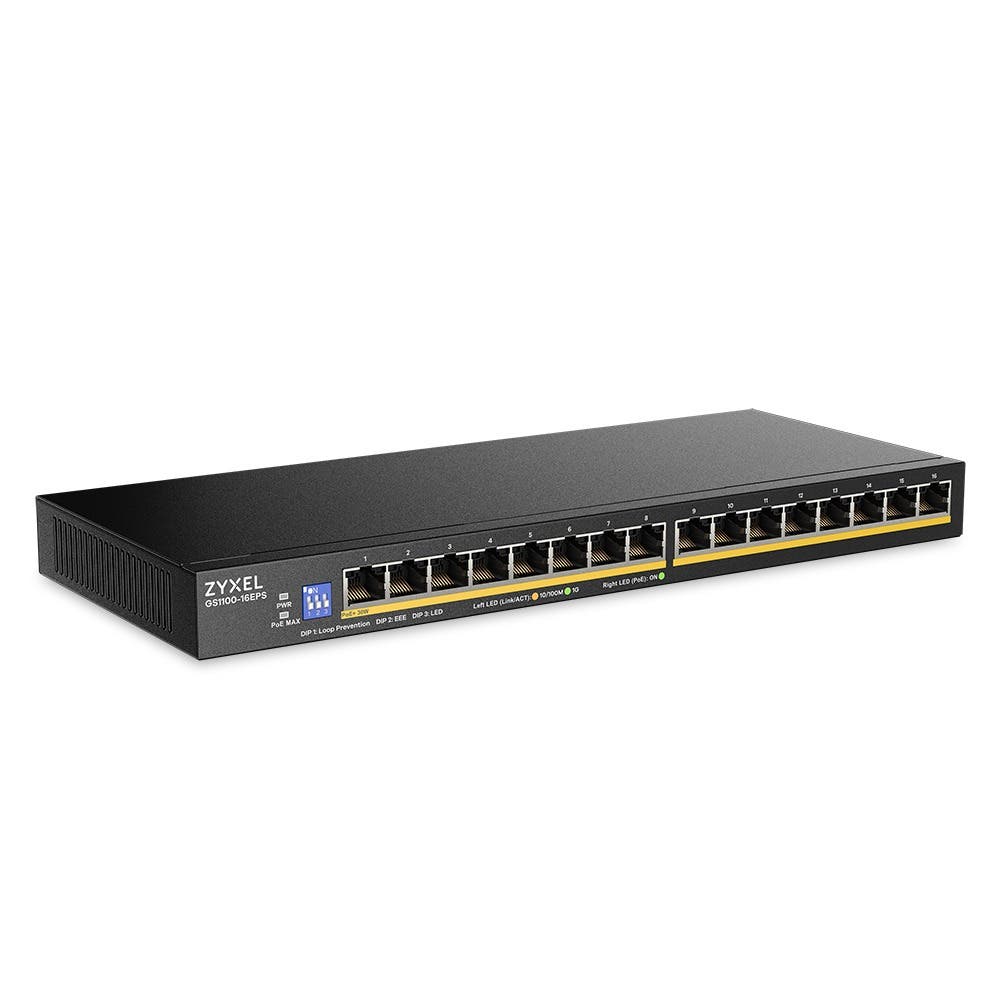
Sixteen powered ports and no fan is a rarer combination than it sounds. Most switches this dense move air to stay cool, and the noise rules them out of a hallway cupboard or an office where people are working. This one cools through a vented steel chassis barely more than an inch tall, and makes no sound at all.
That is the reason to choose it, and the rest of the specification is deliberately plain. All sixteen ports are gigabit rather than multi-gig, all sixteen supply PoE+ at up to thirty watts each, and there is no management of any kind: no VLANs, no link aggregation, no traffic prioritization, no interface to log into. Its switching capacity covers every port running at once, so nothing is throttled internally.
The number that governs what you can actually connect is the shared power budget. One hundred and thirty-five watts across sixteen ports works out at a little over eight watts per port if everything draws at once, which is fine for a set of small cameras and a couple of access points, and nowhere near enough for sixteen demanding devices. As always, add up real consumption rather than trusting the per-port maximum.
The gigabit ceiling deserves thought too. For cameras and older access points it is entirely adequate. For current Wi-Fi 7 hardware that can exceed a gigabit, this switch will be the limit.
It suits a camera-heavy home or a small office that needs many powered ports, silence and simplicity, and can live within gigabit. Anyone planning around multi-gig access points should look at a newer generation instead.
Category strengths
Where the Zyxel GS1100-16EPS beats the median
- More PoE ports ?16 vs 4 (median)
- More gigabit ports ?16 vs 0 (median)
- More total ports ?16 vs 10 (median)
Where the Zyxel GS1100-16EPS trails the median
- A much higher power consumption ?157.9 W vs 26.5 W (median)
- No VLAN support ?
- No link aggregation ?
- A lower switching capacity ?32 Gbps vs 40 Gbps (median)
- A lower forwarding rate ?23.8 Mpps vs 32.73 Mpps (median)
- No cloud management ?
How this VS Score was computed
Score 52: each known spec is measured against the median of all network switches (17 products), then weighted; 50 means level with that median. In classes of six or more, a value beyond the class’s 10th–90th percentile range counts as that limit, so one extreme product cannot set the scale. 88% of the scoreable weight could be used; unknown values, features not applicable to this class and proxies (battery capacity where a rated life exists) add or remove nothing.
| Specification | This product | Cohort median | Score weight | Points moved |
|---|---|---|---|---|
| Gigabit ports | 16 | 0 | 1.5 | +75.0 |
| Total ports | 16 | 10 | 2 | +60.0 |
| PoE ports | 16 | 4 | 1.2 | +60.0 |
| VLAN support | No | 59% of the class have it | 0.8 | −38.4 |
| Management level | Unmanaged | Smart managed | 1 | −25.0 |
| Link aggregation | No | 53% of the class have it | 0.5 | −24.0 |
| Power consumption | 157.9 — capped at the class’s upper range (116.9) | 26.5 | 0.5 | −19.5 |
| Cloud management | No | 50% of the class have it | 0.4 | −19.2 |
| Switching capacity | 32 | 40 | 1.5 | −15.0 |
| Rack-mountable | No | 35% of the class have it | 0.3 | −14.4 |
| Forwarding rate | 23.8 | 32.73 | 0.8 | −11.2 |
| 2.5G ports | 0 | 0 | 1 | +0.0 |
| 10G ports | 0 | 0 | 0.8 | +0.0 |
| SFP/SFP+ ports | 0 | 0 | 0.5 | +0.0 |
| PoE standard | PoE+ (802.3at) | PoE+ (802.3at) | 0.8 | +0.0 |
| PoE budget | 135 | 135 | 1.2 | +0.0 |
| MAC address table | 16 | 16 | 0.3 | +0.0 |
Not scored: Jumbo frame support (standard for the class (100% have it)); Quality of Service (QoS) (unknown: not scored); IGMP snooping (unknown: not scored); Fanless (standard for the class (80% have it)); Metal housing (standard for the class (87% have it)).
Editor’s note
The GS1100-16EPS answers a question small offices and camera-heavy homes ask constantly: how do you power sixteen PoE devices without installing something that sounds like a server room? This switch is fanless (zero decibels, cooled through a vented steel chassis just 26 mm tall), and every one of its sixteen gigabit ports supplies PoE+, up to 30 W each. Silent sixteen-port PoE is uncommon, and most rivals this dense cool themselves with a fan you will hear in a quiet room.
The number to check before buying is the budget: 135 W shared across the whole switch. That's about 8.4 W per port with all sixteen drawing together, which is comfortable for IP cameras, VoIP phones and modest access points, but it will not run sixteen power-hungry Wi-Fi 7 APs or PTZ cameras simultaneously. Add up your actual device draws. If the total crowds the switch's budget, you want a bigger one, not more ports.
The other defining fact: it's unmanaged, and completely so. No web page, no VLANs, no QoS settings. Configuration is three physical DIP switches on the case for loop prevention, energy-efficient Ethernet and turning the port LEDs off. I consider that a feature in the right hands: nothing to misconfigure, nothing to patch, surge protection and a lifetime warranty on top. But if you plan to isolate cameras on their own VLAN, this is the wrong tool, and that's what smart-managed units like Netgear's GS108EPP tier exist for.
Two practical notes: the power comes from an external brick (that's what makes fanless possible, so give it shelf space), and the box includes a wall-mount kit but no rack ears, unlike some of its non-PoE GS1100 siblings.
As plug-in-and-forget PoE for a quiet space, it's an easy recommendation.
Specifications
Quality bars show where each figure sits between the lowest and highest of the 17 network switches this VS Score is measured against.
Ports
Power over Ethernet
Performance
Management
Design & power
Networking assessment
What the specification table does not say on its own: what this device needs to connect, what speeds are realistic, what costs extra, and where it falls short. Every statement below is read from the verified sheet or written by an editor — nothing is estimated.
Test environment
Research-based assessment: this brief is derived from the manufacturer’s published specifications for the Zyxel GS1100-16EPS and the documents listed under Sources and verification. We have not run this unit on our own network, so nothing here is a measurement of ours.
Connection requirements
Unmanaged: it plugs into any router’s LAN port and needs no configuration, but it also offers none — no VLANs, no port monitoring.
Ports: 16 in total, of which 16 are Gigabit.
PoE budget is 135 W shared across the powered ports — add up the draw of the cameras, phones and access points you intend to hang off it before assuming they all fit.
Throughput expectations
Switching capacity is 32 Gbps, enough for every port to run flat out at once — the usual case for a home or small-office switch.
Jumbo frames are supported, which helps large file transfers between NAS and desktop.
Security support
Security-update cadence is not something manufacturers publish as a specification; see Support and updates below.
Known limitations
Not offered, according to the spec sheet: vLAN support, link aggregation, cloud management, rack-mountable.
2 specifications are not published by the manufacturer and are shown as Unknown rather than guessed.
Support and updates
We have not found a published firmware support-lifetime commitment for this model. Update policies differ widely between brands; check the support page linked under Sources and verification before relying on it for a long deployment, and treat a device that has stopped receiving security updates as due for replacement.
Sources and verification
Where the specifications come from
- Official product pagezyxel.com
Verification
- First published
- Specifications last checked
- Sheet completeness
- 20 of 22 specifications verified; the rest show as Unknown and are never estimated or scored
- Page type
- Product specification page — Compiled from the manufacturer’s published specifications and the cited sources; this is not a hands-on test.
- Basis
- Research-based: specifications and editorial text were compiled from the documents listed here and the manufacturer’s published data. We have not tested this unit ourselves; where independent measurements are mentioned they belong to the linked publication.
Network Switches with similar specs to the Zyxel GS1100-16EPS

Ratings & reviews
No reviews yet. Be the first to share your experience.
The bottom line
The Zyxel GS1100-16EPS earns a VS Score of 52, above the median of the 17 network switches it is measured against (a score of 50 is level with that median).
- Who it’s for
- Camera-heavy homes and small offices that want sixteen PoE+ ports with zero noise and zero configuration: plug in, power devices, forget it exists. The lifetime warranty and surge protection suit install-and-walk-away jobs.
- Who should look elsewhere
- Anyone who needs VLANs, QoS or any visibility into the network (unmanaged means none, ever), and dense high-draw deployments, where sixteen hungry APs or PTZ cameras will blow through the shared power budget.
- The trade-off that matters
- Port count versus power budget: sixteen PoE+ ports draw on one shared supply, so it's built for many low-draw devices like cameras and phones, not a rack of power-hungry access points.
- The main alternative
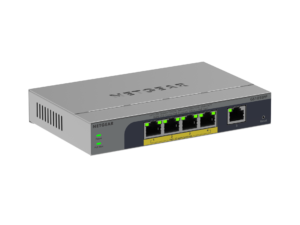
- NETGEAR GS108EPP: half the ports but nearly the same power budget (123 W), plus VLANs and QoS, for installs where a bit of management earns its keep.
The VS Score is calculated from the weighted specifications above, each measured against the median of comparable network switches — a shortlisting guide, not a substitute for your own priorities. See how we score.