GL.iNet Flint 3 (GL-BE9300): Specs, Features, Pros & Cons
Turn the Flint 3 around and every one of its five Ethernet ports runs at 2.5 Gigabit. No gigabit stragglers, no deciding which device deserves the fast socket. On a router at this price that back panel is the most immediately useful thing about it, and it is the clearest upgrade over the model it replaces.
Like the rest of the range, it is an OpenWrt machine first. The firmware is the open one with GL.iNet's interface over the top, which brings network-wide ad and tracker filtering, mesh-VPN clients for reaching the home network remotely, Tor routing, and a drop-in gateway mode that lets it take over routing duties behind an existing modem or router without rebuilding the network. The package manager is there for anything the interface does not cover.
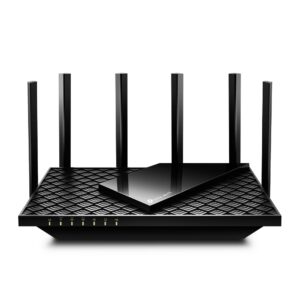
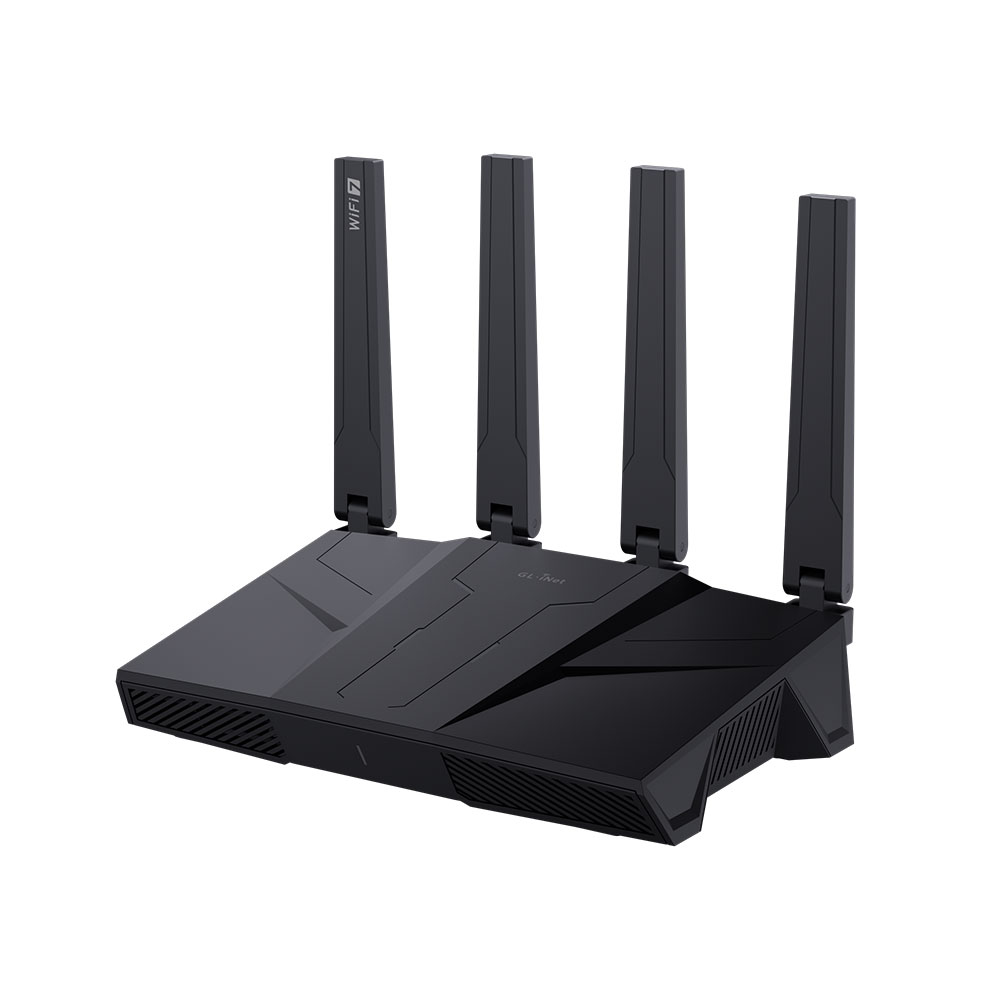
The radio side is now tri-band Wi-Fi 7 with a real 6 GHz band, all three at 2×2, alongside four foldable antennas and a USB 3.0 port. Firmware 4.10.0, released in September 2026, added EasyMesh, so a second Flint 3 or a Slate 7 can now extend it as a mesh node.
The awkward part is the processor. The Flint 3 uses a 1.5 GHz quad-core where its predecessor ran at 2 GHz, and GL.iNet's own VPN throughput figures are lower as a result, a meaningful drop for the buyer who chose this brand specifically because its routers encrypt quickly. Anyone whose whole household runs through a tunnel should compare those numbers rather than assume the newer model is faster.
It is a step forward in ports and wireless, bought with a step back in raw VPN speed, and which of the two counts depends on what the household runs every day.
Category strengths
Where the GL.iNet Flint 3 (GL-BE9300) beats the median
- A higher max wireless speed ?9,335 Mbps vs 7,876 Mbps (median)
Where the GL.iNet Flint 3 (GL-BE9300) trails the median
- Fewer max connected devices ?124 vs 189 (median)
- A heavier build ?848 g vs 762.5 g (median)
How this VS Score was computed
Score 57: each known spec is measured against the median of all wi-fi routers (26 products), then weighted; 50 means level with that median. In classes of six or more, a value beyond the class’s 10th–90th percentile range counts as that limit, so one extreme product cannot set the scale. 50% of the scoreable weight could be used; unknown values, features not applicable to this class and proxies (battery capacity where a rated life exists) add or remove nothing.
| Specification | This product | Cohort median | Score weight | Points moved |
|---|---|---|---|---|
| Multi-gig LAN | Yes | 69% of the class have it | 0.8 | +40.0 |
| Built-in security suite | Yes | 52% of the class have it | 0.5 | +25.0 |
| Max wireless speed | 9,335 | 7,876 | 2 | +18.0 |
| Max connected devices | 124 | 189 | 0.5 | −8.5 |
| Weight | 848 | 762.5 | 0.2 | −1.0 |
| Coverage area | 2,000 | 2,000 | 1.5 | +0.0 |
| WAN port speed | 2.5 | 2.5 | 1.5 | +0.0 |
| LAN ports | 4 | 4 | 1 | +0.0 |
| USB ports | 1 | 1 | 0.3 | +0.0 |
| Processor cores | 4 | 4 | 0.5 | +0.0 |
| Processor speed | 1.5 | 1.5 | 0.5 | +0.0 |
| RAM | 1,024 | 1,024 | 0.7 | +0.0 |
| Antennas | 4 | 4 | 0.3 | +0.0 |
Not scored: Wi-Fi standard (unknown: not scored); Frequency bands (unknown: not scored); 6 GHz band (unknown: not scored); MU-MIMO (unknown: not scored); OFDMA (unknown: not scored); Beamforming (unknown: not scored); Link aggregation (unknown: not scored); WPA3 (unknown: not scored); Mesh support (standard for the class (94% have it)); Guest network (standard for the class (100% have it)); Parental controls (standard for the class (100% have it)); Quality of Service (QoS) (unknown: not scored); VPN server (standard for the class (100% have it)); App control (standard for the class (100% have it)); Wall-mountable (unknown: not scored).
Editor’s note
The Flint 3 fixes the Flint 2's back panel and moves to Wi-Fi 7, and it comes with one surprising asterisk.
The upgrades over the Flint 2 are exactly right. GL.iNet rates the three radios at 688, 2,882 and 5,765 Mbps, all 2×2, but the back panel is the part that changes daily use. On the Flint 2 four of the six ports were plain gigabit, which was the single most irritating thing about it. It ships on OpenWrt 23.05 with AdGuard Home, Tailscale and ZeroTier.
GL.iNet quotes VPN throughput of 680 Mbps on both WireGuard and OpenVPN with DCO. The older Flint 2 quotes 900 Mbps and 880 Mbps. The cause is the Flint 3's slower Qualcomm quad-core against the Flint 2's MediaTek chip, and on the one workload GL.iNet is famous for, the newer router is the slower one. If you are buying a GL.iNet box specifically to push a whole household through WireGuard at full speed, that is a real regression and worth pausing over.
GL.iNet rates coverage at 2,000 sq ft and around 124 simultaneous devices, and the unit is a chunky 848 g.
If VPN throughput is the whole point, the older Flint 2 is still the faster router, which is not a sentence you often get to write about a successor.
Specifications
Quality bars show where each figure sits between the lowest and highest of the 26 wi-fi routers this VS Score is measured against.
Wireless
Ports & wired
Hardware
Features & security
Design
Networking assessment
What the specification table does not say on its own: what this device needs to connect, what speeds are realistic, what costs extra, and where it falls short. Every statement below is read from the verified sheet or written by an editor — nothing is estimated.
Test environment
Research-based assessment: this brief is derived from the manufacturer’s published specifications for the GL.iNet Flint 3 (GL-BE9300) and the documents listed under Sources and verification. We have not run this unit on our own network, so nothing here is a measurement of ours.
Connection requirements
The WAN (internet) port is rated at 2.5 Gbps. An internet plan faster than that is capped at the router, and nothing on the network can download faster than this port regardless of the wireless figures.
There are 4 LAN ports, at least one of them multi-gig, so one wired device can run above Gigabit speed.
Throughput expectations
The Wi-Fi headline of 9,335 Mbps adds together the theoretical peak of every band. A single device connects to one band at a time, so no client ever sees the total, and real-world speeds run well below the link rate even in the same room.
Firmware and subscriptions
The GL-BE9300 is on firmware 4.10.1, released September 20, 2026, four days after 4.10.0 brought EasyMesh networking with GL.iNet mesh nodes, a GL.iNet Account page and native IEEE 802.1Q VLANs. GL.iNet's download center lists eight stable builds since 4.7.11 in May 2025, each installed from the Admin Panel's Upgrade page, online or from a file. The firmware is GL.iNet's interface on top of OpenWrt 23.05.
A built-in security suite is on the spec sheet. On most brands the full version is a paid subscription after a trial; check the manufacturer’s page linked under Sources for the current terms.
Set-up and management run through the manufacturer’s app; check whether a local web interface is offered as well.
Parental controls are listed; on several brands the scheduling and filtering tiers sit behind the same subscription as the security suite.
VPN support is built in, which avoids a subscription to a third-party VPN router service for remote access.
Security support
A guest network is available for visitors and smart-home devices, keeping them off the network your computers use.
Security-update cadence is not something manufacturers publish as a specification; see Support and updates below.
Real-world household suitability
The manufacturer rates coverage at 2,000 sq ft. That figure assumes open space; brick, concrete and floors reduce it, and a large or multi-storey home is usually better served by a mesh system than by one router.
Rated for 124 connected devices — a marketing figure, but a useful indication of whether a home full of smart plugs, cameras and phones is within its design.
Mesh support means coverage can be extended later with a compatible satellite instead of replacing the router.
Known limitations
10 specifications are not published by the manufacturer and are shown as Unknown rather than guessed.
Support and updates
Setup and every Admin Panel feature are covered in GL.iNet's online Flint 3 user guide, next to VPN and network tutorials and a community forum. Remote management runs through GL.iNet's GoodCloud service, and the Log page exports logs when the support team asks for them.
Sources and verification
Where the specifications come from
- Official product pagegl-inet.com
- Datasheet or manualstatic.gl-inet.com
- Support and firmware documentationdl.gl-inet.com
- Independent testingrtings.com
Verification
- First published
- Specifications last checked
- Sheet completeness
- 18 of 28 specifications verified; the rest show as Unknown and are never estimated or scored
- Page type
- Product specification page — Compiled from the manufacturer’s published specifications and the cited sources; this is not a hands-on test.
- Basis
- Research-based: specifications and editorial text were compiled from the documents listed here and the manufacturer’s published data. We have not tested this unit ourselves; where independent measurements are mentioned they belong to the linked publication.
Wi-Fi Routers with similar specs to the GL.iNet Flint 3 (GL-BE9300)
Ratings & reviews
No reviews yet. Be the first to share your experience.
The bottom line
The GL.iNet Flint 3 (GL-BE9300) earns a VS Score of 57, above the median of the 26 wi-fi routers it is measured against (a score of 50 is level with that median).
- Who it’s for
- Anyone who runs OpenWrt and wants Wi-Fi 7 plus a back panel where every port is multi-gig, the biggest practical upgrade over the Flint 2.
- Who should look elsewhere
- Anyone buying a GL.iNet router primarily for VPN speed, since GL.iNet's WireGuard figure for it sits below the older Flint 2's, a result of the slower processor.
- The trade-off that matters
- You gain Wi-Fi 7 and an all-2.5G back panel, and give up roughly a quarter of the VPN throughput that made the previous model worth owning.
- The main alternative
- GL.iNet Flint 2 (GL-MT6000): older and Wi-Fi 6 only, but faster through a VPN tunnel and still the better pick if that is your use case.
The VS Score is calculated from the weighted specifications above, each measured against the median of comparable wi-fi routers — a shortlisting guide, not a substitute for your own priorities. See how we score.