NETGEAR Orbi RBR750: Specs, Price, Pros & Cons
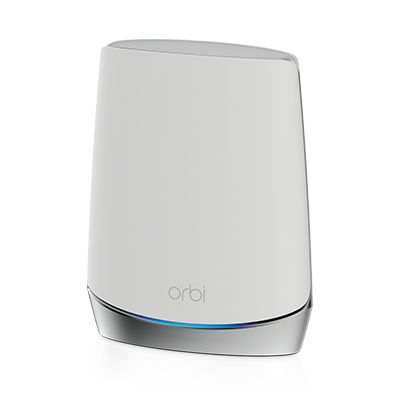
Bought on its own, the RBR750 carries a radio with nothing to talk to. It's the router from NETGEAR's Orbi RBK752 Wi-Fi 6 kit, and NETGEAR reserves its third band for the link to Orbi satellites. With no satellite on the network, that band carries no client traffic. Phones and laptops share the other two radios, as they would on an ordinary dual-band router.
With an RBS750 satellite or two, the design makes sense. NETGEAR calls it tri-band dedicated wireless backhaul: the satellites get a band of their own, so client traffic and mesh traffic don't compete for airtime. NETGEAR still builds its flagship mesh, the Orbi 970, around the same idea.
The radios are Wi-Fi 6 with no 6 GHz band. NETGEAR rates the router at AX4200, the total of its three radios, and the biggest share, 2,400 Mbps, belongs to the backhaul band. So the fastest radio serves no phones or laptops at all. Clients get 1,200 Mbps on the other 5 GHz radio and 600 Mbps on 2.4 GHz. Its four Ethernet sockets (one WAN, three LAN) are all gigabit, and the WAN and one LAN port can be aggregated. There's no USB port, and at 9.1 inches the router is tall. NETGEAR's data sheet gives it a quad-core 1.4 GHz processor and 1 GB of RAM.
NETGEAR's store no longer sells the RBK752 kit. Its old product address now opens the support page, so a matching router or satellite has to come from other retailers. That support page still carries firmware for the router and the satellite together.
Category strengths
Where the NETGEAR Orbi RBR750 beats the median
- Has dedicated wireless backhaul ?
- A higher ethernet ports per unit ?4 vs 3 (median)
Where the NETGEAR Orbi RBR750 trails the median
- No 6 GHz band ?
- No multi-gig WAN ?
- A much lower units included ?1 vs 2 (median)
- A lower max wireless speed ?4,200 Mbps vs 5,320 Mbps (median)
- A slightly higher unit weight ?862 g vs 801 g (median)
How this VS Score was computed
Score 36: each known spec is measured against the median of all mesh wi-fi systems (17 products), then weighted. 62% of the scoreable weight could be used. See how we score
| Specification | This product | Cohort median | Score weight | Points moved |
|---|---|---|---|---|
| Wi-Fi standard | Wi-Fi 6 | Wi-Fi 7 | 2 | −96.0 |
| Tri-band | Yes | 69% of the class have it | 1 | +50.0 |
| Dedicated wireless backhaul | Yes | 36% of the class have it | 1 | +50.0 |
| 6 GHz band | No | 65% of the class have it | 0.8 | −38.4 |
| Multi-gig WAN | No | 71% of the class have it | 0.8 | −38.4 |
| Security suite, no subscription | No | 24% of the class have it | 0.5 | −24.0 |
| Units included | 1 | 2 | 0.8 | −20.0 |
| Ethernet ports per unit | 4 | 3 | 1 | +17.0 |
| Max wireless speed | 4,200 | 5,320 | 1.5 | −16.5 |
| Smart home hub | No | 45% of the class have it | 0.3 | −14.4 |
| USB port | No | 35% of the class have it | 0.2 | −9.6 |
| Unit weight | 862 | 801 | 0.2 | −0.8 |
Not scored: Coverage area (unknown: not scored); Max connected devices (unknown: not scored); Wired backhaul support (unknown: not scored); WPA3 (standard for the class (100% have it)); App control (standard for the class (100% have it)); Parental controls (standard for the class (100% have it)); Quality of Service (QoS) (standard for the class (100% have it)); Guest network (standard for the class (100% have it)).
Editor’s note
NETGEAR Armor comes free only for a trial and then needs a yearly subscription, and the premium plan of NETGEAR Smart Parental Controls costs extra too. NETGEAR's free technical support ends 90 days after purchase from an authorized reseller. The Orbi app, voice control through Alexa or Google Assistant, a guest network and WPA3 come without charge.
I wouldn't buy it as a first router. NETGEAR's newer entry-level mesh, the Orbi 370, moves to Wi-Fi 7 and 2.5 gigabit ports but drops the reserved backhaul band. Its satellites share airtime with your devices.
An RBR750 paired with a satellite keeps that traffic apart, and each RBS750 satellite has two gigabit LAN ports for a wired desk in a far room. In a large house with no cable between floors, that separation can count for more than the newer standard. It's why the router is worth replacing like for like in an existing RBK752 system.
Specifications
Wireless
Ports & backhaul
Features & security
Design
Networking assessment
Connection requirements
The pack contains 1 units; the main unit plugs into your modem or existing gateway and the rest are placed around the home.
A dedicated wireless backhaul band links the units, so client traffic does not compete with the connection between nodes.
Throughput expectations
The Wi-Fi 6 headline of 4,200 Mbps adds together the theoretical peak of every band. A single device connects to one band at a time, so no client ever sees the total, and real-world speeds run well below the link rate even in the same room.
There is no 6 GHz band, so the least congested spectrum available to new phones and laptops is not on offer here.
Firmware and subscriptions
NETGEAR's RBR750 support page lists firmware 7.2.8.8 for the RBR750 router and RBS750 satellite, released September 9, 2026, with security fixes. The user manual describes checking for and installing updates from the router's web interface, or loading a downloaded file manually.
Set-up and management run through the manufacturer’s app; check whether a local web interface is offered as well.
Parental controls are listed; on several brands the scheduling and filtering tiers sit behind the same subscription as the security suite.
Security support
WPA3 is supported, the current Wi-Fi encryption standard; devices that only speak WPA2 still connect in mixed mode.
A guest network is available for visitors and smart-home devices, keeping them off the network your computers use.
Security-update cadence is not something manufacturers publish as a specification; see Support and updates below.
Known limitations
Not offered, according to the spec sheet: 6 GHz band, multi-gig WAN, security suite, no subscription, smart home hub.
3 specifications are not published by the manufacturer and are shown as Unknown rather than guessed.
Support and updates
The support page links the RBK752 data sheet, installation guide and user manual. The data sheet promises 90 days of complimentary technical support after purchase from an authorized NETGEAR reseller.
Sources and verification
Where the specifications come from
- Official product pagenetgear.com
- Retailer listing (cross-check)amazon.com
Verification
- First published
- Specifications last checked
- Sheet completeness
- 18 of 21 specifications verified; the rest show as Unknown and are never estimated or scored
- Page type
- Product specification page — Compiled from the manufacturer’s published specifications and the cited sources; this is not a hands-on test.
- Basis
- Research-based: specifications and editorial text were compiled from the documents listed here and the manufacturer’s published data. We have not tested this unit ourselves; where independent measurements are mentioned they belong to the linked publication.
Where to buy
Prices and availability may change. Check the retailer before buying. We may earn a commission on purchases.
Price history
Mesh Wi-Fi Systems with similar specs to the NETGEAR Orbi RBR750

Ratings & reviews
No reviews yet. Write the first one
The bottom line
The NETGEAR Orbi RBR750 earns a VS Score of 36, below the median of the 17 mesh wi-fi systems it is measured against (a score of 50 is level with that median).
- Who it’s for
- Owners of an Orbi RBK752 system replacing a failed router, or anyone holding RBS750 satellites who needs the router that matches them.
- Who should look elsewhere
- Anyone buying a first router for a single floor, and homes on plans faster than its gigabit sockets.
- The trade-off that matters
- The reserved backhaul band only pays off once a satellite joins, and everything else is Wi-Fi 6 hardware with gigabit sockets.
- The main alternative
- NETGEAR Orbi 370 (RBE373, 3-Pack): the newer NETGEAR kit to buy when starting from scratch with no Orbi hardware in the house.
This page was created with the help of AI. How we work
Latest Mesh Wi-Fi Systems