ASUS TUF Gaming BE9400: Specs, Features, Pros & Cons
TUF Gaming is the ASUS line that sits under ROG, and the BE9400 is the point in that line where the spec sheet stops looking like a compromise. It is a tri-band Wi-Fi 7 router (2.4, 5 and 6 GHz, two streams each, summed to a BE9400 class badge) with 320 MHz channels on the 6 GHz band and four 2.5-gigabit ports.
The ports are the practical headline. One 2.5 GbE WAN and three 2.5 GbE LAN means a multi-gig internet plan, a NAS and a desktop can all run above gigabit at once without buying a switch, which is rare at this tier. A USB 3.2 Gen 1 port handles drive sharing and a 4G or 5G phone as a tethered backup.
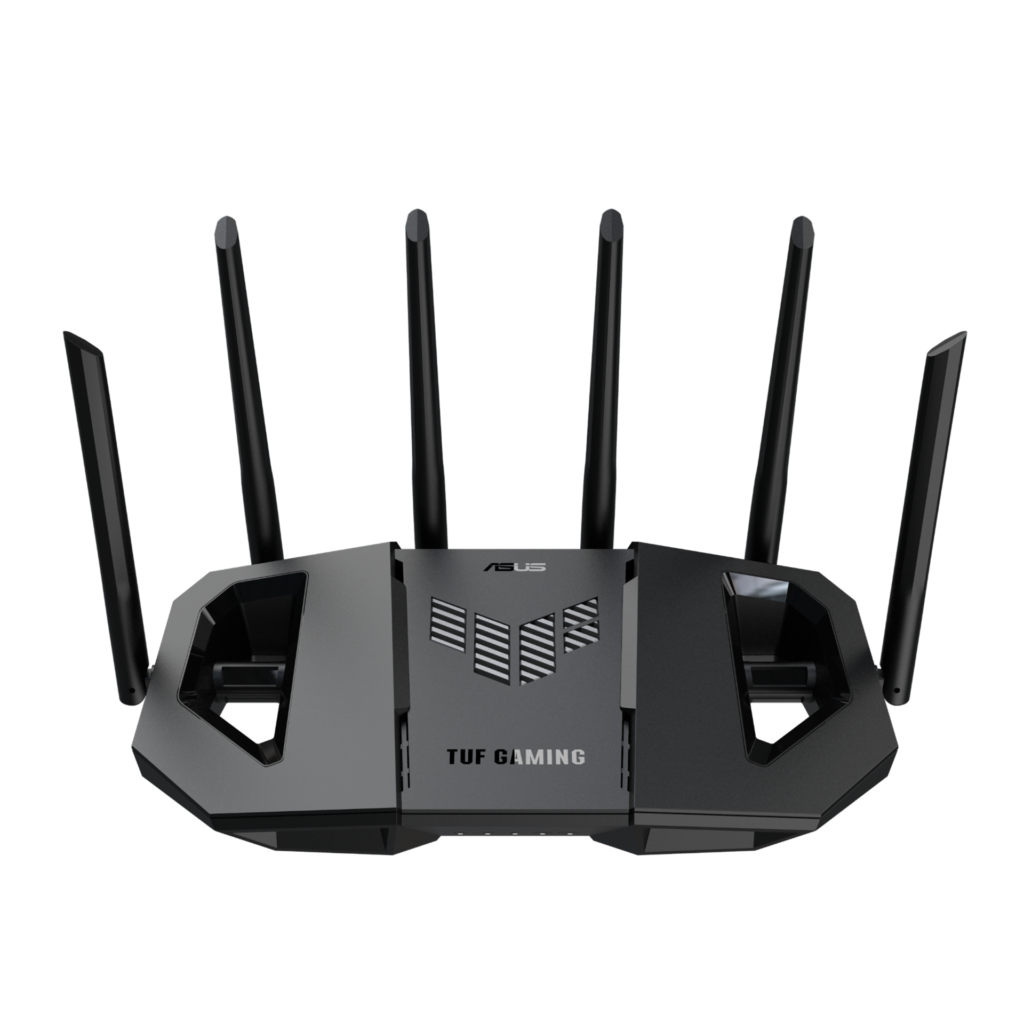
Inside is a 1.5 GHz quad-core with 1 GB of RAM, six fixed external antennas, and the full ASUSWRT stack: AiMesh, Adaptive QoS, WireGuard and OpenVPN servers, VPN Fusion for running a client and a server at once, and AiProtection with two-way intrusion prevention bundled free. The gaming additions are OpenNAT profiles, a mobile game mode and a dedicated gaming port. They are useful mostly to people who know they want them.
The 6 GHz band is only useful to Wi-Fi 6E and Wi-Fi 7 clients, and every older device on the network keeps to the two lower bands regardless. Setup and daily management run through the ASUS Router app or the full web interface, which remains one of the more complete consumer firmwares: per-device rules, guest networks, static routes and proper logging are all there without installing anything third-party.
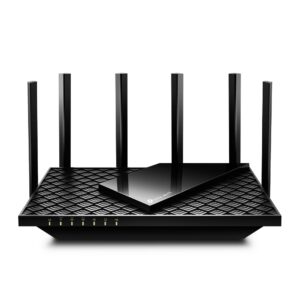
Physically it is a large object (764 grams, six fixed antennas and the angular TUF shell), designed to be seen on a shelf rather than tucked behind one.
Category strengths
Where the ASUS TUF Gaming BE9400 beats the median
- A higher max wireless speed ?9,334 Mbps vs 7,876 Mbps (median)
- More antennas ?6 vs 4 (median)
Where the ASUS TUF Gaming BE9400 trails the median
- Fewer LAN ports ?3 vs 4 (median)
How this VS Score was computed
Score 60: each known spec is measured against the median of all wi-fi routers (26 products), then weighted; 50 means level with that median. In classes of six or more, a value beyond the class’s 10th–90th percentile range counts as that limit, so one extreme product cannot set the scale. 60% of the scoreable weight could be used; unknown values, features not applicable to this class and proxies (battery capacity where a rated life exists) add or remove nothing.
| Specification | This product | Cohort median | Score weight | Points moved |
|---|---|---|---|---|
| 6 GHz band | Yes | 52% of the class have it | 1 | +50.0 |
| Multi-gig LAN | Yes | 69% of the class have it | 0.8 | +40.0 |
| Built-in security suite | Yes | 52% of the class have it | 0.5 | +25.0 |
| Max wireless speed | 9,334 | 7,876 | 2 | +18.0 |
| LAN ports | 3 | 4 | 1 | −12.0 |
| Antennas | 6 | 4 | 0.3 | +7.5 |
| Wi-Fi standard | Wi-Fi 7 | Wi-Fi 7 | 2 | +0.0 |
| Frequency bands | 3 | 3 | 1 | +0.0 |
| WAN port speed | 2.5 | 2.5 | 1.5 | +0.0 |
| USB ports | 1 | 1 | 0.3 | +0.0 |
| Processor cores | 4 | 4 | 0.5 | +0.0 |
| Processor speed | 1.5 | 1.5 | 0.5 | +0.0 |
| RAM | 1,024 | 1,024 | 0.7 | +0.0 |
| Weight | 764 | 762.5 | 0.2 | +0.0 |
Not scored: Coverage area (unknown: not scored); MU-MIMO (standard for the class (100% have it)); OFDMA (standard for the class (100% have it)); Beamforming (standard for the class (100% have it)); Max connected devices (unknown: not scored); Link aggregation (unknown: not scored); WPA3 (standard for the class (100% have it)); Mesh support (standard for the class (94% have it)); Guest network (standard for the class (100% have it)); Parental controls (standard for the class (100% have it)); Quality of Service (QoS) (standard for the class (100% have it)); VPN server (standard for the class (100% have it)); App control (standard for the class (100% have it)); Wall-mountable (unknown: not scored).
Editor’s note
This is the router in ASUS's Wi-Fi 7 range that I think is easiest to justify, and that is mostly because of the ports. Most routers at this level give you one multi-gig socket and four gigabit ones. This one gives you four multi-gig sockets and asks you to decide which is the WAN. If you have a fast plan and more than one wired machine that matters, that alone separates it from the dual-band units below it.
The tri-band part I would weigh more carefully. The new band and its wide channels are fast to a Wi-Fi 7 client, but two streams per band is a modest layout, and that band's range is short. In a house with one Wi-Fi 7 phone and a lot of older devices, the third band will sit mostly idle while the 5 GHz radio does the work, and a well-chosen dual-band Wi-Fi 7 router would feel identical.
What earns its keep regardless is the software. Subscription-free AiProtection with intrusion prevention, a WireGuard server that actually performs on a quad-core, and AiMesh for adding a node later are the things that matter every day. The gaming features are real but niche. OpenNAT is worth having if you play on a console, and irrelevant otherwise.
What would make me hesitate is the size and the look. This is a large, angular router that will not disappear on a shelf, and the TUF styling is a specific taste. Buyers who want the same ports and software in a quieter package should look at ASUS's non-gaming RT-BE series.
The honest test is what the fastest thing in the house is. If it is a Wi-Fi 6 laptop, the third band is a radio nothing will use, and a dual-band unit with the same sockets would do the same job. If it is a quick line with wired machines hanging off it, the sockets are in use from the first day.
Specifications
Quality bars show where each figure sits between the lowest and highest of the 26 wi-fi routers this VS Score is measured against.
Wireless
Ports & wired
Hardware
Features & security
Design
Networking assessment
What the specification table does not say on its own: what this device needs to connect, what speeds are realistic, what costs extra, and where it falls short. Every statement below is read from the verified sheet or written by an editor — nothing is estimated.
Test environment
Research-based assessment: this brief is derived from the manufacturer’s published specifications for the ASUS TUF Gaming BE9400 and the documents listed under Sources and verification. We have not run this unit on our own network, so nothing here is a measurement of ours.
Connection requirements
The WAN (internet) port is rated at 2.5 Gbps. An internet plan faster than that is capped at the router, and nothing on the network can download faster than this port regardless of the wireless figures.
There are 3 LAN ports, at least one of them multi-gig, so one wired device can run above Gigabit speed.
Throughput expectations
The Wi-Fi 7 headline of 9,334 Mbps adds together the theoretical peak of every band. A single device connects to one band at a time, so no client ever sees the total, and real-world speeds run well below the link rate even in the same room.
The 6 GHz band is only usable by Wi-Fi 6E or Wi-Fi 7 clients and has noticeably shorter range through walls; older devices stay on the 5 GHz and 2.4 GHz bands.
OFDMA and MU-MIMO help most when many devices are active at once; they do not make a single download faster.
Firmware and subscriptions
ASUS released TUF-BE9400 firmware 3.0.0.6.102_58500 on September 23, 2026, after builds in May, July and August, and the support page lists releases back to September 2025. The same build numbers reached the RT-BE90U on the same days, so this gaming model is not on a slower track than ASUS's plain tri-band router. Updates can install automatically through Auto Firmware Update or be loaded from the support page.
A built-in security suite is on the spec sheet. On most brands the full version is a paid subscription after a trial; check the manufacturer’s page linked under Sources for the current terms.
Set-up and management run through the manufacturer’s app; check whether a local web interface is offered as well.
Parental controls are listed; on several brands the scheduling and filtering tiers sit behind the same subscription as the security suite.
VPN support is built in, which avoids a subscription to a third-party VPN router service for remote access.
Security support
WPA3 is supported, the current Wi-Fi encryption standard; devices that only speak WPA2 still connect in mixed mode.
A guest network is available for visitors and smart-home devices, keeping them off the network your computers use.
Security-update cadence is not something manufacturers publish as a specification; see Support and updates below.
Real-world household suitability
Mesh support means coverage can be extended later with a compatible satellite instead of replacing the router.
Known limitations
4 specifications are not published by the manufacturer and are shown as Unknown rather than guessed.
Support and updates
AiProtection here includes the router security assessment, malicious site blocking and two-way IPS, and ASUS describes AiProtection as subscription-free. The support page carries the English user manual and the firmware files, and the router is managed from the ASUS Router app or the web interface.
Sources and verification
Where the specifications come from
- Official product pageasus.com
- Datasheet or manualdlcdnets.asus.com
- Support and firmware documentationasus.com
Verification
- First published
- Specifications last checked
- Sheet completeness
- 24 of 28 specifications verified; the rest show as Unknown and are never estimated or scored
- Page type
- Product specification page — Compiled from the manufacturer’s published specifications and the cited sources; this is not a hands-on test.
- Basis
- Research-based: specifications and editorial text were compiled from the documents listed here and the manufacturer’s published data. We have not tested this unit ourselves; where independent measurements are mentioned they belong to the linked publication.
Wi-Fi Routers with similar specs to the ASUS TUF Gaming BE9400
Ratings & reviews
No reviews yet. Be the first to share your experience.
The bottom line
The ASUS TUF Gaming BE9400 earns a VS Score of 60, above the median of the 26 wi-fi routers it is measured against (a score of 50 is level with that median).
- Who it’s for
- A household on a multi-gig internet plan with a NAS, a wired desktop and a few Wi-Fi 7 devices, that wants four multi-gig ports and ASUS's free security and VPN stack in one box.
- Who should look elsewhere
- Anyone whose fastest client is still a Wi-Fi 6 laptop, anyone on a gigabit-or-slower plan, and anyone who wants a router that disappears on a shelf, because this one is large, angular and unmistakably gaming.
- The trade-off that matters
- The third band only serves current-generation clients, while the stream count per band matches ASUS's dual-band Wi-Fi 7 units. The ports, not the radio, are what you are buying.
- The main alternative
- TP-Link Archer BE550: a tri-band BE9300 Wi-Fi 7 router with the same 2×2 layout and multi-gig ports in a plainer, smaller package, for buyers who do not want the gaming styling.
The VS Score is calculated from the weighted specifications above, each measured against the median of comparable wi-fi routers — a shortlisting guide, not a substitute for your own priorities. See how we score.