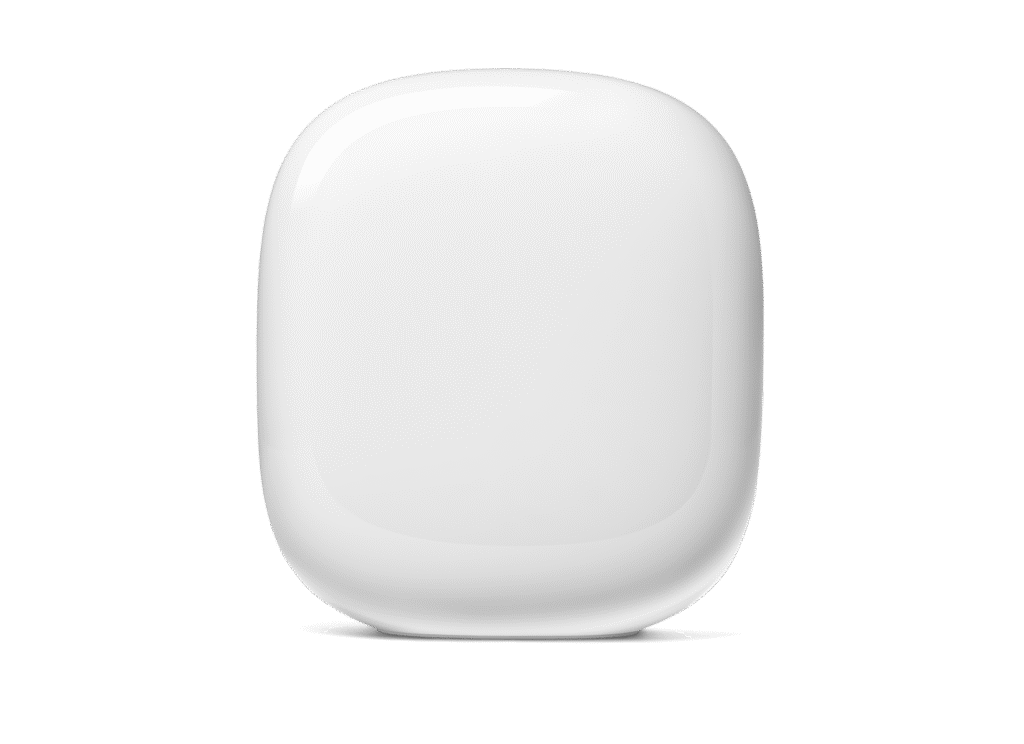
Google Nest Wifi Pro (2-Pack): Specs, Features, Pros & Cons
Nest Wifi Pro is Wi-Fi 6E rather than Wi-Fi 7, and that is the first thing to weigh, because it means the hardware sits one generation behind almost everything it competes with. It still has the 6 GHz band (6E is what introduced it), so the practical gap is narrower than the name suggests, but the newer standard's channel widths and multi-band linking are absent.
The harder limit is wired. Each node has two gigabit ports and there is no multi-gig socket anywhere, so a broadband plan faster than a gigabit will be capped by the router. On a system in this price bracket that is a real omission and worth checking against your own connection before anything else.
What it does exceptionally well is the smart home. Each unit is a Thread border router with Matter support and acts as a Google Home hub, so on a Google or Nest household the network hardware and the home controller become the same object.
The software model is also refreshingly plain: parental controls, guest networking, automatic prioritization for video calls and security updates are simply included, with nothing held back for a subscription. Setup and diagnostics are aimed squarely at people who do not want to think about networking, and the units are small and light enough to sit in a living room without comment.
Buy it for a Google-centered smart home on a gigabit-or-slower connection, where the hub duties and the included software are the point. Avoid it if your broadband exceeds what its ports can carry, or if you want the current wireless generation rather than the one before it.
Category strengths
Where the Google Nest Wifi Pro (2-Pack) beats the median
- Has smart home hub ?
- A lower unit weight ?450 g vs 801 g (median)
Where the Google Nest Wifi Pro (2-Pack) trails the median
- No multi-gig WAN ?
- A lower coverage area ?4,400 sq ft vs 6,500 sq ft (median)
- A lower ethernet ports per unit ?2 vs 3 (median)
- A lower units included ?2 vs 2.5 (median)
How this VS Score was computed
Score 44: each known spec is measured against the median of all mesh wi-fi systems (16 products), then weighted; 50 means level with that median. In classes of six or more, a value beyond the class’s 10th–90th percentile range counts as that limit, so one extreme product cannot set the scale. 72% of the scoreable weight could be used; unknown values, features not applicable to this class and proxies (battery capacity where a rated life exists) add or remove nothing.
| Specification | This product | Cohort median | Score weight | Points moved |
|---|---|---|---|---|
| Wi-Fi standard | Wi-Fi 6E | Wi-Fi 7 | 2 | −50.0 |
| Tri-band | Yes | 73% of the class have it | 1 | +50.0 |
| 6 GHz band | Yes | 69% of the class have it | 0.8 | +40.0 |
| Multi-gig WAN | No | 75% of the class have it | 0.8 | −38.4 |
| Coverage area | 4,400 | 6,500 | 2 | −32.0 |
| Built-in security suite | No | 44% of the class have it | 0.5 | −24.0 |
| Ethernet ports per unit | 2 | 3 | 1 | −17.0 |
| Smart home hub | Yes | 40% of the class have it | 0.3 | +15.0 |
| USB port | No | 38% of the class have it | 0.2 | −9.6 |
| Units included | 2 | 2.5 | 0.8 | −8.0 |
| Unit weight | 450 | 801 | 0.2 | +7.8 |
| Max wireless speed | 5,400 | 5,360 | 1.5 | +0.0 |
| Max connected devices | 200 | 200 | 0.5 | +0.0 |
Not scored: Dedicated wireless backhaul (unknown: not scored); Wired backhaul support (unknown: not scored); WPA3 (standard for the class (100% have it)); App control (standard for the class (100% have it)); Parental controls (standard for the class (100% have it)); Quality of Service (QoS) (standard for the class (92% have it)); Guest network (standard for the class (100% have it)).
Editor’s note
The Nest Wifi Pro cannot join a mesh with Nest Wifi or Google Wifi points, Google's spec page says, so an owner of the older system replaces every point at once. The old hardware gives no head start, and the Pro has to win against a whole new kit from any brand.
Each router has a two-stream radio on 6 GHz, 5 GHz and 2.4 GHz under Google's AXE5400 rating, and the 6 GHz band gives 6E phones and laptops a lane the older devices in the house cannot crowd.
Google's one-year warranty is short next to the three years eero gives its Wi-Fi 7 Max 7 and Pro 7. Software support has been steadier than the warranty suggests: Google's release notes list a Nest Wifi Pro update roughly twice a year since 2024, installed automatically, the latest in February 2026.
Google sells the routers in four colors, Snow, Fog, Linen and Lemongrass, which helps when the best spot for a node is a living-room shelf.
Where Google Home already runs the lights and locks, having the router double as the Thread border router is worth more than faster sockets would be.
Specifications
Quality bars show where each figure sits between the lowest and highest of the 16 mesh wi-fi systems this VS Score is measured against.
Wireless
Ports & backhaul
Features & security
Design
Networking assessment
What the specification table does not say on its own: what this device needs to connect, what speeds are realistic, what costs extra, and where it falls short. Every statement below is read from the verified sheet or written by an editor — nothing is estimated.
Test environment
Research-based assessment: this brief is derived from the manufacturer’s published specifications for the Google Nest Wifi Pro (2-Pack) and the documents listed under Sources and verification. We have not run this unit on our own network, so nothing here is a measurement of ours.
Connection requirements
The pack contains 2 units; the main unit plugs into your modem or existing gateway and the rest are placed around the home.
Throughput expectations
The Wi-Fi 6E headline of 5,400 Mbps adds together the theoretical peak of every band. A single device connects to one band at a time, so no client ever sees the total, and real-world speeds run well below the link rate even in the same room.
The 6 GHz band is only usable by Wi-Fi 6E or Wi-Fi 7 clients and has noticeably shorter range through walls; older devices stay on the 5 GHz and 2.4 GHz bands.
Firmware and subscriptions
Google installs Nest Wifi Pro updates automatically and lists them on its Wi-Fi release notes page. Version 3.78.518349, dated February 23, 2026, brought mesh performance, stability and security fixes, and the installed version shows under Wi-Fi Information in the Google Home app.
Set-up and management run through the manufacturer’s app; check whether a local web interface is offered as well.
Parental controls are listed; on several brands the scheduling and filtering tiers sit behind the same subscription as the security suite.
Security support
WPA3 is supported, the current Wi-Fi encryption standard; devices that only speak WPA2 still connect in mixed mode.
A guest network is available for visitors and smart-home devices, keeping them off the network your computers use.
Security-update cadence is not something manufacturers publish as a specification; see Support and updates below.
Real-world household suitability
The manufacturer rates coverage at 4,400 sq ft. That figure assumes open space; brick, concrete and floors reduce it, and a large or multi-storey home is usually better served by a mesh system than by one router.
Rated for 200 connected devices — a marketing figure, but a useful indication of whether a home full of smart plugs, cameras and phones is within its design.
Known limitations
Not offered, according to the spec sheet: multi-gig WAN, built-in security suite, uSB port.
2 specifications are not published by the manufacturer and are shown as Unknown rather than guessed.
Support and updates
Google's spec page lists a 1-year limited warranty and requires the Google Home app and a Google Account for setup. The Pro cannot share a mesh with older Nest Wifi or Google Wifi hardware.
Sources and verification
Where the specifications come from
- Official product pagestore.google.com
- Support and firmware documentationsupport.google.com
- Retailer listing (cross-check)amazon.com
Verification
- First published
- Specifications last checked
- Sheet completeness
- 19 of 21 specifications verified; the rest show as Unknown and are never estimated or scored
- Page type
- Product specification page — Compiled from the manufacturer’s published specifications and the cited sources; this is not a hands-on test.
- Basis
- Research-based: specifications and editorial text were compiled from the documents listed here and the manufacturer’s published data. We have not tested this unit ourselves; where independent measurements are mentioned they belong to the linked publication.
Mesh Wi-Fi Systems with similar specs to the Google Nest Wifi Pro (2-Pack)

Ratings & reviews
No reviews yet. Be the first to share your experience.
The bottom line
The Google Nest Wifi Pro (2-Pack) earns a VS Score of 44, below the median of the 16 mesh wi-fi systems it is measured against (a score of 50 is level with that median).
- Who it’s for
- A two-story house or a large apartment run through Google Home, on a gigabit or slower plan.
- Who should look elsewhere
- Owners of Nest Wifi or Google Wifi points hoping to add to them, since the Pro will not mesh with them, and anyone on a plan faster than its ports.
- The trade-off that matters
- 6 GHz Wi-Fi with gigabit wiring: the radios can outrun the Ethernet sockets, so a fast plan or a wired link between routers hits the port limit first.
- The main alternative
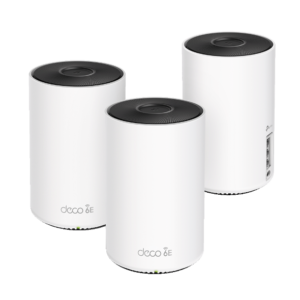
- TP-Link Deco BE25: Wi-Fi 7 with multi-gig ports in place of a 6 GHz radio, for a home whose fastest devices are wired.
The VS Score is calculated from the weighted specifications above, each measured against the median of comparable mesh wi-fi systems — a shortlisting guide, not a substitute for your own priorities. See how we score.