Ubiquiti U7 Long-Range: Specs, Features, Pros & Cons
The U7 Long-Range reaches the same 4.3 Gbps on 5 GHz as Ubiquiti's U7 Pro, by a different route. The Pro gets there with two streams on a 240 MHz channel. This one uses three streams and stops at 160 MHz, the widest channel a Wi-Fi 6 laptop can join.
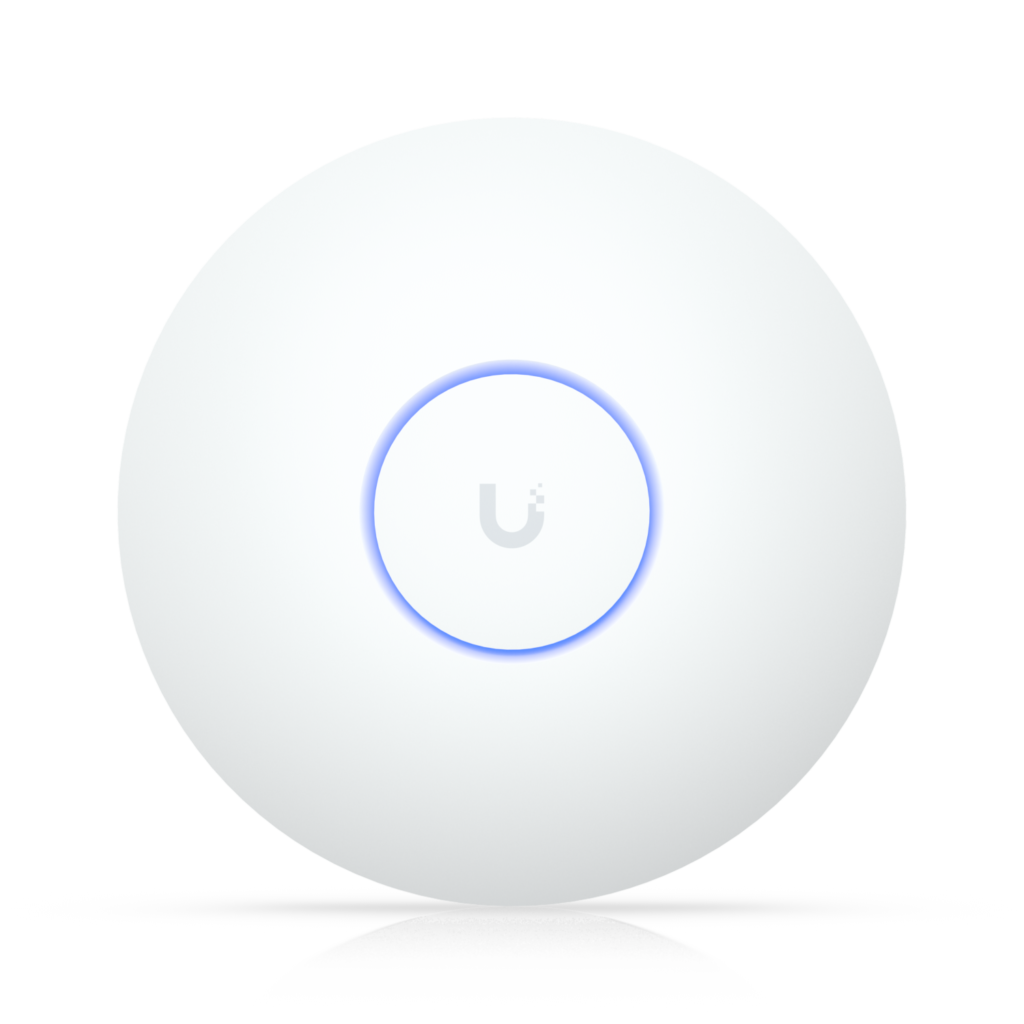
It is a dual-band Wi-Fi 7 access point, 2.4 and 5 GHz only. There is no 6 GHz radio, so the name describes reach and says nothing about the newest band. Ubiquiti puts the effort into transmit power instead: up to 27 dBm on 5 GHz and 26 dBm on 2.4 GHz, against 26 and 23 dBm on the U7 Pro. One ceiling disc is rated for 1,750 sq ft and 300 or more clients.
The Long-Range draws 14 W at most, and Ubiquiti lists plain PoE as its power method where the tri-band U7 models need PoE+ or more, so a basic PoE switch port can feed it. Data goes over a single 2.5 GbE port.
It mounts on a ceiling or a wall with the plastic plate in the box and is rated for indoor use up to 122 degrees Fahrenheit. Ubiquiti lists 802.11k, v and r roaming and wireless meshing, as on the rest of the U7 range, and management runs through the UniFi Network application or the UniFi mobile app. It also sits on its own firmware line, apart from the other U7 models, so its updates arrive on a different schedule.
Category strengths
Where the Ubiquiti U7 Long-Range beats the median
- Has ceiling mountable ?
- A slightly higher coverage area ?1,750 sq ft vs 1,625 sq ft (median)
- A lighter build ?448 g vs 562 g (median)
Where the Ubiquiti U7 Long-Range trails the median
- No standalone mode ?
How this VS Score was computed
Score 43: each known spec is measured against the median of all access points (15 products), then weighted; 50 means level with that median. In classes of six or more, a value beyond the class’s 10th–90th percentile range counts as that limit, so one extreme product cannot set the scale. 71% of the scoreable weight could be used; unknown values, features not applicable to this class and proxies (battery capacity where a rated life exists) add or remove nothing.
| Specification | This product | Cohort median | Score weight | Points moved |
|---|---|---|---|---|
| 6 GHz band | No | 40% of the class have it | 0.8 | −38.4 |
| Standalone mode | No | 58% of the class have it | 0.5 | −24.0 |
| Ceiling mountable | Yes | 47% of the class have it | 0.3 | +15.0 |
| Outdoor rated | No | 40% of the class have it | 0.3 | −14.4 |
| DC power option | No | 46% of the class have it | 0.2 | −9.6 |
| Coverage area | 1,750 | 1,625 | 1 | +4.0 |
| Weight | 448 | 562 | 0.2 | +2.6 |
| Wi-Fi standard | Wi-Fi 7 | Wi-Fi 7 | 2 | +0.0 |
| Max wireless speed | 4,988 | 4,988 | 1.5 | +0.0 |
| Max concurrent clients | 300 | 300 | 1 | +0.0 |
| Ethernet port speed | 2.5 | 2.5 | 1 | +0.0 |
Not scored: MU-MIMO (standard for the class (100% have it)); PoE powered (standard for the class (100% have it)); Controller management (standard for the class (93% have it)); Seamless roaming (standard for the class (100% have it)); VLAN support (standard for the class (100% have it)); Guest network (standard for the class (100% have it)).
Editor’s note
Range on a spec sheet is mostly a downlink story. The extra transmit power pushes the Long-Range's signal further toward a phone at the far end of the house, but the phone answers at its own lower power, so the usable edge of the cell is set by the client as much as by the access point. That makes it a better fit for a long single-story house, an open-plan office or a warehouse floor than for a building with thick walls, where a second access point does more than a louder first one.
The third 5 GHz stream earns its place when several devices share the radio, because MU-MIMO can serve more of them at once. A typical two-stream laptop sees little difference, since it uses two streams either way.
The missing band is the real decision. Wi-Fi 6E and Wi-Fi 7 phones and laptops would otherwise move to 6 GHz and leave 5 GHz to everything older, and on the Long-Range they all stay on the same two bands. Where most of the client list is Wi-Fi 5 and Wi-Fi 6 hardware, that costs nothing. Where it is a household of new phones, the U7 Pro's 6 GHz radio is worth the PoE+ port it asks for.
The separate firmware line is a smaller point, but it means the release notes for the Long-Range have to be read on their own, not assumed from the U7 Pro family's.
I would pick it over the U7 Pro only where the switch or the client list rules out the third band anyway.
Specifications
Quality bars show where each figure sits between the lowest and highest of the 15 access points this VS Score is measured against.
Wireless
Ports & power
Management
Design
Networking assessment
What the specification table does not say on its own: what this device needs to connect, what speeds are realistic, what costs extra, and where it falls short. Every statement below is read from the verified sheet or written by an editor — nothing is estimated.
Test environment
Research-based assessment: this brief is derived from the manufacturer’s published specifications for the Ubiquiti U7 Long-Range and the documents listed under Sources and verification. We have not run this unit on our own network, so nothing here is a measurement of ours.
Connection requirements
Powered over Ethernet (PoE, 14 W max): the switch port or injector feeding it must supply that standard, or it will not start.
It is managed through the manufacturer’s controller and does not run standalone, so budget for the controller (hardware or hosted) as part of the deployment.
The uplink is a 2.5 Gbps Ethernet port; the wired side of the network caps everything the access point can pass through.
Throughput expectations
The Wi-Fi 7 headline of 4,988 Mbps adds together the theoretical peak of every band. A single device connects to one band at a time, so no client ever sees the total, and real-world speeds run well below the link rate even in the same room.
There is no 6 GHz band, so the least congested spectrum available to new phones and laptops is not on offer here.
OFDMA and MU-MIMO help most when many devices are active at once; they do not make a single download faster.
Firmware and subscriptions
The U7 Long-Range runs its own firmware line. Ubiquiti's download center lists version 8.0.76, published September 3, 2026, for the Long-Range alone, while the U7 Pro family is on 8.7.11. It needs UniFi Network 9.1.120 or later, and Ubiquiti also lists the UniFi mobile app (iOS 10.20.2, Android 10.21.7 or later).
Security support
A guest network is available for visitors and smart-home devices, keeping them off the network your computers use.
VLAN support allows work, IoT and guest traffic to be separated on the wired side.
Security-update cadence is not something manufacturers publish as a specification; see Support and updates below.
Real-world household suitability
The manufacturer rates coverage at 1,750 sq ft. That figure assumes open space; brick, concrete and floors reduce it, and a large or multi-storey home is usually better served by a mesh system than by one router.
Rated for 300 connected devices — a marketing figure, but a useful indication of whether a home full of smart plugs, cameras and phones is within its design.
Known limitations
Not offered, according to the spec sheet: 6 GHz band, standalone mode, outdoor rated, dC power option.
Support and updates
Ubiquiti publishes a web installation guide at dl.ui.com/qig/u7-lr and a tech-spec page for the Long-Range. Warranty and RMA requests are handled through help.ui.com.
Sources and verification
Where the specifications come from
- Official product pagetechspecs.ui.com
- Datasheet or manualdl.ui.com
- Support and firmware documentationui.com
Verification
- First published
- Specifications last checked
- Sheet completeness
- 18 of 18 specifications verified; the rest show as Unknown and are never estimated or scored
- Page type
- Product specification page — Compiled from the manufacturer’s published specifications and the cited sources; this is not a hands-on test.
- Basis
- Research-based: specifications and editorial text were compiled from the documents listed here and the manufacturer’s published data. We have not tested this unit ourselves; where independent measurements are mentioned they belong to the linked publication.
Access Points with similar specs to the Ubiquiti U7 Long-Range
Ratings & reviews
No reviews yet. Be the first to share your experience.
The bottom line
The Ubiquiti U7 Long-Range earns a VS Score of 43, below the median of the 15 access points it is measured against (a score of 50 is level with that median).
- Who it’s for
- A house or office with a large open floor, mostly Wi-Fi 5 and Wi-Fi 6 devices and a basic PoE switch, where a stronger 5 GHz signal from one ceiling point is worth more than a third band.
- Who should look elsewhere
- Anyone buying Wi-Fi 7 for the 6 GHz band, which this model lacks, so new phones and laptops that could use the cleaner band stay on 5 GHz with everything else.
- The trade-off that matters
- Transmit power and an extra 5 GHz stream in place of a third band: more reach for older devices, no quiet lane for new ones.
- The main alternative
- Ubiquiti UniFi U7 Pro: adds the 6 GHz radio on the same kind of ceiling disc, at the cost of a PoE+ port.
The VS Score is calculated from the weighted specifications above, each measured against the median of comparable access points — a shortlisting guide, not a substitute for your own priorities. See how we score.