TP-Link Deco BE63: Specs, Features, Pros & Cons
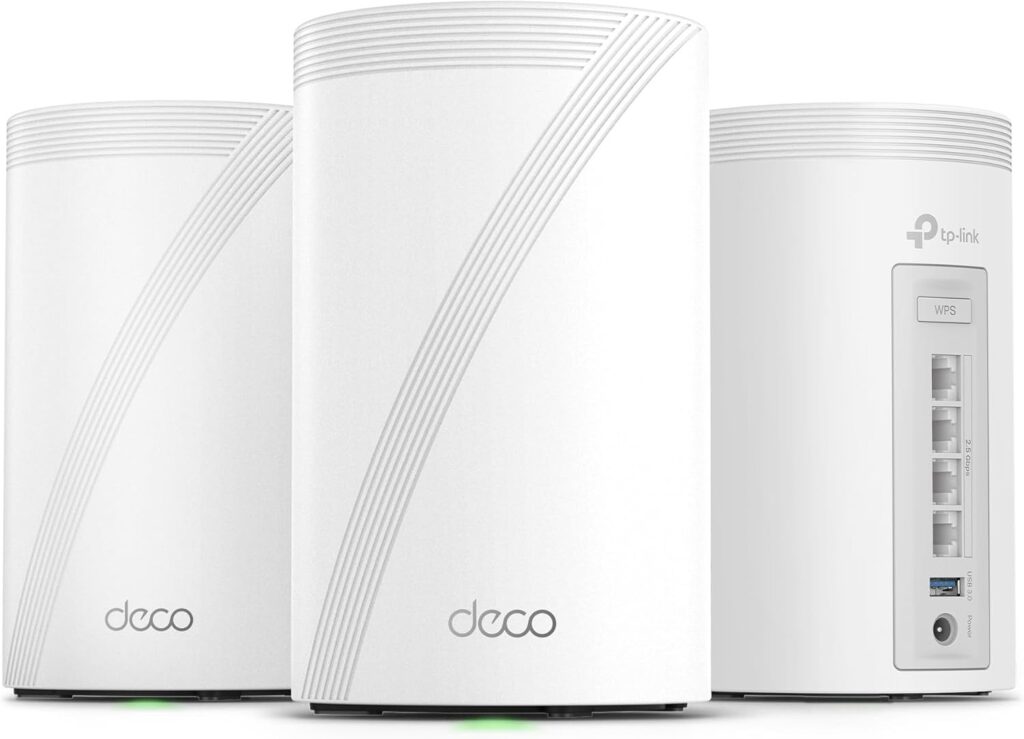
Four 2.5 Gbps Ethernet ports on every node is the specification that should decide this one, and it is easy to skim past. Most mesh units at this level give you two sockets and expect you to buy a switch. Here a cylinder can take the wired backhaul, a desk, a television and a console at once, all above the gigabit ceiling.
The wireless is the real thing rather than the badge version: tri-band Wi-Fi 7 with a genuine 6 GHz radio and multi-band linking, in a three-pack rated for a large house and around two hundred devices. That combination of proper radios and generous multi-gig wiring makes this the sensible middle of TP-Link's Wi-Fi 7 range.
It has no dedicated backhaul radio, so the units share bands with your devices when they talk to each other wirelessly. The four fast ports per node are the mitigation, and using at least one of them for a wired link between units is the single best thing you can do for the system.
There is no smart-home hub radio, and the security software follows the subscription pattern common to the brand, with the fuller protection in a paid tier.
For a house of this size with some cabling available, it is a well-balanced set of choices. Where it struggles is the same place every backhaul-free mesh does: long wireless hops between distant nodes, where a system with a reserved band keeps more of its speed.
Category strengths
Where the TP-Link Deco BE63 beats the median
- A much higher max wireless speed ?10,086 Mbps vs 5,320 Mbps (median)
- A higher coverage area ?7,600 sq ft vs 6,000 sq ft (median)
- A much higher units included ?3 vs 2 (median)
- A higher ethernet ports per unit ?4 vs 3 (median)
- Has USB port ?
How this VS Score was computed
Score 65: each known spec is measured against the median of all mesh wi-fi systems (17 products), then weighted. 77% of the scoreable weight could be used. See how we score
| Specification | This product | Cohort median | Score weight | Points moved |
|---|---|---|---|---|
| Max wireless speed | 10,086 | 5,320 | 1.5 | +67.5 |
| Tri-band | Yes | 69% of the class have it | 1 | +50.0 |
| Dedicated wireless backhaul | No | 36% of the class have it | 1 | −48.0 |
| 6 GHz band | Yes | 65% of the class have it | 0.8 | +40.0 |
| Multi-gig WAN | Yes | 71% of the class have it | 0.8 | +40.0 |
| Coverage area | 7,600 | 6,000 | 2 | +26.0 |
| Security suite, no subscription | No | 24% of the class have it | 0.5 | −24.0 |
| Units included | 3 | 2 | 0.8 | +20.0 |
| Ethernet ports per unit | 4 | 3 | 1 | +17.0 |
| Smart home hub | No | 45% of the class have it | 0.3 | −14.4 |
| USB port | Yes | 35% of the class have it | 0.2 | +10.0 |
| Wi-Fi standard | Wi-Fi 7 | Wi-Fi 7 | 2 | +0.0 |
| Max connected devices | 200 | 200 | 0.5 | +0.0 |
Not scored: Wired backhaul support (standard for the class (100% have it)); WPA3 (standard for the class (100% have it)); App control (standard for the class (100% have it)); Parental controls (standard for the class (100% have it)); Quality of Service (QoS) (standard for the class (100% have it)); Guest network (standard for the class (100% have it)); Unit weight (unknown: not scored).
Editor’s note
The Deco BE63 is the value pick of TP-Link's Wi-Fi 7 mesh line, with a 10,086 Mbps combined rating across its three bands. TP-Link quotes 5,800 sq ft for the two-pack and 7,600 for the three-pack, with capacity for 200 devices. For a typical family home on a gigabit-or-so plan, that's more system than you'll saturate.
Against the Deco BE67, you give up a 10 Gbps port (there isn't one anywhere in the system) and some speed on the third band. Premium mesh systems generally add a dedicated backhaul band, while the BE63's units relay traffic over the same radios your devices use, which is why wiring the nodes pays off here. There's also no smart-home radio, so no Zigbee or Thread hub duty, and TP-Link's HomeShield security follows the familiar pattern of free basics plus a paid tier for the real protection.
For me this is the sensible default in TP-Link's Wi-Fi 7 mesh range, because the ports on each node solve the backhaul problem its radios leave open. Skip it only if you have a multi-gig plan begging for a 10G port, which is the BE67's job, or if you want your mesh to double as a smart-home hub, where Amazon's eero line is the more natural fit.
Specifications
Wireless
Ports & backhaul
Features & security
Design
Networking assessment
Connection requirements
The pack contains 3 units; the main unit plugs into your modem or existing gateway and the rest are placed around the home.
Wired backhaul is supported: running Ethernet between the units gives every satellite the full speed of the main unit.
Throughput expectations
The Wi-Fi 7 headline of 10,086 Mbps adds together the theoretical peak of every band. A single device connects to one band at a time, so no client ever sees the total, and real-world speeds run well below the link rate even in the same room.
The 6 GHz band is only usable by Wi-Fi 6E or Wi-Fi 7 clients and has noticeably shorter range through walls; older devices stay on the 5 GHz and 2.4 GHz bands.
Firmware and subscriptions
The US Deco BE63 has shipped in three hardware versions (V1.60, V2.60 and V3.60), each with its own firmware list. The current V3.6 release is 1.0.7, published August 14, 2026, with stability and security improvements and a NAT loopback fix, and the Deco app can install updates over the air.
Set-up and management run through the manufacturer’s app; check whether a local web interface is offered as well.
Parental controls are listed; on several brands the scheduling and filtering tiers sit behind the same subscription as the security suite.
Security support
WPA3 is supported, the current Wi-Fi encryption standard; devices that only speak WPA2 still connect in mixed mode.
A guest network is available for visitors and smart-home devices, keeping them off the network your computers use.
Security-update cadence is not something manufacturers publish as a specification; see Support and updates below.
Real-world household suitability
The manufacturer rates coverage at 7,600 sq ft. That figure assumes open space; brick, concrete and floors reduce it, and a large or multi-storey home is usually better served by a mesh system than by one router.
Rated for 200 connected devices — a marketing figure, but a useful indication of whether a home full of smart plugs, cameras and phones is within its design.
Known limitations
Not offered, according to the spec sheet: dedicated wireless backhaul, security suite, no subscription, smart home hub.
One specification is not published by the manufacturer and is shown as Unknown rather than guessed.
Support and updates
TP-Link's support page links the US datasheet, a product and installation guide, Deco FAQs, the TP-Link Community forum and TP-Link's technical-support and warranty pages.
Sources and verification
Where the specifications come from
- Official product pagetp-link.com
Verification
- First published
- Specifications last checked
- Sheet completeness
- 20 of 21 specifications verified; the rest show as Unknown and are never estimated or scored
- Page type
- Product specification page — Compiled from the manufacturer’s published specifications and the cited sources; this is not a hands-on test.
- Basis
- Research-based: specifications and editorial text were compiled from the documents listed here and the manufacturer’s published data. We have not tested this unit ourselves; where independent measurements are mentioned they belong to the linked publication.
Mesh Wi-Fi Systems with similar specs to the TP-Link Deco BE63

Ratings & reviews
No reviews yet. Write the first one
The bottom line
The TP-Link Deco BE63 earns a VS Score of 65, above the median of the 17 mesh wi-fi systems it is measured against (a score of 50 is level with that median).
- Who it’s for
- Family homes on gigabit-to-2.5G plans that want full tri-band Wi-Fi 7 mesh with MLO and unusually flexible wiring: four multi-gig ports on every unit mean wired backhaul plus a TV, console and desk without buying a switch.
- Who should look elsewhere
- Multi-gig households wanting a 10G port (there isn't one anywhere in the system), buyers who need a smart-home hub built into their mesh, and anyone expecting the full security suite without a subscription.
- The trade-off that matters
- Wiring versus backhaul: there's no dedicated band for node-to-node traffic, so the system assumes you'll wire at least the far node. Leave it wireless in a sprawling house and systems with a reserved backhaul band pull ahead.
- The main alternative
- TP-Link Deco BE67: the same family with a 10G port per unit and a faster radio on the third band, worth the step up only when a multi-gig plan or NAS will use it.
This page was created with the help of AI. How we work