No current price: no retailer we track lists it right now.
20 facts in comparison
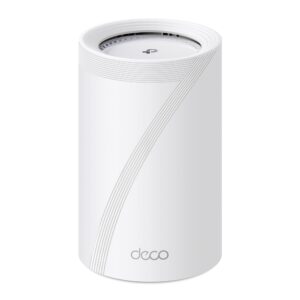
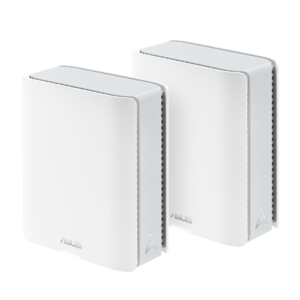
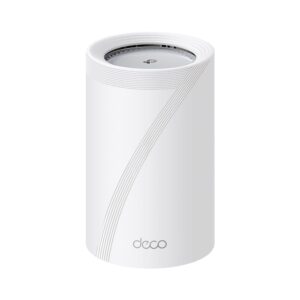
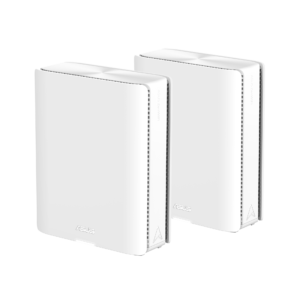
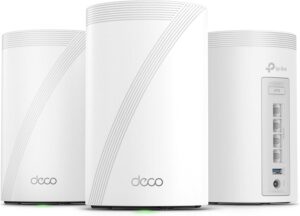
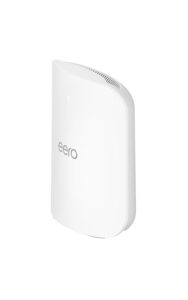
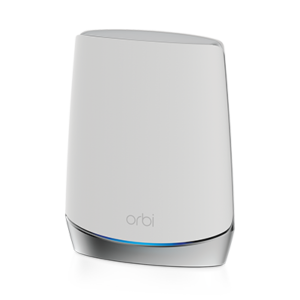
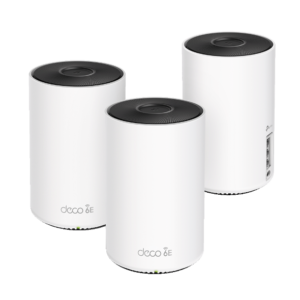
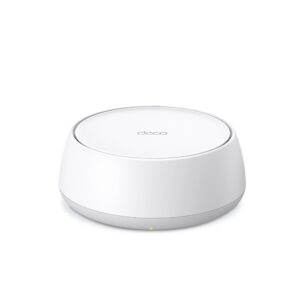
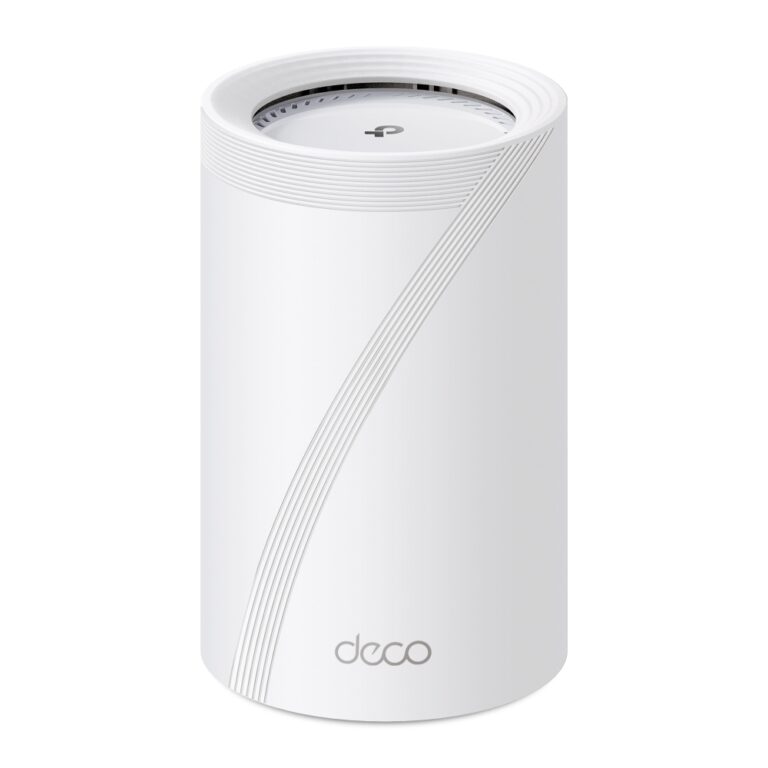
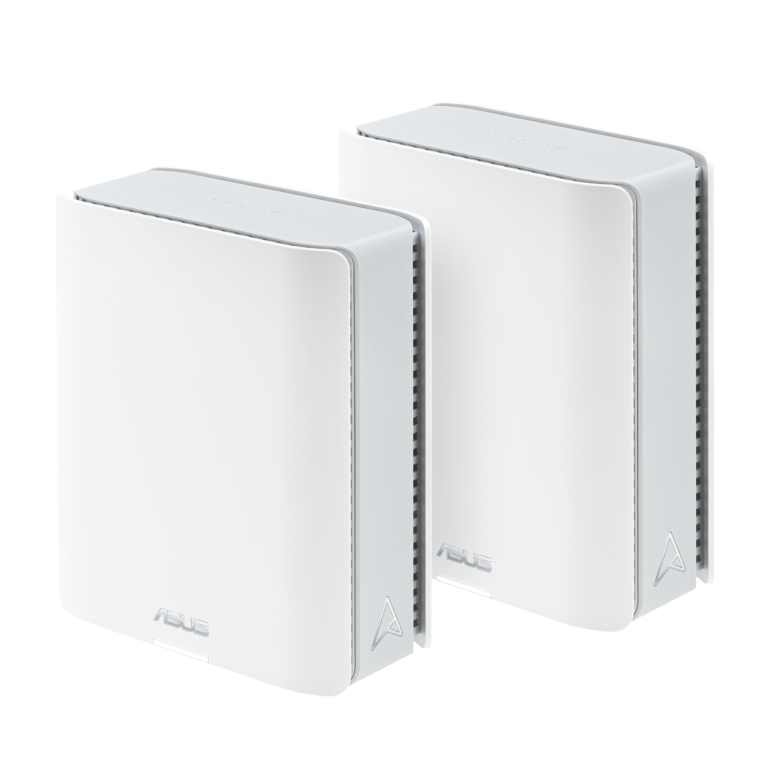
TP-Link Deco BE67 vs ASUS ZenWiFi BT10
A three-pack against a two-pack, which is the first thing to hold in mind while reading the coverage figures - more nodes is not the same as better hardware, and the Deco's larger rating comes partly from the extra unit in the box.
Per unit, the ASUS is the stronger piece of equipment. The BT10 carries two 10 Gbps ports on each node and a higher wireless class, which is what an owner with Ethernet in the walls and a multi-gig plan wants: wired backhaul that will never bottleneck, and a fast port left over for a desktop or a NAS. It also ships with ASUS's security suite, VPN server and QoS with no subscription, and its firmware exposes far more than TP-Link's app.
The Deco BE67 gives you three nodes for similar money, each with a 10 Gbps port and a USB port, and a simpler app that most households will never need to look behind. Its fuller security tier is a paid HomeShield plan. Where the house is large or awkwardly shaped, the third node is worth more than any radio difference, because a node in the right room beats a faster node in the wrong one.
Neither has a reserved backhaul radio, so both depend on either a cable between units or a clean wireless path. Both handle EasyMesh-style expansion in their own ecosystems.
The choice is the house and the owner. A large or long house with no Ethernet in the walls wants the Deco's third node. A wired house with a technical owner, a multi-gig plan, and a dislike of subscriptions wants the ZenWiFi pair, and will find the second 10 Gbps port on every node genuinely useful.
Editor’s note
The ZenWiFi BT10 is the more serious engineering and the more demanding purchase. A pair of fast sockets on every node is a configuration that usually implies business equipment, and ASUS gives away permanently what rivals meter monthly, including the security suite, adaptive traffic shaping and tunnel servers in both directions. The compromise is that all of it assumes competence and cable. Left entirely wireless in a big house, a two-node system sharing its backhaul is precisely the scenario competitors charge double to solve, and the owner will blame the wrong component.
The Deco BE67 is the better-judged product for an ordinary household and the thinner one underneath. Three units is coverage you can feel rather than a figure on a box, and the app hides everything most owners should never touch. Its quiet compromises are twofold. Only one socket per node is the fast one, so a wired desk fills the rest quickly, and the fuller security tier arrives as a bill that keeps arriving rather than as a feature.
Neither carries a smart-home radio, so anyone hoping the mesh will double as a Zigbee or Matter hub is shopping in the wrong aisle. Anyone in a small flat is buying coverage they have no room to spend, and would be better served by a single capable router.
Head-to-head points: every spec is scaled between these products only, so a product can score high here and modestly on its own page, where the VS Score measures it against the median of its class.
Where the TP-Link Deco BE67 beats the ASUS ZenWiFi BT10
- A higher coverage area ?8,100 sq ft vs 6,000 sq ft
- A much higher units included ?3 vs 2
- A slightly lower unit height ?176 mm vs 186 mm
Where the ASUS ZenWiFi BT10 beats the TP-Link Deco BE67
- A higher max wireless speed ?17,981 Mbps vs 13,659 Mbps
- Has built-in security suite ?
Key real-world differences
The spec sheet pulls in both directions. These are the gaps big enough to shape the decision — with the actual figures, and what each one means in real-world use.
- Coverage areaWireless8,100 sq ft vs 6,000 sq ft — 35% more for the TP-Link Deco BE67
The total home size the included units are rated to cover.
- Built-in security suiteFeatures & securityNo vs Yes — only the ASUS ZenWiFi BT10 has it
Network-level threat protection included or subscription-based.
- Max wireless speedWireless13,659 Mbps vs 17,981 Mbps — 31.6% more for the ASUS ZenWiFi BT10
The combined theoretical throughput across all bands.
Which one should you buy?
There is no single answer — it depends on what you will actually use it for. Match your priority to the pick below.
- Best for wireless TP-Link Deco BE67 takes the category 81 to 65 — driven by coverage area (8,100 sq ft vs 6,000 sq ft).
- Best for features & security ASUS ZenWiFi BT10 takes the category 100 to 85 — driven by built-in security suite (No vs Yes).
- Top overall score TP-Link Deco BE67 tops the overall VS Score at 86 while winning 1 of 3 categories outright.
Where each one falls short
TP-Link Deco BE67
- Built-in security suite: No vs Yes
- Max wireless speed: 13,659 Mbps vs 17,981 Mbps
- 1 spec is unreported (shown as Unknown) and excluded from its scores.
ASUS ZenWiFi BT10
- Coverage area: 8,100 sq ft vs 6,000 sq ft
- Units included: 3 vs 2
- 2 specs are unreported (shown as Unknown) and excluded from its scores.
What matters to you?
Drag the sliders to weight each category and re-rank the products to suit your priorities.
Score breakdown
Wireless
Ports & backhaul
Features & security
Design
Specs last verified October 11, 2026TP-Link Deco BE67: 20 of 21 specs verified (95%)ASUS ZenWiFi BT10: 19 of 21 specs verified (90%)Unverified specs show as Unknown — never estimated, never scored
What reviewers say
The bottom line
Both of these are wired-first systems wearing wireless clothing, and that is the fact to decide on. Neither reserves a radio for node-to-node traffic, so in a house with no Ethernet between rooms both spend your devices' airtime talking to themselves, and the extra Deco unit does more good than any specification on the ASUS.
Run a cable between the nodes and the ranking inverts at once. The ZenWiFi becomes the better hardware and the better long-term bet, with its software drawer permanently open where TP-Link keeps the best of its own behind a recurring charge.
So the honest question is not which mesh but whether cable will get pulled. Answer no in a large house, and neither system is being bought for the thing it does best.