21 facts in comparison
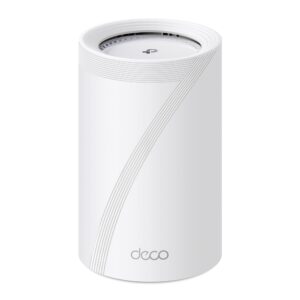
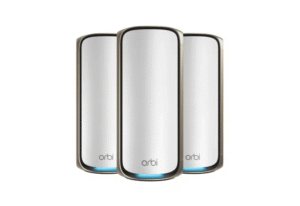
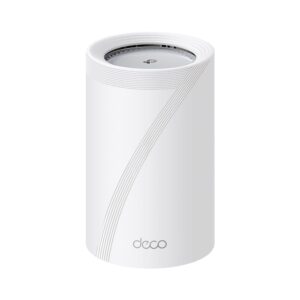
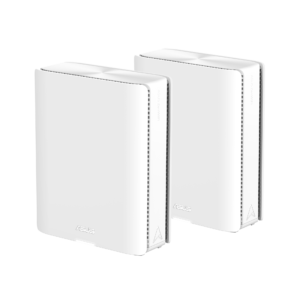
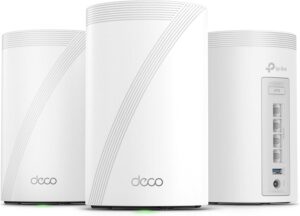
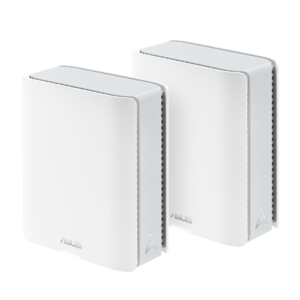
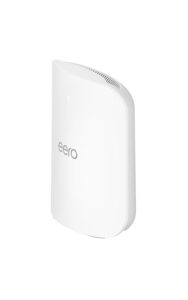
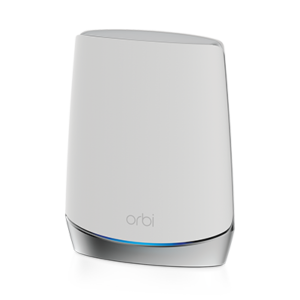
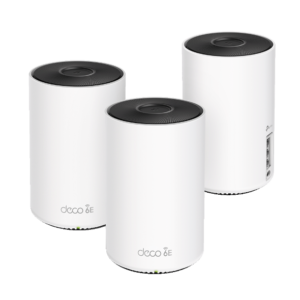
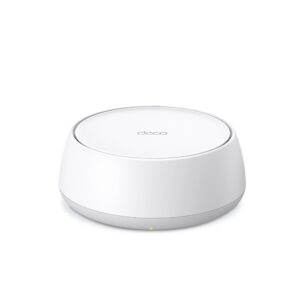
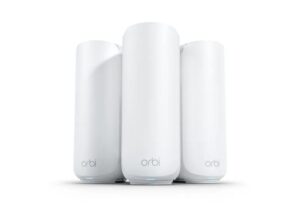
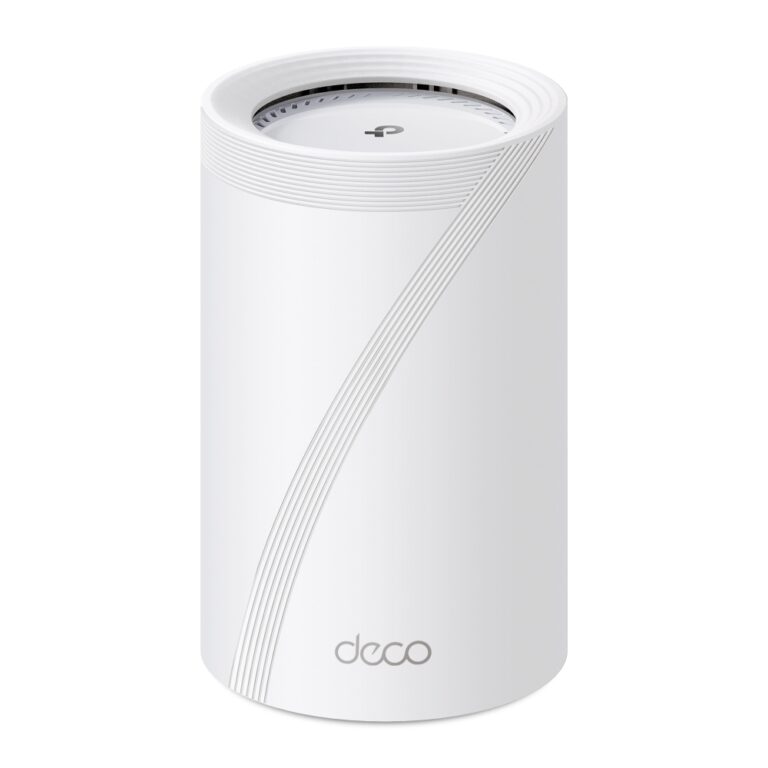
TP-Link Deco BE67 vs NETGEAR Orbi 970
A value flagship against an actual flagship, and the honest framing is that they are built for different houses rather than for different budgets alone.
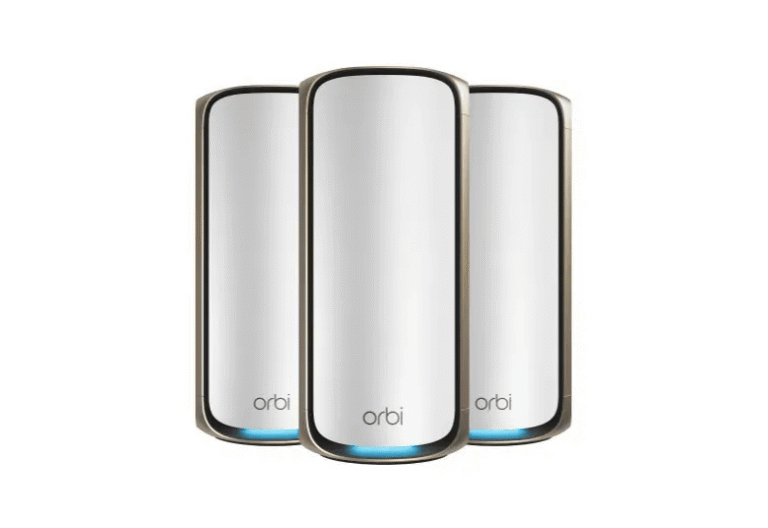
The Orbi 970 is engineered around a reserved wireless backhaul. Its satellites carry their traffic on a radio that client devices never touch, which is what lets Netgear rate the three-pack for 10,000 square feet and quote a wireless class nearly double the Deco's. The cost is physical as much as financial: the units are tall, heavy and impossible to hide, and the bundled Armor security is the only extra you get for the outlay.
The Deco BE67 takes the opposite bet. It has no dedicated backhaul radio, a lower coverage rating, and a much lower price, but every unit carries a 10 Gbps port and a USB port, and the units are short enough to live on a shelf. In a house that can run Ethernet between rooms, the Deco uses the cable as its backhaul and the Orbi's reserved radio stops being an advantage.
That is the pivot of the comparison. Wired backhaul makes the Deco a near-equal for far less; wireless-only backhaul over long distances or through thick walls is where the Orbi's extra radio earns its money, and where the Deco's far node will be the slower one.
Neither is the wrong product. The Orbi suits a large, hard-to-wire home whose owner wants the coverage guaranteed by hardware. The Deco suits a home with Ethernet in the walls, or a smaller footprint, where a 10 Gbps port on every node is worth more than a radio you cannot see.
Head-to-head points: every spec is scaled between these products only, so a product can score high here and modestly on its own page, where the VS Score measures it against the median of its class.
Where the TP-Link Deco BE67 beats the NETGEAR Orbi 970
- Has USB port ?
- A lower unit height ?176 mm vs 294 mm
Where the NETGEAR Orbi 970 beats the TP-Link Deco BE67
- A much higher max wireless speed ?27,000 Mbps vs 13,659 Mbps
- A higher coverage area ?10,000 sq ft vs 8,100 sq ft
- Has dedicated wireless backhaul ?
- Has built-in security suite ?
Key real-world differences
The spec sheet pulls in both directions. These are the gaps big enough to shape the decision — with the actual figures, and what each one means in real-world use.
- Dedicated wireless backhaulWirelessNo vs Yes — only the NETGEAR Orbi 970 has it
A band reserved for unit-to-unit traffic so client speeds don't halve.
- Max wireless speedWireless13,659 Mbps vs 27,000 Mbps — 97.7% more for the NETGEAR Orbi 970
The combined theoretical throughput across all bands.
- Built-in security suiteFeatures & securityNo vs Yes — only the NETGEAR Orbi 970 has it
Network-level threat protection included or subscription-based.
- USB portPorts & backhaulYes vs No — only the TP-Link Deco BE67 has it
A USB port for shared drives or printers.
Which one should you buy?
There is no single answer — it depends on what you will actually use it for. Match your priority to the pick below.
- Best for wireless NETGEAR Orbi 970 takes the category 100 to 53 — driven by dedicated wireless backhaul (No vs Yes).
- Best for features & security NETGEAR Orbi 970 takes the category 100 to 83 — driven by built-in security suite (No vs Yes).
- Best for ports & backhaul TP-Link Deco BE67 takes the category 100 to 93 — driven by USB port (Yes vs No).
- The safe all-rounder NETGEAR Orbi 970 wins 2 of 3 categories and tops the overall VS Score at 99.
Where each one falls short
TP-Link Deco BE67
- Dedicated wireless backhaul: No vs Yes
- Max wireless speed: 13,659 Mbps vs 27,000 Mbps
- Built-in security suite: No vs Yes
- 1 spec is unreported (shown as Unknown) and excluded from its scores.
NETGEAR Orbi 970
- USB port: Yes vs No
- 1 spec is unreported (shown as Unknown) and excluded from its scores.
What matters to you?
Drag the sliders to weight each category and re-rank the products to suit your priorities.
Score breakdown
Wireless
Ports & backhaul
Features & security
Design
Specs last verified October 11, 2026TP-Link Deco BE67: 20 of 21 specs verified (95%)NETGEAR Orbi 970: 20 of 21 specs verified (95%)Unverified specs show as Unknown — never estimated, never scored
What reviewers say
The bottom line
The NETGEAR Orbi 970 is the clear winner, scoring 99 to 67 on our VS Score. It leads on Wireless and Features & security. The TP-Link Deco BE67 answers back with stronger Ports & backhaul. Pick the NETGEAR Orbi 970 unless Ports & backhaul matters most to you — then the TP-Link Deco BE67 is the smarter buy.