No current price: no retailer we track lists it right now.
22 facts in comparison
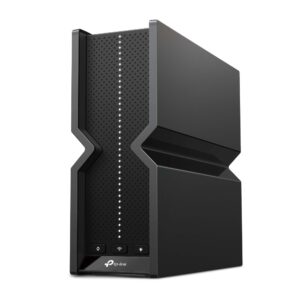
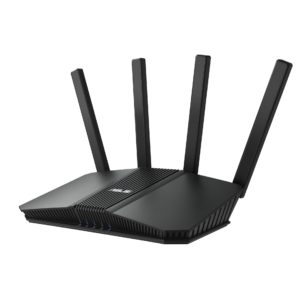
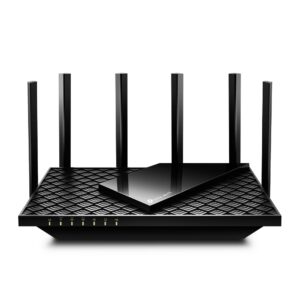
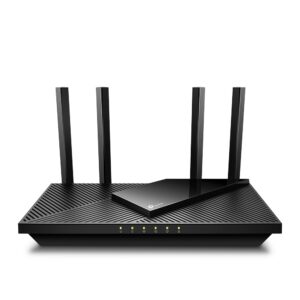
TP-Link Archer AX55 vs TP-Link Archer BE9500
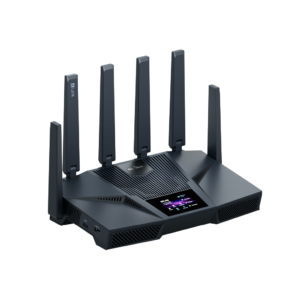
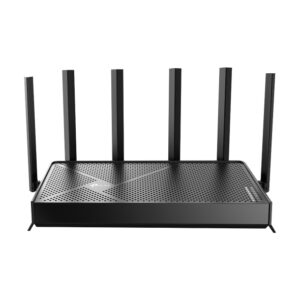
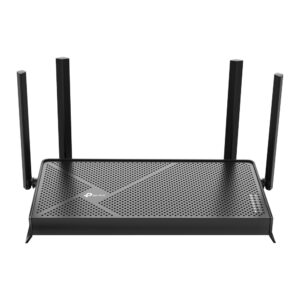
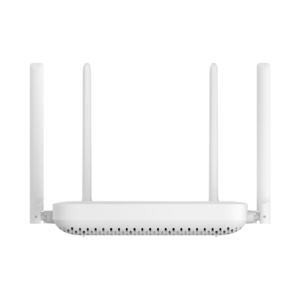
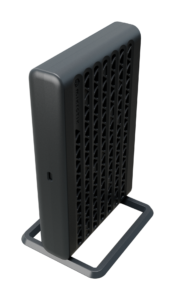
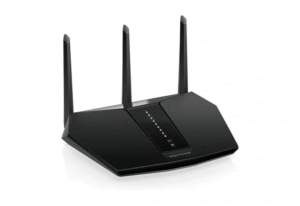
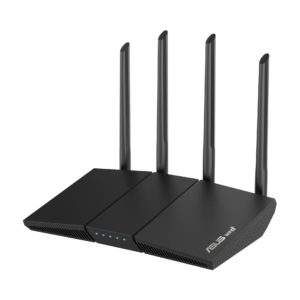
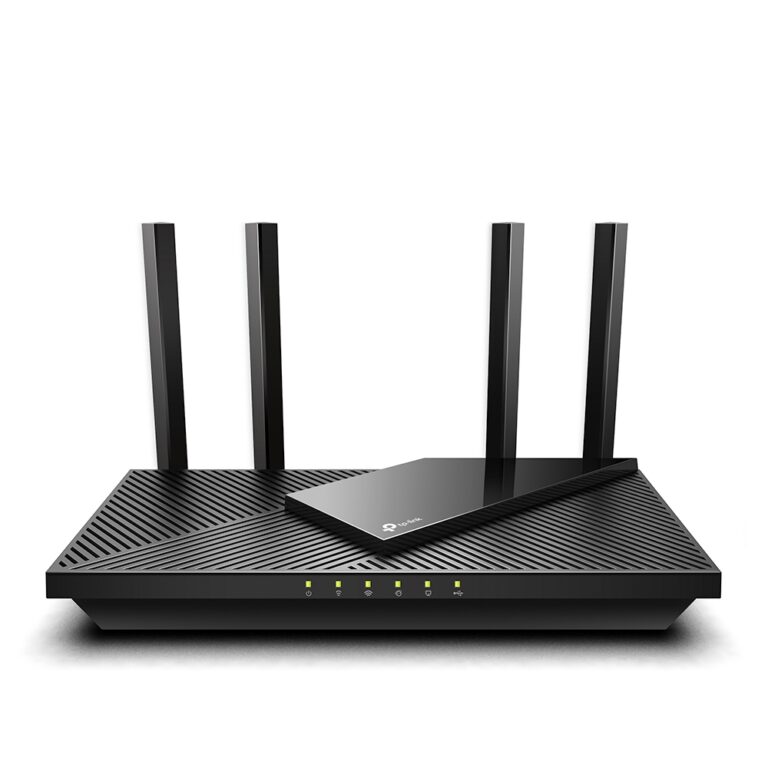
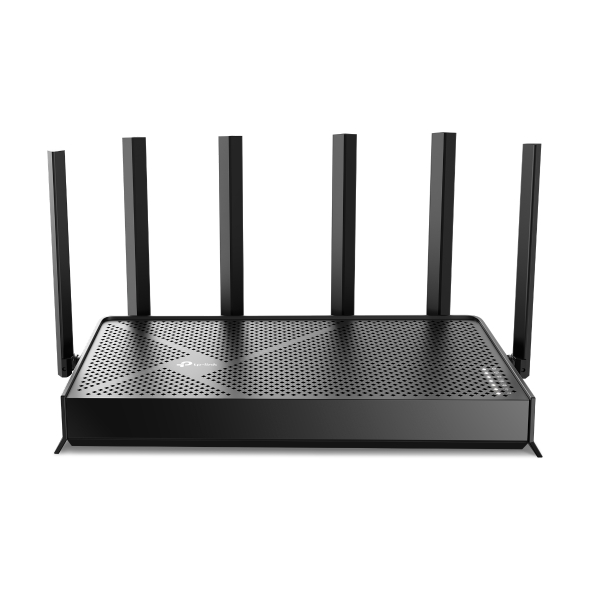
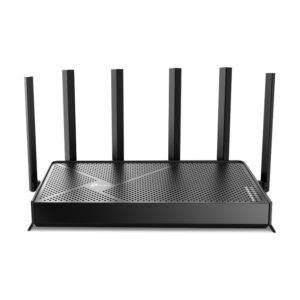
Same brand, two generations, and a table that looks like an easy win for the newer one. The Archer AX55 is TP-Link's long-running budget Wi-Fi 6 router, dual-band, with more memory than its class usually gets and four gigabit ports. The Archer BE9500 is a tri-band Wi-Fi 7 router with a 6 GHz radio, a 10 Gigabit WAN port and multi-gig LAN. Every diff row points the same direction. Whether any of them matters depends on one thing the table cannot see: the line coming into the building.
The row that decides it is WAN port speed. On a plan at or below a gigabit, the AX55's port is not a limit and the BE9500's fast port sits idle. Above a gigabit, the AX55 is the bottleneck and no amount of Wi-Fi 6 will fix it. That single fact sorts most households before the wireless columns are read.
Each router makes an honest compromise. The AX55 spent its budget on memory, antennas and wide channels rather than multi-gig Ethernet, which is why it stays composed with thirty-odd devices attached and why it caps a fast connection. The BE9500 spent its budget on the 6 GHz band and the wired side, and the 6 GHz band is a same-room radio: it carries the headline speed and barely survives a wall, so devices further away fall back to a 5 GHz radio you could have had for much less.
Who is wrong for whom: a house of laptops, phones and a television on a gigabit line will feel no difference between these two beyond the outlay, and should buy the AX55 or its dual-band Wi-Fi 7 sibling. A house with a NAS, a workstation and a multi-gig plan, where the fast devices sit in the same room as the router, is the one the BE9500 was built for. Both carry the same subscription caveat: the more useful security and parental features sit behind a paid tier.
Editor’s note
The AX55 is a default recommendation for an unfashionable reason: it has more memory than it strictly needs, and that is what keeps it calm when a house fills with devices. Where it quietly compromises is the ports. Every one is gigabit, so it is the wrong router the day a multi-gig plan arrives. The security suite is the other caveat: the free tier is basic and the useful parental controls cost extra, which is easy to miss on the feature list.
The BE9500 is genuinely well spent on the wired side. A ten-gigabit WAN alongside multi-gig LAN on one chassis is unusual outside the gaming tier, and it means a modem, a NAS and a workstation can all run fast at once. The compromise is the band that carries the headline. The 6 GHz radio is short-range and does not pass walls politely, so its benefit is confined to the room the router lives in. Position it around the fast devices, not the middle of the house.
Walk past the BE9500 if the wired ports would sit empty; TP-Link's dual-band Wi-Fi 7 model does the same job for far less. Walk past the AX55 if your line is already faster than its ports, because then it is the bottleneck by design.
Head-to-head points: every spec is scaled between these products only, so a product can score high here and modestly on its own page, where the VS Score measures it against the median of its class.
Where the TP-Link Archer AX55 beats the TP-Link Archer BE9500
No standout advantages.
Where the TP-Link Archer BE9500 beats the TP-Link Archer AX55
- Wi-Fi 7 Wi-Fi standard ?Wi-Fi 7 vs Wi-Fi 6
- A much higher max wireless speed ?9,519 Mbps vs 2,976 Mbps
- More frequency bands ?3 vs 2
- Has 6 GHz band ?
- A much higher WAN port speed ?10 Gbps vs 1 Gbps
- Has multi-gig LAN ?
- More antennas ?6 vs 4
Key real-world differences
The spec sheet pulls in both directions. These are the gaps big enough to shape the decision — with the actual figures, and what each one means in real-world use.
- Max wireless speedWireless2,976 Mbps vs 9,519 Mbps — 3.2× more for the TP-Link Archer BE9500
The combined theoretical throughput across all bands.
- WAN port speedPorts & wired1 Gbps vs 10 Gbps — 10× more for the TP-Link Archer BE9500
The internet-facing port speed; a multi-gig WAN futureproofs fast plans.
- Wi-Fi standardWirelessWi-Fi 6 vs Wi-Fi 7 — advantage TP-Link Archer BE9500
The Wi-Fi generation supported; later is faster and handles more devices.
- Multi-gig LANPorts & wiredNo vs Yes — only the TP-Link Archer BE9500 has it
At least one LAN port faster than 1 Gbps (2.5G/5G/10G).
- AntennasHardware4 vs 6 — 50% more for the TP-Link Archer BE9500
The number of antennas (internal or external).
Which one should you buy?
There is no single answer — it depends on what you will actually use it for. Match your priority to the pick below.
- Best for wireless TP-Link Archer BE9500 takes the category 100 to 14 — driven by max wireless speed (2,976 Mbps vs 9,519 Mbps).
- Best for ports & wired TP-Link Archer BE9500 takes the category 100 to 36 — driven by WAN port speed (1 Gbps vs 10 Gbps).
- Best for hardware TP-Link Archer BE9500 takes the category 100 to 0 — driven by antennas (4 vs 6).
- The safe all-rounder TP-Link Archer BE9500 wins 3 of 4 categories and tops the overall VS Score at 100.
Where each one falls short
TP-Link Archer AX55
- Max wireless speed: 2,976 Mbps vs 9,519 Mbps
- WAN port speed: 1 Gbps vs 10 Gbps
- Wi-Fi standard: Wi-Fi 6 vs Wi-Fi 7
- 7 specs are unreported (shown as Unknown) and excluded from its scores.
TP-Link Archer BE9500
- No major spec weaknesses in this matchup — the gaps that exist are small.
- 8 specs are unreported (shown as Unknown) and excluded from its scores.
What matters to you?
Drag the sliders to weight each category and re-rank the products to suit your priorities.
Score breakdown
Wireless
Ports & wired
Hardware
Features & security
Design
Specs last verified October 11, 2026TP-Link Archer AX55: 21 of 28 specs verified (75%)TP-Link Archer BE9500: 20 of 28 specs verified (71%)Unverified specs show as Unknown — never estimated, never scored
What reviewers say
The bottom line
Buy the Archer AX55 if your internet plan is a gigabit or slower and your devices are the ordinary household mix. It is well provisioned, steady under a heavy device count, and nothing in that house can use what the BE9500 adds. Buy the Archer BE9500 if you are already past a gigabit, or have wired gear that wants more than an ordinary multi-gig port, and can place the router where the fast devices sit.
The trade-off that decides it is where the money goes: into memory and steadiness on gigabit ports, or into a fast wired side and a short-range 6 GHz band. Buy the one your broadband plan can actually fill.
Latest comparisons